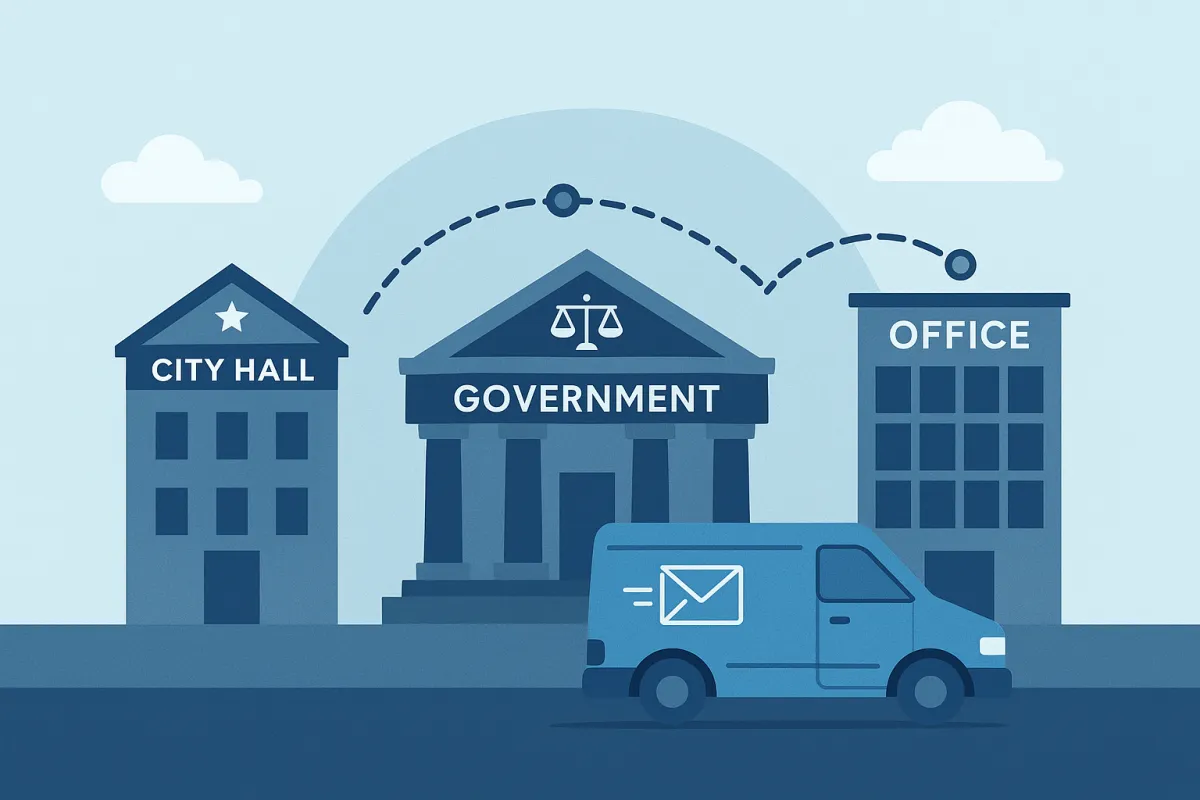
How Local Governments Can Modernize Inter-Office Mail with Route-Based Courier Services
For most city and county governments, inter-office mail still looks a lot like it did 20+ years ago: in-house drivers or clerks doing manual runs, ad-hoc trips between buildings, and paper logs that live in a binder on a mailroom desk. It works—until it doesn’t. When routes are inconsistent, staff get pulled from their actual jobs to deliver envelopes, and there’s no clear chain of custody when something goes missing.
The good news is that local governments don’t have to reinvent the wheel to modernize inter-office mail. Route-based courier services give agencies a way to turn scattered mail runs into a predictable, trackable logistics system—without adding headcount or vehicles.
Why Inter-Office Mail Is a Hidden Problem for Local Governments
If you walk through many public-sector mailrooms, you’ll see the same patterns:
Inconsistent schedules. Some departments get pickups twice a day, others “whenever someone is driving that way.” Federal and departmental mail handbooks have long warned that unscheduled, informal messenger runs increase risk and reduce efficiency.
No real visibility. Once the envelope leaves the building, there’s limited tracking beyond a manual log or a signature on a clipboard.
Staff time wasted on “courier duty.” Administrative staff, code enforcement officers, or even IT techs are often asked to “drop this off on your way,” taking them away from their core responsibilities.
Security and compliance gaps. Mail management guides for government agencies repeatedly emphasize the need for secure handling, clear workflows, and documented procedures for internal mail.
When you add in pressures like open-records compliance, time-sensitive notices, HR files, and confidential legal documents, these informal systems start to feel risky and outdated.
What Are Route-Based Courier Services?
Route-based courier services are scheduled, recurring delivery routes designed around your actual mail patterns. Instead of relying solely on ad-hoc trips, a dedicated courier partner establishes fixed runs between city or county facilities at set times each day or week.
In the private sector, routed delivery is already a standard for recurring needs like inter-office mail, supply replenishment, and scheduled customer deliveries, because it consolidates stops into efficient, predictable loops. For local governments, the same logic applies:
The routes are planned up front based on your departments and buildings.
Stops and frequencies are adjusted to match your workloads.
You lock in service levels and expectations instead of improvising every day.
With a partner like Express Courier Services, route-based delivery also connects to real-time tracking and centralized oversight so leadership can finally see how inter-office mail actually flows across the organization.
How Route-Based Couriers Modernize Inter-Office Mail
1. Turning “whenever” into a predictable schedule
Modern mail management standards stress the importance of written schedules, right-sized frequency, and non-overlapping routes for messenger services. Route-based courier programs put that into practice:
Each facility gets defined pickup and drop-off windows (e.g., 9:30 AM and 3:30 PM, Monday–Friday).
Departments know exactly when outgoing mail must be ready.
Extra capacity can be layered on for high-volume hubs like the main city hall, tax office, or records department.
This predictability improves service quality for internal customers—staff can plan around mail movements instead of guessing.
2. Increasing accountability and chain of custody
Many government mail guides require clear procedures for internal mail, including how to safeguard sensitive documents and ensure they reach the intended recipient.
When you work with a professional courier partner that uses GPS tracking and scan events at pickup and drop-off, your inter-office mail starts to look more like a modern delivery network:
Items can be bagged, labeled, and scanned as they enter the route.
Each stop creates a digital handoff record instead of a clipboard note.
Supervisors have audit trails when questions or disputes arise.
If you partner with a provider that already supports regulated workloads (healthcare, legal, or financial), they’re typically well-versed in chain-of-custody, data privacy, and secure handling standards.
For example, Express Courier Services’ government logistics solutions are designed around compliance and traceability for federal, state, and local agencies—covering everything from permits and inter-office packets to compliance and legal files.
3. Reducing cost and operational friction
At first glance, using an outside courier can look like “another line item.” In practice, route-based delivery often costs less than in-house approaches when you factor in:
Staff time pulled away from primary duties
Vehicle purchase, insurance, fuel, and maintenance
Overtime or backfill when the usual “mail driver” is out
Private-sector case studies on routed delivery show that consolidating regular trips into planned routes reduces mileage, idle time, and duplicate runs. Local governments can realize similar savings by:
Moving from multiple overlapping internal trips to one optimized route
Right-sizing frequency by building volume data over time
Using the courier’s existing fleet instead of maintaining their own just for documents
4. Improving resilience and security
Mail center security guidance for public agencies points out the need for standardized procedures, training, and contingency plans for unusual or suspicious mail.
A professional courier partner can strengthen your posture by:
Training drivers on handling sensitive, urgent, or suspicious items
Integrating inter-office routes with centralized screening locations where appropriate
Providing real-time rerouting if a building is inaccessible due to an emergency, protest, or weather event
In other words, you get an inter-office mail system that can adapt quickly, instead of relying on whoever happens to be available to drive documents across town.
A Practical Roadmap for Local Governments
If you’re considering route-based courier services for your city or county, here’s a practical sequence you can follow.
Step 1: Map your current inter-office mail flows
Start with a simple inventory:
Which departments send the most documents?
Which buildings are involved?
How often are runs happening now (formal and informal)?
Where are the current pain points—late deliveries, lost envelopes, overloaded staff?
You can borrow ideas from existing mail management checklists used in government departments, which look at schedules, route design, and workflow through the mail facility.
Step 2: Define your service levels
Before you engage a courier partner, decide on:
Standard route frequency (once or twice per day, five days a week, etc.)
Special handling rules for sensitive departments (HR, legal, finance)
Time-sensitive flows (e.g., daily deposit runs, council packets, building permit packages)
This becomes the backbone of your future route design and pricing.
Step 3: Design initial routes with your courier partner
Work with a provider that understands public-sector operations. Partners like Express Courier Services’ government team can help translate your mail map into concrete routes, stop lists, and cut-off times.
At this stage, you’ll:
Group buildings into logical loops
Set scheduled pickup / drop-off windows
Decide which runs need vehicle types with extra security or capacity
Step 4: Connect technology and reporting
To really “modernize” inter-office mail, you’ll want more than a van and a driver. Look for a partner with strong tracking and reporting tools:
GPS tracking and route optimization
Real-time status for each stop and bag
Historical reports for volume, on-time performance, and exceptions
You can see how this works in practice on Express Courier Services’ Technology & Tracking page, which highlights real-time visibility and route optimization capabilities.
Step 5: Pilot, refine, then scale
Start with a pilot route covering a subset of buildings—perhaps city hall, the records center, finance, and HR. Track:
How often mail misses the cut-off
On-time delivery rates
Staff satisfaction (are people spending less time chasing envelopes?)
Use that data to adjust frequency, add or consolidate stops, and then roll out additional routes across the rest of the organization.
Why Work with Express Courier Services for Government Inter-Office Mail
Local governments in California have unique challenges: large geographies, multi-site operations, and citizens who expect transparency and responsiveness. Working with a regional specialist like Express Courier Services gives you:
A partner already experienced with public-sector logistics, as described on their Government Agency page.
Flexible courier services that range from same-day and STAT runs to route-based programs.
Real-time technology and tracking designed to give agencies clear visibility and reporting.
Together, those pieces allow you to treat inter-office mail as a serious operational process—not an afterthought.
Bringing It All Together
Modernizing inter-office mail isn’t just about outsourcing a few errands. It’s about upgrading from informal, staff-driven runs to a structured, route-based logistics program that supports everything your local government does:
Faster, more predictable internal communication
Better security and chain-of-custody for sensitive documents
Reduced burden on internal staff and vehicles
Clear data and accountability for mail performance
If your city or county is ready to take that step, you can start by reviewing your current flows, defining service levels, and exploring what a route-based program with a specialized partner would look like.
When you’re ready to talk specifics for your agencies and buildings, you can reach out directly through Express Courier Services’ contact page to outline your routes, mail volumes, and goals.
