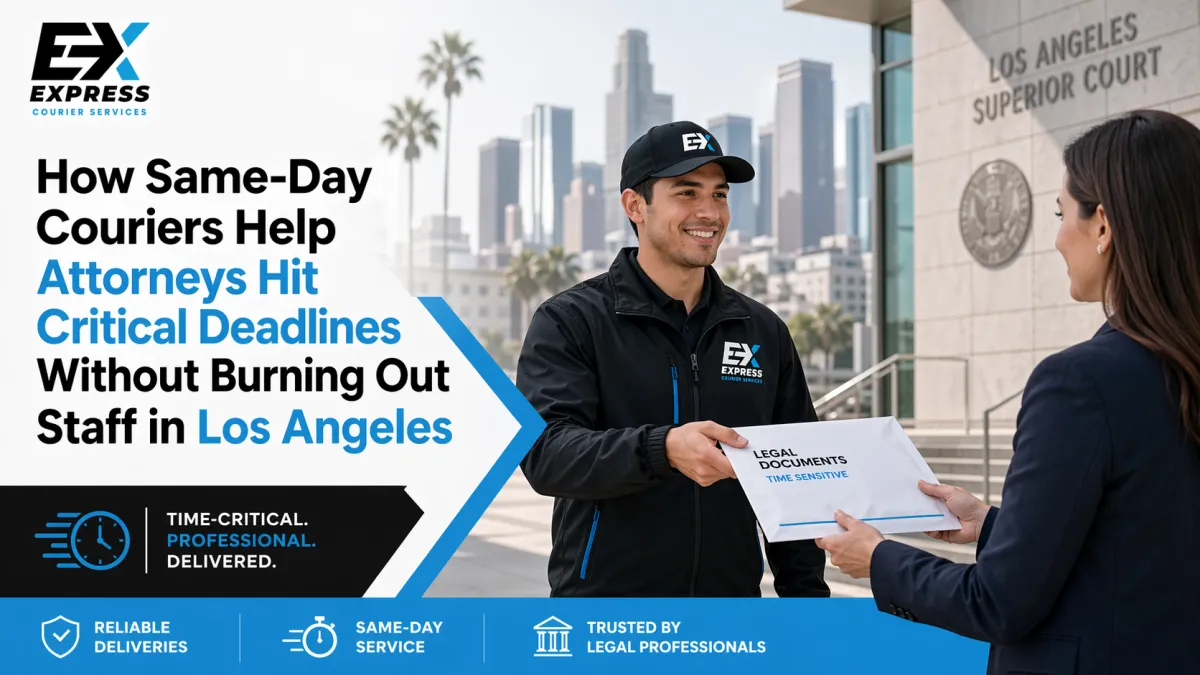
How Same-Day Couriers Help Attorneys Hit Critical Deadlines Without Burning Out Staff in Los Angeles
Los Angeles legal work runs on deadlines, but LA traffic, courthouse logistics, and multi-location client activity make “quick runs” anything but quick. One late filing, one missed receiving window, or one disputed handoff can create expensive downstream problems. That’s why many law offices end up relying on staff heroics. A paralegal leaves the desk, drives across town, searches for parking, waits in line, and returns stressed, behind on everything else.
It works, but it burns out teams.
Same-day courier programs help LA law firms turn last-minute deliveries into a repeatable system, so attorneys can hit critical deadlines without draining staff time and energy. The benefit is not only speed. It’s control, documentation, and fewer interruptions.
If you want a courier partner built specifically for legal filings, secure client deliveries, and evidence-style handoffs, start here.
If you want service options for same-day, on-demand, and scheduled routes, start here.
If you want real-time tracking, proof of delivery, and exception alerts, start here.
Why LA law office burnout often starts with “just one quick run”
In Los Angeles, deliveries don’t fail because the distance is far. They fail because the city adds friction to every step:
Traffic variability by time of day
Parking constraints near courthouses and dense commercial areas
Security desks, receiving windows, and “no mailroom” policies
Multiple office locations and clients spread across the county
Same-day commitments that cannot slide to tomorrow
When law offices rely on internal staff for these deliveries, burnout builds in predictable ways:
Time leaks from casework and client communication
Teams operate in constant reactive mode
Status chasing becomes a daily distraction
Mistakes happen because the process is informal
Same-day couriers reduce burnout by removing the “runner role” from staff and replacing it with a monitored delivery workflow.
The true cost of staff deliveries is bigger than the delivery itself
A staff-run delivery is not just the driving time. It’s the interruption:
Leaving the desk
Parking and walking
Waiting in line
Finding the correct window or recipient
Returning and re-entering the workflow
Even if the employee is salaried, the time is not free. It is time redirected away from billable support, document prep, client updates, and case coordination.
If staff use personal vehicles for these tasks, vehicle cost is real too. The IRS business mileage rate is a common proxy for what driving actually costs, and the IRS set the 2026 business standard mileage rate at 72.5 cents per mile.
In California, employers should also understand reimbursement obligations for necessary work-related expenses, including business driving, under Labor Code 2802.
Courier programs don’t just “save a trip.” They protect the workflow that the trip interrupts.
Where same-day couriers reduce stress the most for LA law firms
1) Courthouse filings and conformed copy returns
Courthouse runs are deadline events, not errands. A filing run needs the right location, the right window, and the right success definition, like “file-stamp and return conformed copy.” When staff handle filings, they become the bottleneck and the stress point.
Same-day couriers reduce this risk by providing an execution lane: the run is placed with clear instructions, tracked in transit, and closed with proof of delivery documentation.
2) Client deliveries that require signature and professionalism
Clients judge your professionalism by how smoothly logistics is handled, especially for sensitive documents. Same-day couriers support named recipient delivery, signature capture, and consistent timing without pulling staff away from casework.
3) Records runs and document retrieval
Records runs consume staff time because the cost is waiting, not driving. A courier can do the run while staff continue to manage deadlines and client work.
4) Exhibits and evidence-style items where custody matters
Law firms often move exhibits, sealed materials, and sensitive originals. Those runs should be treated with a custody mindset: clear handoffs, documented events, and escalation rather than improvisation.
NIST provides a useful formal definition for chain of custody, describing the need to document handling and transfers to preserve traceability and integrity.
5) Settlement checks and cash-equivalent packets
Checks and cash-equivalent items should not be handled casually. A courier model with direct-to-recipient delivery, signature required, and documented handoffs reduces disputes and exposure.
USPS Inspection Service guidance on mail theft prevention is a helpful reminder of why high-value items should not rely on unattended mail flows.
How same-day couriers prevent staff burnout in LA, mechanically
Same-day couriers reduce burnout through two practical mechanisms.
Fewer interruptions to staff work
Your team stops being pulled into driving, waiting, and coordinating. That improves workload predictability and reduces daily stress.
Fewer “status fires”
When tracking and proof of delivery are standardized, staff stop chasing updates, calling recipients, and trying to reconstruct events.
How to set up a same-day courier program that actually protects your LA team
Courier programs only reduce burnout if they are structured. Here is a simple setup that works for most law offices.
1) Separate routine movement from urgent exceptions
If you have repeatable runs, put them on scheduled routes. Use same-day on-demand for true urgency and deadlines.
2) Standardize delivery notes and handoff rules
Every request should include:
Case name and internal reference
Exact address and suite
Named recipient or receiving department
Signature required yes or no
Mailroom or reception allowed or not
Escalation contact if access fails
Return instructions for conformed copies or pickups
This reduces misdeliveries and prevents drivers from improvising, which is where disputes begin.
3) Make proof of delivery the default
If your firm cannot retrieve proof of delivery quickly, your process will collapse under pressure. Make POD requirements standard for legal runs.
4) Define an exception escalation workflow
A courier should escalate immediately when instructions cannot be followed, rather than changing the plan without authorization.
A simple internal policy that stops “runner burnout”
Many LA firms adopt a rule like this:
Routine runs go to scheduled courier routes.
Same-day runs are approved only for critical deadlines or urgent client needs.
Staff driving is reserved for rare low-risk internal moves only.
This policy turns a chaotic pattern into a controlled system.
How Express Courier Services supports same-day legal workflows in Los Angeles
Express Courier Services supports legal deliveries with same-day options, scheduled routes, real-time tracking, proof of delivery, and documented exception handling.
Closing
Los Angeles makes last-minute legal deliveries harder than they look. When staff become runners, the firm pays twice: once in lost productivity and again in burnout.
Same-day couriers help law firms protect deadlines and protect people by turning urgent legal deliveries into a trackable system with clear handoff rules, proof of delivery, and exception escalation. The result is calmer operations, fewer surprises, and a team that can focus on legal work instead of driving work.
