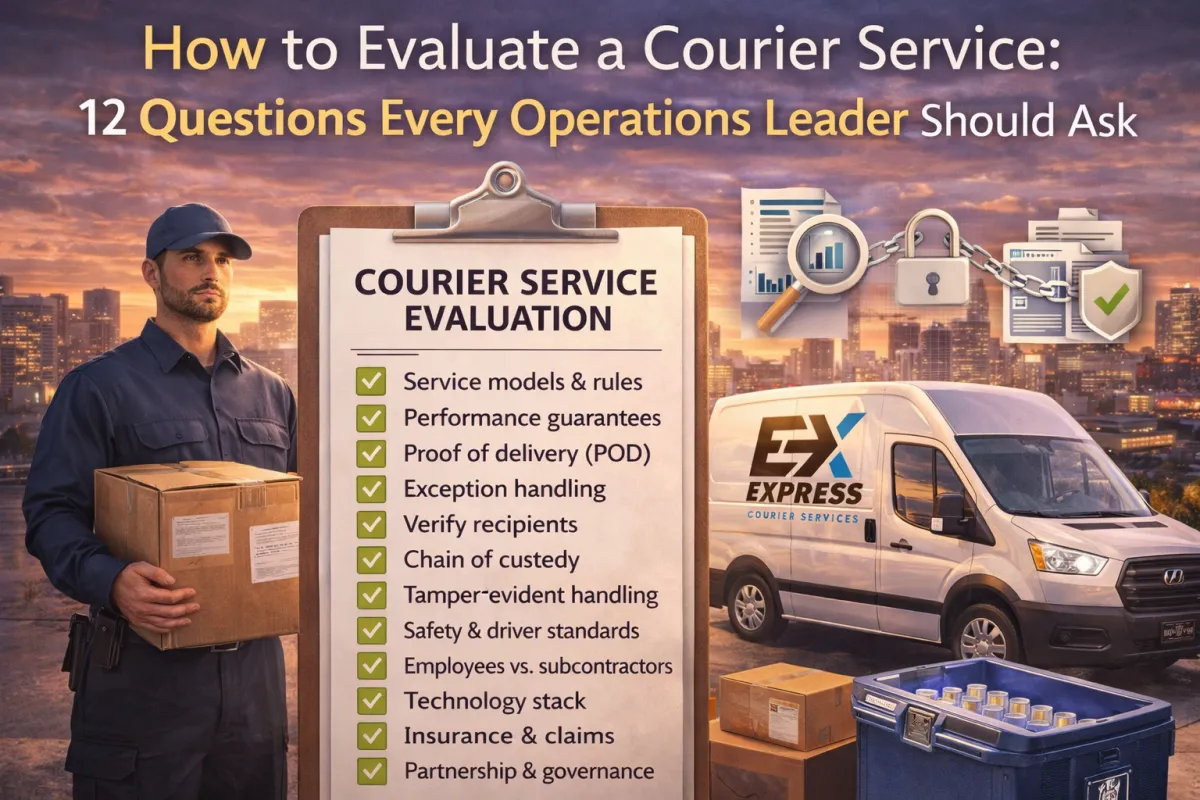
How to Evaluate a Courier Service: 12 Questions Every Operations Leader Should Ask
Most courier problems do not show up on day one. They show up later, when volume increases, a delivery gets disputed, a time-critical run misses a window, or a sensitive item is handed off the wrong way. That’s why evaluating a courier service is not just a pricing exercise. It is an operational risk decision.
The best courier partner is the one that can prove performance, document every handoff, and handle exceptions without turning your team into dispatch. Use the questions below as a practical scorecard for vendor selection, renewals, and quarterly reviews.
If you want to compare service models first (scheduled routes, on-demand, same-day, dedicated vehicle), start here.
If you want to confirm a partner’s visibility layer (real-time tracking, exception alerts, proof of delivery), start here.
1) What service model fits our workflow, and what are the rules?
Ask the courier to separate your deliveries into clear lanes: scheduled routes for repeatable movement, on-demand for true exceptions, and urgent or STAT for time-critical work. If they cannot explain service tiers and qualification rules clearly, you will end up paying premium rates for routine work.
2) What do you guarantee for pickup and delivery performance, and how do you measure it?
Do not accept “we’re reliable” as an answer. Require metrics: on-time pickup rate, on-time delivery rate, average exception resolution time, and percent of deliveries with complete proof of delivery records. Then ask for how those metrics are reported and what time window is used.
A useful perspective is that last-mile delivery is widely recognized as the most expensive and complex stage of shipping, so performance measurement matters.
3) What does proof of delivery include, and how quickly can we retrieve it?
Ask what “proof” actually means. You want timestamp, location confirmation, recipient name, signature when required, plus exception notes if delivery rules could not be followed exactly. Ask how long records are retained and how you export them for audits or disputes.
4) How do you handle exceptions, and who owns escalation to closure?
This is one of the most important questions. Ask for the written exception workflow. If a delivery cannot be completed as instructed, does the driver improvise, or does dispatch escalate immediately? You want documented escalation, not guesswork.
5) How do you verify recipients and prevent unauthorized drop-offs?
Receiving rules vary widely: some sites accept mailroom deliveries, others require named recipients, and some have strict “no reception” policies. Ask how your courier ensures the correct person receives the item, especially for sensitive materials.
6) What is your chain-of-custody process for sensitive items?
If you move checks, contracts, HR documents, legal packets, medical items, or equipment, chain-of-custody thinking matters. Ask what custody events are logged and what documentation is produced when items are high risk.
7) Do you support tamper-evident handling, and what is your seal protocol?
For cash-equivalent and sensitive items, ask if they support tamper-evident bags or seals, whether seal integrity is verified at pickup and delivery, and what happens if a seal appears compromised. This is a practical control that prevents silent mishandling.
8) What are your driver standards, training, and safety program?
Ask how drivers are screened and trained, and how often training is refreshed. Also ask about the safety program. Driving for work is a workplace safety issue, and OSHA provides employer guidance for motor vehicle safety programs.
9) Are drivers employees or contractors, and do you use subcontractors?
Subcontracting is not automatically bad, but hidden subcontracting is. Ask whether subcontractors are used, under what conditions, and whether subcontractors meet the same standards and documentation requirements. Require disclosure and controls.
10) What is your technology stack, and what happens if the tech fails?
Ask what systems support tracking, dispatch, proof of delivery, and reporting. Then ask what happens during downtime. A good partner has a fallback workflow that still produces accountability.
11) What insurance do you carry, and how does claims handling work?
Ask for proof of insurance and coverage limits. Then ask for the claims process and typical resolution timelines. If they cannot explain claims handling clearly, you will feel it later when something goes wrong.
12) How will you implement and govern the partnership after we start?
Ask who owns onboarding, who your account manager is, how performance reviews are structured, and what the reporting cadence is. The strongest courier relationships include quarterly business reviews and continuous improvement, not “set it and forget it.”
A quick way to score courier vendors using these questions
If you want a simple scoring system:
Give each question a score from 1 to 5
Weight questions 3, 4, 6, and 12 higher if you move sensitive or time-critical items
Ask for evidence, not narrative: sample POD record, sample exception report, sample monthly KPI report
This forces operational clarity early and prevents the “great proposal, weak execution” trap.
Closing
If you ask these 12 questions, you will quickly see who has a real operating system and who is relying on luck and heroic drivers. The right courier partner reduces internal coordination, improves accountability, and protects your operation from the small delivery failures that turn into big problems.
If you want a quick capability review or help mapping your delivery activity into scheduled routes vs on-demand tiers, start here.
