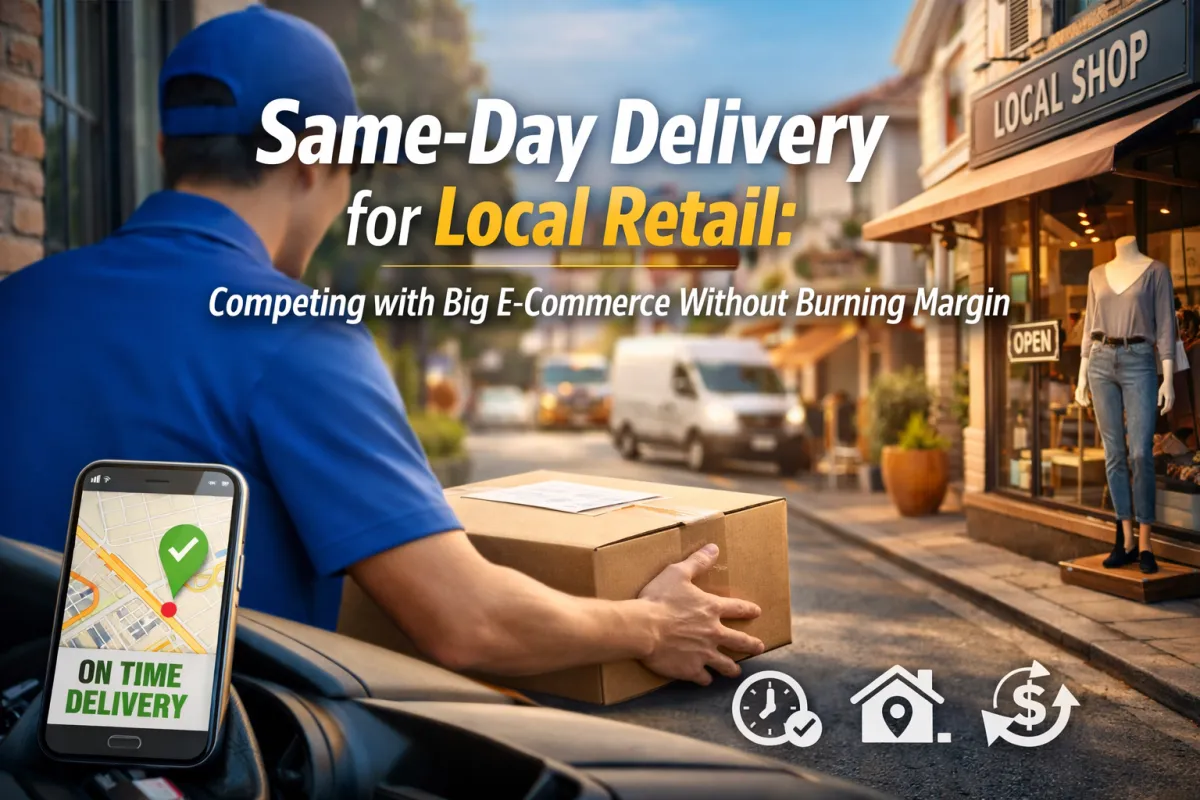
Same-Day Delivery for Local Retail: Competing with Big E-Commerce Without Burning Margin
Same-day delivery used to feel like a perk only national e-commerce brands could afford. Now, customers expect it from local retailers too—especially when they can compare your checkout experience to a giant marketplace in seconds. The challenge is that if you launch same-day the wrong way, you’ll win a few orders while quietly bleeding margin through inefficient routes, unpredictable labor, and refund-heavy exceptions.
The goal isn’t to “out-Amazon” Amazon. It’s to build a local same-day model that’s reliable, transparent, and profitable—using proximity, density, and clear service rules as your advantage.
Why same-day delivery often destroys margin for local retailers
Most retailers don’t lose money on same-day delivery because it’s inherently unprofitable. They lose money because they treat it like a favor instead of a system. The common traps are: offering “same-day anytime” with no cutoff times, underpricing delivery, sending drivers on one-off trips, and letting exceptions (wrong addresses, missed handoffs, replacements) eat the profit.
If you’re building or upgrading a same-day program, start by aligning your promise with an actual courier workflow and customer expectations. This ECS article is a helpful internal reference to frame the basics for clients and stakeholders: Real-Time Tracking and Proof of Delivery: What Modern Clients Expect from Couriers.
The profitable model: delivery windows + batching + route density
Competing with big e-commerce doesn’t mean offering instant delivery for every order. The most profitable local approach is predictable delivery windows that let you batch stops into routes.
A simple setup that works well for retail is two dispatch waves:
Midday wave: orders placed by late morning go out early afternoon
Evening wave: orders placed by mid-afternoon go out early evening
This structure improves driver utilization and cuts dead miles. It also sets customer expectations clearly—reducing “Where is my order?” calls and refund pressure.
ECS related article (extra capabilities that support structured delivery): https://www.expcourierservices.com/post/10-things-you-didnt-know-your-courier-service-can-do-but-we-do
Pricing guardrails that protect margin without scaring customers
Customers will accept delivery rules when they’re clear and consistent at checkout. Your job is to make sure the delivery offer is priced to cover real costs—driver time, mileage, dispatch oversight, and exception handling.
A practical, margin-safe structure:
Zone-based pricing (by radius/postal codes) so farther deliveries don’t subsidize near ones
Minimum order thresholds so one-item runs don’t destroy unit economics
Premium STAT pricing for true urgency (high-value orders only), not your default promise
For retailers running Shopify, it’s useful to cite how modern platforms support delivery zones and conditional pricing. Shopify’s official documentation outlines how to set up local delivery zones and rules.
Beat big e-commerce with trust: tracking, proof, and proactive updates
Speed matters, but certainty matters more. Most customers don’t just want “same-day.” They want visibility: a clear ETA, delivery confirmation, and quick resolution when there’s an exception. This is where local retail can outperform national marketplaces—because you can deliver a more consistent, human experience with real accountability.
ECS positions its technology around real-time GPS tracking and automated proof of delivery (signatures/photos/timestamps), which directly supports this “trust advantage.”
Returns and exchanges: turn reverse logistics into retention
Returns don’t just cost money—they’re a loyalty moment. If returns feel hard, customers churn. If returns feel smooth, customers buy again (and often spend more the next time).
NRF has long highlighted that consumers continue to demand faster fulfillment options—and that retailers face rising fulfillment pressure when meeting these expectations. Separately, NRF-linked reporting on returns underscores how large the returns problem is for retail overall (useful context when you’re explaining why reverse logistics needs a plan).
A simple rollout plan that avoids chaos
Launch same-day delivery in controlled phases so you don’t create operational chaos:
Start with one radius, two delivery waves, clear cutoff times, and pricing guardrails (zones + minimum order threshold). Track cost per stop, stops per route, on-time rate, and reattempt/refund rate weekly. Once you’re consistent, expand carefully: add a third wave only when volume supports it, and expand radius only where you reliably get route density.
If you need a customer-facing reference point for how modern courier operations and capabilities can support different service levels, this internal post is a useful “what else a courier can do” overview: 10 Things You Didn’t Know Your Courier Service Can Do (But We Do).
Final takeaway
Big e-commerce competes with scale. Local retail competes with precision.
When you structure same-day delivery around delivery windows, batching, pricing guardrails, and trust-building visibility (tracking + proof of delivery), you can meet the speed expectation without sacrificing margin. The winning promise isn’t “fastest at any cost”—it’s “same-day you can count on.”
