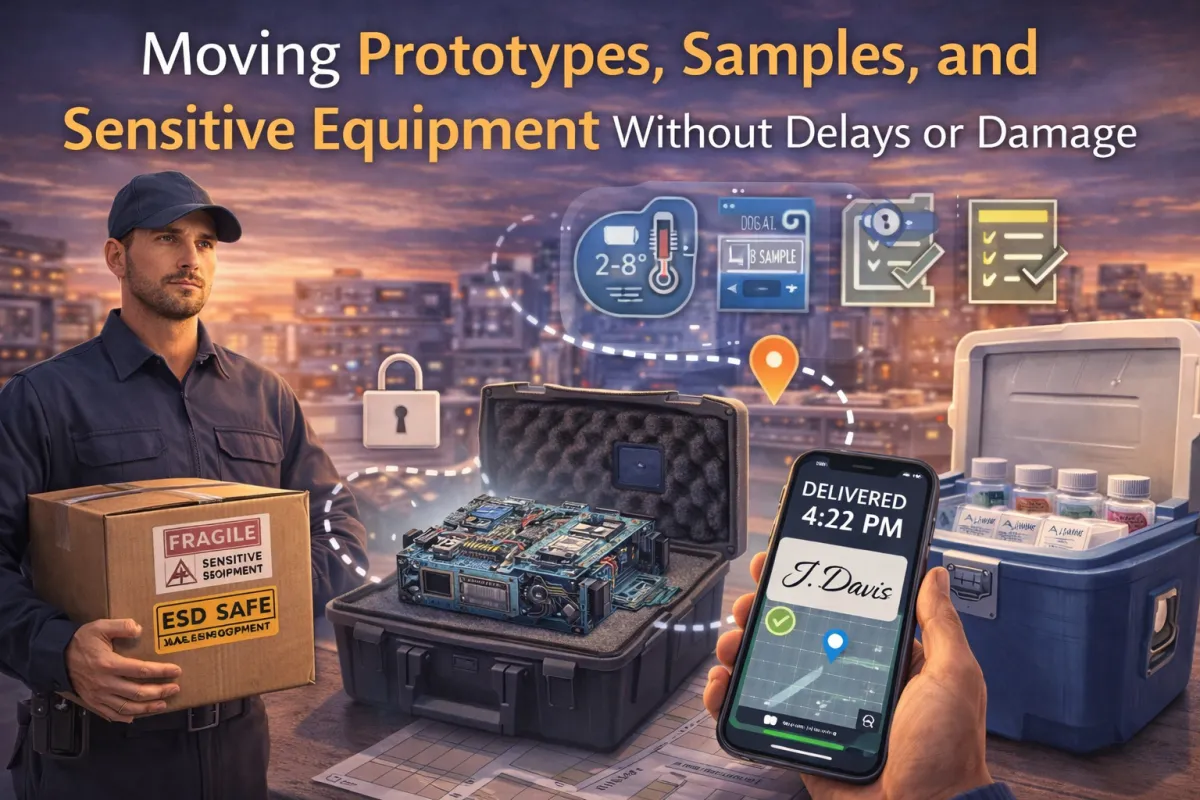
Moving Prototypes, Samples, and Sensitive Equipment Without Delays or Damage
When you’re moving prototypes, lab samples, demo units, or sensitive equipment, the cost of a “small delay” is rarely small. A missed meeting can push a launch. A damaged prototype can force a rebuild. A mislabeled kit can derail a workflow. The goal is not just delivery. The goal is controlled transport: correct handling, predictable timing, and documentation you can stand behind.
If you need same-day service models like on-demand, dedicated vehicle, or scheduled routes for high-priority items, this is a good overview.
If you need visibility such as GPS tracking, time-stamped proof of delivery, and exception alerts, this explains the documentation layer.
Why “normal shipping” fails prototypes and sensitive gear
Sensitive shipments usually fail for one of five reasons: handling shock, temperature drift, electrostatic discharge (ESD), poor custody documentation, or preventable delays at handoff points.
Shock and vibration are the obvious threat because prototypes and instruments often have fragile components, alignment tolerances, and connectors that can be damaged by drops or rough handling. One way organizations reduce this risk is by designing packaging and validating it through transit testing standards such as ISTA procedures.
Temperature drift is the silent threat. Some samples degrade, adhesives soften, batteries behave differently, and certain test materials become unusable if they sit in heat or cold for too long. For shipments that truly require temperature control, IATA’s Temperature Control Regulations are a common reference framework for packaging and handling requirements.
ESD is the threat many teams miss. Electronics and sensitive components can be damaged by electrostatic discharge even when the package looks perfect. ANSI/ESD S20.20 is widely used as a baseline for ESD control program guidance and highlights controls like packaging and handling discipline.
Finally, custody and proof. If a demo unit arrives late, or a lab kit goes missing, your team needs defensible delivery records. That’s where real-time tracking and proof of delivery are not “nice to have,” they’re operational protection.
Step 1: Decide what “success” looks like for this shipment
Before you hand anything off, define the non-negotiables in one sentence. Examples: “Deliver by 2:00 PM to a named recipient,” “Maintain 2–8°C and log exceptions,” “No drops, keep upright, signature required,” “ESD-safe packaging required.”
If you ship medical devices or sterile barrier components, packaging requirements and validation are often governed by standards like ISO 11607, which specifies requirements and test methods to maintain sterility until point of use.
If the shipment has temperature requirements, write them as a range plus a maximum time out of range, and align packaging expectations with temperature-control guidance like IATA TCR when applicable.
Step 2: Choose the right delivery model
Most delays happen because the delivery model does not match the urgency.
If the item is time-critical or tied to a meeting, install, or test window, you typically want an on-demand courier or dedicated run, not a “whenever it fits the route” approach.
If you move prototypes or equipment between the same locations repeatedly, scheduled routes often reduce cost and prevent last-minute scrambling, while still keeping timing predictable.
For industries that routinely handle sensitive electronics, components, and devices where delays cause project setbacks, this tech-focused courier capability page frames the need clearly.
For biotech and trial operations where time, handling discipline, chain-of-custody, and monitored conditions matter, this describes protocol-driven delivery expectations.
Step 3: Package like the shipment will be handled by people, not miracles
The single best damage-prevention move is packaging that assumes real-world handling: lifts, set-downs, vibration, and the occasional bump.
If you want external validation frameworks for packaging testing, ISTA standards and process guidance are a common starting point for transit simulation procedures.
For sensitive electronics and boards, use ESD-safe packaging, anti-static bags, and handling controls consistent with an ESD control program approach like those described in ANSI/ESD S20.20 guidance.
For fragile prototypes, a practical packaging standard is double-boxing with cushioning, immobilization (so the device does not shift), and clear orientation labels. If the item must remain upright, add “This Side Up” indicators and document that requirement in the courier notes.
If the item is temperature sensitive, pair insulation with pack-out planning and clear limits. IATA’s TCR is a reference point for packaging and documentation expectations for temperature-sensitive shipments.
Step 4: Reduce delay risk by controlling the handoff details
Delays don’t come from distance. They come from friction. Parking issues, lobby access, security desks, elevator queues, and “recipient not available” situations.
Your courier instructions should include:
a named recipient or department,
exact delivery point (front desk vs suite vs receiving dock),
whether reception is allowed,
whether signature is required,
and what to do if access fails.
If your courier partner provides real-time GPS tracking and automated proof of delivery (signatures, photos, time stamps), those features reduce status chasing and help resolve disputes quickly.
Step 5: Require chain-of-custody style documentation for high-value or sensitive items
For prototypes, sensitive equipment, or regulated samples, “delivered” is not enough. You want a traceable story: pickup time, in-transit visibility, delivery time, and who received it.
If you want a formal definition reference for chain-of-custody thinking, NIST describes chain of custody in terms of documenting handling and transfer details to maintain traceability of the item and its integrity.
In practical courier terms, that translates into real-time tracking plus proof of delivery documentation you can retrieve later.
Step 6: Build a contingency plan for “what if something goes wrong”
Sensitive shipments deserve a simple contingency rule set:
If the courier cannot access the building, they must call immediately.
If the recipient is unavailable, the courier must not improvise.
If temperature limits are at risk, the shipment must be escalated.
If the route is delayed, you want exception alerts early, not after the window is missed.
This is where a monitored dispatch and exception process becomes as important as the driver. For a visibility layer that supports exception alerts and documentation, reference this.
Driving safety also matters because many losses happen in transit incidents. OSHA provides employer guidance on motor vehicle safety programs and safe scheduling.
Step 7: Arrival and acceptance should be treated like part of the process
A common failure mode is that the shipment arrives, but nobody logs acceptance properly, or the receiving team does not inspect quickly, or the device sits in the wrong area.
For prototypes and equipment, define what “acceptance” means:
confirm seal integrity or packaging condition,
confirm accessories and cables are present,
power-on check or quick functional check if appropriate,
and sign with a named recipient.
If the equipment is calibration-sensitive or used for measurement, “traceability” language comes up frequently in quality environments. NIST describes traceability as relating a measurement through a chain of calibrations to standards, which is helpful context for why calibration records matter during transfers.
A copy-paste courier request template you can reuse
Use this as a standard paragraph your team can paste into courier notes:
“Pickup at [address] from [name/department] between [time window]. Item is a prototype / sensitive equipment and must be handled carefully with no drops. Keep upright and do not stack. ESD-safe packaging is in place, do not open package. Deliver to [exact address + suite + receiving point] to [named recipient], signature required. If recipient is unavailable or access is blocked, call [phone] immediately before any alternate handoff. Proof of delivery with timestamp is required.”
If you want a courier partner that supports real-time tracking and proof-of-delivery documentation, reference this technology page when setting requirements.
Where Express Courier Services fits for these shipment types
For sensitive electronics, components, and high-value devices where delays or mishandling cause project setbacks, this tech and electronics capability page aligns directly with prototype and equipment moves.
For protocol-driven handling, chain-of-custody, and controlled transport expectations for samples and trial-related materials, this biotech and clinical trials page is relevant.
To choose between on-demand, dedicated, or scheduled route service for your specific workflow, start with this service overview.
If you want help scoping a prototype or equipment delivery workflow with timing, handling requirements, and documentation expectations, contact the team here.
