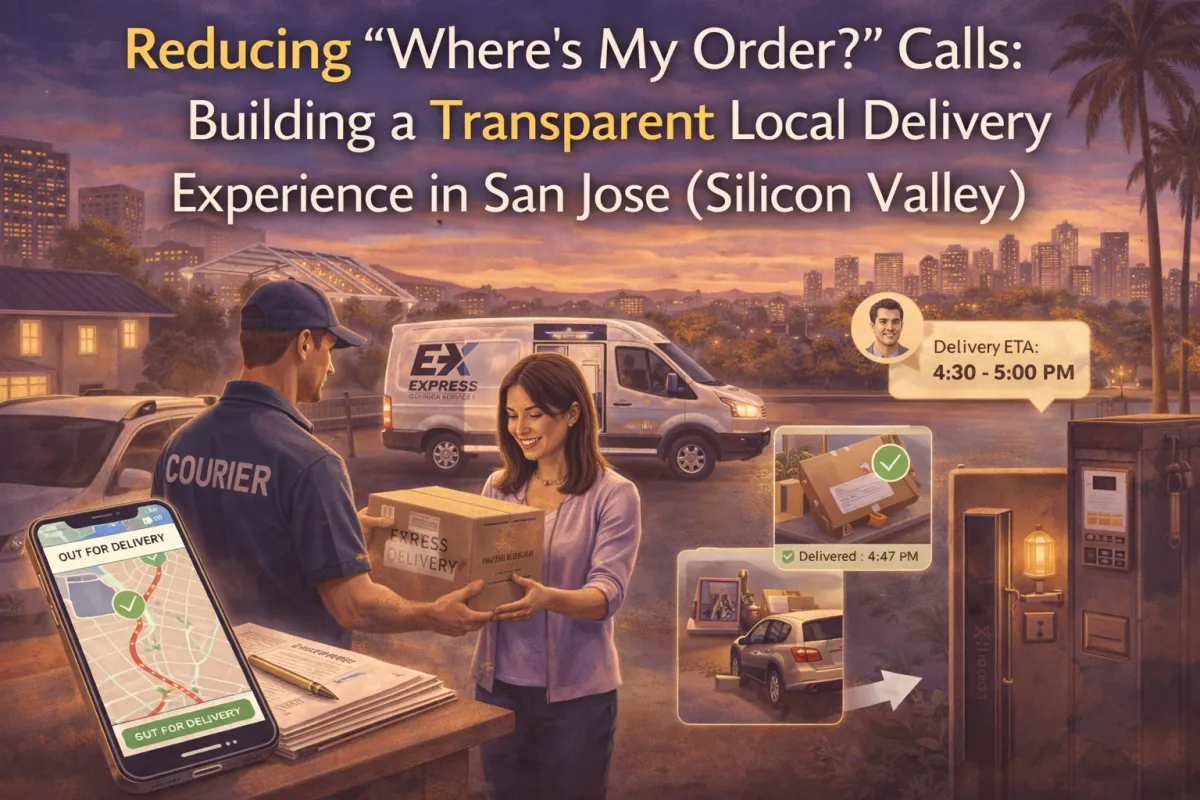
Reducing “Where’s My Order?” Calls: Building a Transparent Local Delivery Experience in San Jose (Silicon Valley)
In San Jose and across Silicon Valley, “Where’s my order?” calls usually mean one thing: the customer feels uncertain. They are not calling because they love updates. They are calling because the delivery experience is missing visibility, accurate timing, or clear communication when something changes.
If you run local deliveries for retail, e-commerce, healthcare, B2B parts, or service operations in San Jose, reducing WISMO calls is one of the fastest ways to lower support workload and improve customer satisfaction. The good news is that WISMO is often fixable with process, messaging, and delivery visibility tools, not by hiring more support staff.
This guide explains what causes WISMO calls in Silicon Valley and how to build a transparent local delivery experience that prevents them.
If you want to see courier service models that support predictable delivery windows (routes) and urgent exceptions (on-demand), start here.
If you want real-time tracking, proof of delivery, and exception alerts that reduce status calls, start here.
If you serve retail and e-commerce workflows, this industry overview is relevant.
Why WISMO calls spike in San Jose
San Jose delivery environments create predictable friction:
Traffic variability between corridors like Downtown, North San Jose, Santa Clara, Milpitas, Campbell, and Cupertino
Gated communities and controlled buildings that slow first-attempt delivery
Business receiving windows that don’t match broad “delivered by end of day” expectations
Packages delivered to mailrooms or reception desks with no named recipient confirmation
Inconsistent or delayed status updates that leave customers guessing
The result is not only more calls. It is higher re-delivery rates, more refunds, and more customer churn.
In last-mile logistics research, delivery complexity and cost are repeatedly highlighted as major factors, with last mile often representing a large portion of total delivery costs. When visibility is poor, those costs increase because exceptions multiply.
The fastest way to reduce WISMO: stop making customers guess
Most WISMO calls are caused by a gap between what customers expect and what your delivery system communicates.
Your solution is transparency in three layers:
Before delivery: clear windows, clear rules, clear expectations
During delivery: live status updates and proactive notifications
At delivery: proof of delivery and immediate closure
Modern courier systems make this practical through real-time tracking and proof of delivery documentation.
If you want the principle in plain language, delivery expectations have shifted toward real-time visibility and documented proof, which is why modern courier providers treat tracking and proof of delivery as baseline, not premium.
Step 1: Offer delivery windows that match how San Jose actually moves
A common WISMO trigger is the “all day window.” Customers hear “today” and interpret it as “soon.” Your system interprets it as “any time before close.” That mismatch creates calls.
Instead, use delivery windows that reflect reality and reduce anxiety:
Morning window
Midday window
Afternoon window
Early evening window (if supported)
Even narrowing the expected window to a 2–3 hour range reduces uncertainty dramatically.
If you have repeatable routes across San Jose neighborhoods, scheduled route programs are designed to create predictable windows.
Step 2: Make tracking useful, not just present
Many businesses technically have tracking, but it is not helpful tracking. It updates too late, shows vague statuses, or doesn’t clearly indicate what’s next.
Good tracking answers three questions:
Where is the order right now?
What is the next event?
When will it arrive?
Courier tech stacks that include real-time GPS visibility and status events reduce “where is it” calls because customers can check without contacting support.
Step 3: Proactive notifications reduce calls more than reactive support
Customers call when they don’t know what is happening. Proactive messaging keeps them calm.
Use a simple notification sequence:
Order out for delivery, with estimated window
Driver en route, with tighter ETA
Delivered, with proof of delivery record when appropriate
Exception notification, if something blocks delivery
If you can only implement one proactive feature, implement exception alerts. A late delivery with no explanation causes more WISMO calls than a late delivery with a clear reason and a revised ETA.
Courier platforms that support exception alerts and documented notes reduce support escalation.
Step 4: Design your delivery instructions to increase first-attempt success
First-attempt delivery success is the hidden driver of WISMO volume. If the driver cannot access the building or cannot find the right receiving point, your support team becomes the coordination layer.
To improve first-attempt success in San Jose:
Collect gate codes, suite numbers, and receiving instructions during checkout
Allow customers to specify “leave with reception” or “signature required”
Clarify whether a mailroom is allowed
Require a contact phone number for access problems
Urban delivery research repeatedly points out that dense environments and access constraints increase cost and complexity, which is why preventing exceptions is a major efficiency lever.
Step 5: Make proof of delivery the final closure event
The fastest way to trigger WISMO calls is a delivery that “says delivered” but has no proof. Customers ask: delivered to who? delivered where? delivered when?
Proof of delivery should be risk-based:
For low-risk deliveries: timestamp and delivery confirmation
For higher-risk deliveries: signature capture or named recipient confirmation
For B2B: receiving department confirmation and exception notes if needed
Courier systems that provide time-stamped proof of delivery, signatures, and documentation reduce disputes and “lost delivery” calls.
Step 6: Use a route plus on-demand model to keep promises without blowing cost
In local delivery, two things are true:
Most deliveries are predictable
Some deliveries become urgent exceptions
A “routes + on-demand” model is often the most cost-effective approach:
Routes handle predictable daily volume and create stable delivery windows
On-demand handles urgent saves, replacements, and exceptions
This service tier structure is typically how professional courier programs maintain reliability without overusing premium emergency delivery.
Step 7: Align support workflows with delivery workflows
WISMO is not only a delivery problem. It is a support workflow problem.
If a customer calls, your team should be able to see:
current delivery status
last scan event
driver notes
ETA window
exception reason if applicable
proof of delivery when completed
That is why delivery visibility tools reduce support workload. They allow your team to answer in seconds rather than chasing the driver or dispatch.
What a transparent local delivery experience looks like in San Jose
A transparent delivery experience is simple from the customer’s perspective:
They choose a clear delivery window.
They receive real-time updates.
They know what’s happening if something changes.
They receive a delivered confirmation that includes proof when needed.
When that happens, WISMO calls drop because uncertainty disappears.
For retailers and e-commerce operations that rely on local delivery and reliable customer experience, this retail logistics overview aligns with the same principles: predictability, visibility, and accountability.
How Express Courier Services supports visibility-driven local delivery
Express Courier Services positions its delivery model around predictable service tiers, real-time tracking, proof of delivery, and exception alerts, which are exactly the levers that reduce WISMO calls.
If you want to build a San Jose delivery program that reduces WISMO calls and improves customer trust, start here.
