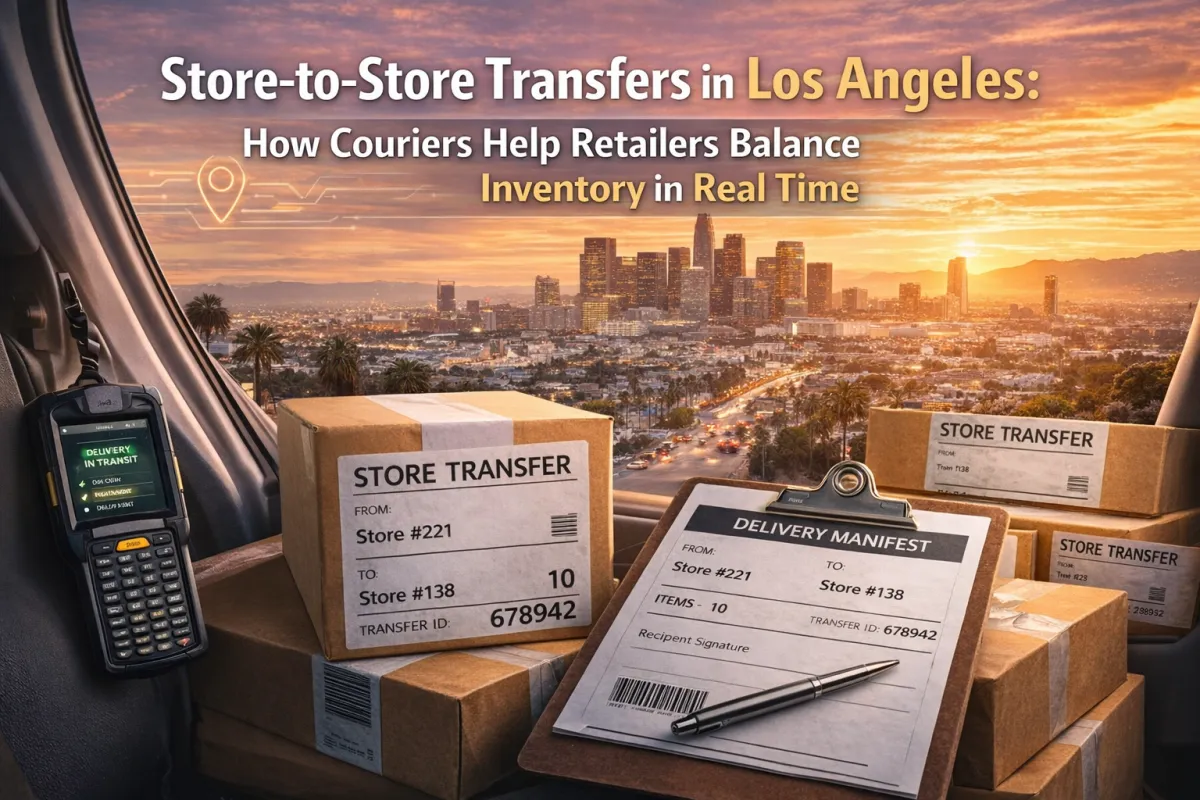
Store-to-Store Transfers in Los Angeles: How Couriers Help Retailers Balance Inventory in Real Time
Los Angeles retail moves at the speed of the customer. If your shelves say “sold out” while the same item sits across town, you are not dealing with an inventory problem. You are dealing with an inventory placement problem.
That gap shows up in familiar ways. A customer wants pickup today, but the pickup store is out. A popular SKU sells out in one neighborhood while another location sits on extra stock. A store manager tries to fix it with a quick drive, but there is no tracking, no proof of handoff, and no reliable timing. Over time, those small failures become cancelled orders, lost foot traffic, and lower conversion.
Store-to-store transfers are the fastest way to correct inventory placement in a city like Los Angeles, where demand shifts quickly and travel time is unpredictable. A professional courier makes those transfers consistent, trackable, and scalable.
Why store-to-store transfers are an LA advantage, not a backup plan
Los Angeles is a city of micro-markets. One location might be packed after work while another spikes on weekends. Promotions hit differently by neighborhood. Even weather and events can influence what sells on a given day.
Retailers that rely only on warehouse replenishment often lose the “right now” sale, because replenishment is not built for same-day urgency. Store-to-store transfers win because the inventory is already inside the metro area. You are simply moving it to where demand is happening.
This is also why omnichannel retailers focus on real-time visibility and fast fulfillment decisions. Omnichannel inventory management is commonly described as centralizing inventory visibility so retailers can fulfill from the best location in real time.
What “real-time inventory balancing” actually means
Real time is not a buzzword. In practice, it means your team can identify a shortage and fix it within the same selling window.
A real-time transfer program usually follows a simple rhythm. Your system flags low stock or an order risk. A manager approves a transfer. The sending store packs, labels, and stages the item. A courier picks up inside a defined window, then delivers with tracking and documented proof. The receiving store confirms the handoff and makes the inventory sellable quickly.
That last step is the difference between “inventory moved” and “inventory ready to sell.”
Why couriers outperform staff-driven transfers in Los Angeles
Many retailers start with staff-to-staff transfers. It seems simple until volume increases, or traffic turns a “quick run” into a 2-hour gap. Then it breaks.
Manual transfers create predictable problems. The store floor loses labor hours. The receiving team does not know when the transfer is arriving. If a box gets delayed or misplaced, there is no defensible chain of accountability. Inventory adjustments lag behind reality, which creates a second wave of problems like overselling, cancelled pickups, and customer complaints.
A courier workflow fixes these issues because it introduces structure. Defined pickup times, tracked movement, and proof of delivery give your ops team clarity without pulling associates off the floor.
The sales impact: fewer cancellations, stronger pickup promises
When a customer chooses pickup or same-day delivery, they are choosing certainty. If your system says “ready today” and the item is not there, you are not just losing the order. You are losing trust.
That is why modern retail fulfillment and delivery expectations keep intensifying. NRF tracks how fulfillment and delivery strategies shape retail competitiveness and customer behavior over time.
A courier-supported transfer system helps you protect the promise. It turns “maybe we can get it” into “yes, we can deliver it from the other store and prove it arrived.”
The operational side: how to run store-to-store transfers without chaos
The best LA transfer programs make the process easy for stores and predictable for operations.
Start with two lanes that match reality.
The first lane is routine transfers. These run on scheduled windows, usually one or two daily loops depending on store density and volume. Routine transfers handle the normal balancing that keeps shelves healthy.
The second lane is urgent transfers. These are triggered by high-value customers, pickup saves, low-stock emergencies, or time-sensitive demand. Urgent transfers use priority handling so the item does not get stuck behind low-priority stops.
Packaging and labeling standards that reduce shrink risk
High-value retail items deserve higher discipline. In Los Angeles, store-to-store transfers commonly include premium apparel, footwear drops, fragrance, cosmetics, electronics accessories, and specialty items that are easy to resell if lost.
Make your transfer packaging boring and consistent. Use a standard mailer or carton size when possible. Add a transfer label that includes origin store, destination store, transfer ID, and item count. If the value is high, use a tamper-evident seal and log the seal number at pickup and delivery.
This is where standards like GS1 are helpful as a mindset. GS1’s work is about consistent identification and shared data language across supply chains. Even if you are not implementing GS1 end-to-end, consistent identifiers are what reduce transfer confusion.
What to look for in a courier partner for LA store transfers
A courier can only help if the operation fits retail needs. For Los Angeles transfers, look for these capabilities:
You want defined pickup windows. Retail teams need predictable timing so staging and receiving do not interrupt peak customer flow.
You want tracking that operations can see without calling anyone. Real-time visibility reduces wasted store labor and improves inventory reconciliation.
You want proof of delivery that closes the loop. A transfer is not complete until the receiving store can confirm it arrived and who accepted it.
You want exception handling that escalates fast. In LA, traffic and building access issues happen. The difference is whether your courier alerts you early or leaves you guessing until the customer cancels.
How couriers help retailers balance inventory across LA neighborhoods
In practice, courier transfers are most valuable when demand shifts faster than replenishment can follow. That includes product drops, weekend spikes, post-work surges, pop-up events, and marketing-driven promotions.
A strong transfer program makes it normal to move product between nearby stores rather than treating each location as isolated. Over time, the retailer becomes more resilient. Stockouts decrease, markdown pressure eases, and customers stop hearing “we can’t get it until next week.”
If your stores also fulfill online orders, transfers become a fulfillment tool too. Store-based fulfillment and inventory positioning are widely discussed in retail operations because stores are increasingly used as fulfillment nodes, and balancing becomes a core challenge.
The simplest way to measure if transfers are working
You do not need a complicated dashboard to start improving. Track a few numbers consistently.
Measure transfer cycle time from request to delivery. Watch on-time pickup and on-time delivery. Track exceptions and their causes. Measure how long it takes for receiving stores to confirm and make inventory sellable.
When those metrics improve, your customer metrics improve too. Fewer cancellations, fewer “out of stock” moments, and stronger pickup performance.
Closing: turn LA inventory into a shared resource, not isolated shelves
Los Angeles retailers win when inventory moves like the city does. Fast, responsive, and always adapting.
Store-to-store transfers are the practical way to balance inventory in real time, protect your customer promise, and keep store teams focused on selling rather than driving. A professional courier makes that possible with predictable pickup windows, real-time tracking, and proof of delivery that reduces disputes.
If you want to build a transfer program or add an urgent transfer lane for LA, start here:
