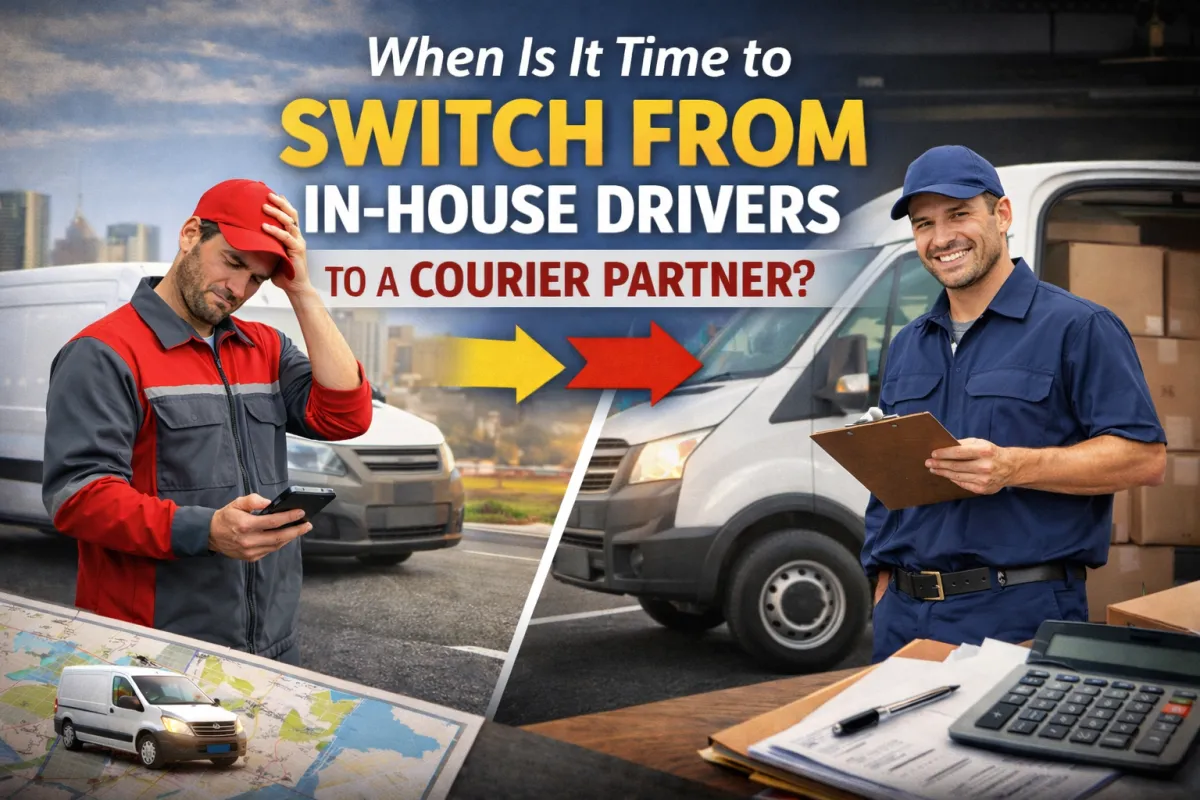
When to Switch from In-House Drivers to a Courier Partner (Cost, Risk, Scaling)
If you are running deliveries with in-house drivers, you are not doing it wrong. For many businesses, in-house delivery starts as the fastest way to stay in control. You hire a trusted driver, hand them the keys, and keep the workflow simple.
The challenge is that delivery operations do not stay simple. Volume grows, service areas expand, exceptions pile up, and the “easy” part becomes managing labor, vehicles, routing, compliance, and customer expectations all at the same time.
This post breaks down the clearest signs that you have reached the tipping point, and how to switch without disrupting your day-to-day operations.
Why in-house delivery works at the beginning
In-house delivery usually wins early because it feels predictable. You control schedules, you control priorities, and you can adjust on the fly. If your deliveries are low volume, mostly local, and rarely urgent, a small in-house setup can feel efficient.
But the benefits are often tied to a narrow operating window: limited stops, limited geography, and limited urgency. Once you move beyond that window, the hidden costs and risks start showing up.
The signals that it is time to switch
1) You are managing drivers more than you are managing the business
When dispatching, calling customers, rescheduling missed drops, and chasing proofs of delivery become daily work for leadership, delivery has turned into a management burden instead of a support function.
A courier partner should absorb that burden through dispatch oversight, exception handling, and consistent reporting. If you want an example of what modern visibility looks like, this is the baseline most clients now expect: Real-Time Tracking and Proof of Delivery.
2) Your delivery volume swings week to week
In-house teams struggle with variability. You either staff for peak and waste money during slow weeks, or staff lean and disappoint customers during busy periods. A courier partner can flex capacity across routes, on-demand calls, and time windows without forcing you to overhire.
3) Cost per stop is rising and you cannot explain why
This is the big one. Most teams track wages and fuel, but they miss the real drivers of cost: depreciation, insurance, maintenance, downtime, recruiting churn, and the cost of exceptions.
A quick cost check that many operators use is the IRS standard mileage rate as a proxy for true vehicle cost. For 2026, the IRS business standard mileage rate is 72.5 cents per mile. If you are running 1,000 business miles per week, that proxy alone is roughly $725 per week in vehicle cost before you even add wages, dispatch time, insurance variation, and risk.
AAA’s “Your Driving Costs” research often shows total ownership and operating costs can land near or above a dollar per mile depending on mileage and vehicle category. That does not mean your exact number is a dollar, but it is a useful reminder that “fuel and wages” is rarely the full picture.
4) Service failures are becoming normal
Late deliveries happen. What matters is whether your operation has a system that catches issues early, communicates clearly, and prevents repeats.
If your internal team is regularly dealing with missed handoffs, redeliveries, wrong addresses, and “driver called out” problems, it is a sign you need more redundancy and a stronger exception workflow. A good reference point for how pros approach this is: Common Delivery Delays and How Express Courier Prevents Them.
5) You are expanding into regulated or high-liability deliveries
Healthcare, pharmacy, legal, and financial deliveries add expectations that most in-house setups are not built to handle consistently. You may need chain-of-custody discipline, audit-ready documentation, and policies that protect sensitive information.
If you handle workflows tied to HIPAA-regulated environments, HHS guidance around covered entities and business associates is a helpful baseline for understanding where responsibilities can apply.
If your business is moving toward medical and pharmacy logistics, this is the kind of specialization you want to see from a partner: Healthcare and Pharmacies. If you are in the legal world, look for the same operational maturity here: Legal Industry Courier Support.
6) Customers now expect visibility you cannot provide
More clients want live ETAs, real-time status, and proof of delivery with photos and signatures. If your internal process is still “call the driver” and “text me when it is done,” your customer experience will eventually lag competitors.
A courier partner should provide that visibility by default. Example: ECS Technologies.
7) Route planning is eating your week
Once you reach multi-stop routes, the game changes. It is no longer about driving. It is about batching, time windows, stop density, and repeatable route design.
If route planning is becoming complex, you will get value from a partner who does it daily. Here is a deeper internal reference that frames the operational side clearly: Pharmacy Route Optimization in Riverside & San Bernardino.
A simple “switch” decision framework
A good rule of thumb is to consider a courier partner when at least two of these are true:
You are running regular routes and also receiving urgent same-day requests. Your delivery geography is widening beyond a tight local radius. Your internal delivery performance depends on specific people not calling out. Your customers are asking for tracking and better documentation. Your cost per stop is rising faster than revenue.
At that point, delivery is no longer a side task. It is its own operation.
What to look for in a courier partner
Start with three questions:
Can they run both on-demand and scheduled routes?
That matters because many businesses end up needing both. This is the operational model to benchmark: Courier Services.
Do they have real oversight and an exception process?
If they cannot explain how they handle failures, they will eventually hand those failures back to you.
Can they prove performance with documentation?
Proof-of-delivery, timestamps, signatures, photos, and visibility are not “nice to have” anymore. They are table stakes. The technology side should look like this: Tracking and Proof of Delivery.
You can also sanity-check a partner’s reliability through client feedback. Example: Client Testimonials.
How to transition without disruption
The safest switch is rarely an overnight cutover. A smoother approach is a hybrid rollout.
Start by moving either your most time-sensitive lane or your most operationally annoying lane to a courier partner first. That might be same-day requests, high exception routes, or a specific region like Orange County or Los Angeles where traffic variability makes performance harder to maintain consistently. Internal references for those footprints include Irvine Courier Coverage and Los Angeles Courier Coverage.
From there, define success in plain operational terms: on-time rate, average delivery time, exception rate, and proof-of-delivery completion. Once performance stabilizes, expand the scope.
FAQ
Should I keep one in-house driver even if I partner with a courier?
Often yes. Many businesses keep one internal driver for a narrow internal function (like inter-office runs) while outsourcing everything that requires flexibility, speed, or broad coverage.
Will outsourcing hurt customer experience?
It can, if you choose a partner that is not built for visibility and accountability. But with real-time tracking, proof-of-delivery, and strong exception handling, many businesses see customer satisfaction improve because communication and reliability become consistent.
How do I request a quote that is actually accurate?
Share your pickup zones, drop zones, time windows, average stops per day, and the split between scheduled routes and urgent calls. If you want a fast start, use: Contact Express Courier Services.
Closing thought
In-house drivers are a solid starting point. A courier partner becomes the better move when delivery starts behaving like a real department with real complexity, real risk, and real opportunity cost.
