Why Growing Manufacturers Are Replacing Ad-Hoc Drivers with Structured Courier Programs in Long Beach
Long Beach manufacturers operate in one of the most logistics-intensive environments in the country. Between port activity, industrial corridors, supplier networks, and constant movement between warehouses, yards, customers, and service partners, “moving things” becomes a daily operational reality, not an occasional task.
At first, many manufacturers handle these movements with ad-hoc drivers. A supervisor runs a part to a vendor. A warehouse lead takes a sample to a customer. A staff member drops paperwork at a broker or forwarder. It works until growth turns ad-hoc into routine. Then the cracks appear: missed cutoffs, delayed production, unclear handoffs, and wasted labor.
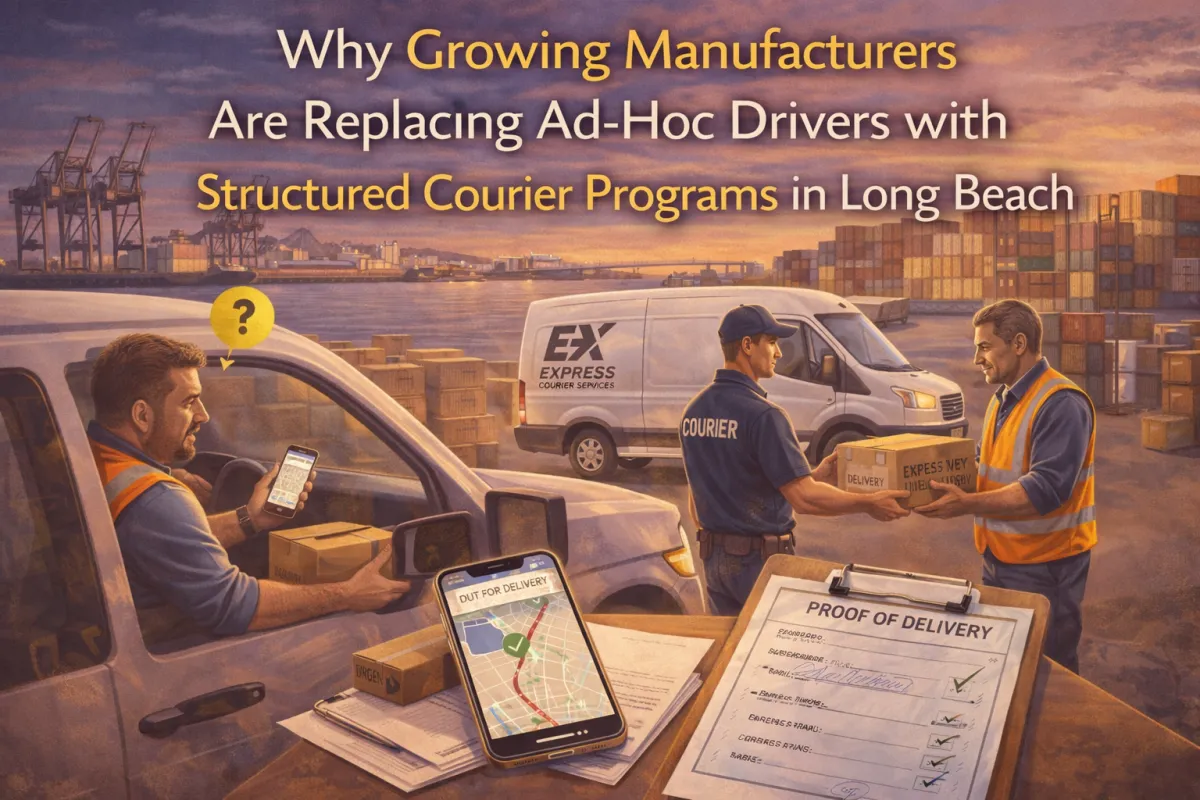
That’s why growing manufacturers in Long Beach are increasingly replacing ad-hoc driving with structured courier programs: scheduled routes for predictable movement plus on-demand coverage for urgent exceptions, all backed by tracking, proof of delivery, and an exception escalation process.
If you want to see courier service options that support scheduled routes and on-demand urgent runs, start here.
If you want real-time tracking, proof of delivery, and exception alerts, start here.
The hidden cost of ad-hoc drivers in manufacturing
Ad-hoc driving feels cheap because it looks like you’re using resources you already have. In reality, it creates costs that don’t show up cleanly on a P&L line.
The cost categories manufacturers usually miss
Lost production time
When a key person leaves the floor to run a delivery, you lose throughput. In manufacturing, the cost is not just wages, it’s lost output and delayed workflows.
Unpredictable timing
Ad-hoc runs happen when someone is available, not when the process needs them. That creates delays and missed windows.
Vehicle and mileage cost
Business driving adds real vehicle costs. Even if you don’t reimburse at the IRS mileage rate, it’s a useful proxy for true cost. The IRS set the 2026 business mileage rate at 72.5 cents per mile.
Reimbursement and policy risk
If employees use personal vehicles for business driving, reimbursement obligations and policies matter. Many businesses end up creating policies after the fact, usually because the model gets messy.
Liability exposure
Work-related driving is a workplace safety issue. OSHA’s employer guidance highlights the importance of motor vehicle safety programs and safe scheduling for driving work.
No proof when something goes wrong
If a part is disputed, a sample goes missing, or a receiving team claims they never got it, ad-hoc deliveries usually don’t have defensible proof of delivery, timestamps, or recipient confirmation. That creates rework and blame.
Why Long Beach amplifies ad-hoc failures
Long Beach is not just another manufacturing region. It’s connected to dense freight lanes and port-adjacent congestion patterns. That means even short-distance runs can become unpredictable. When manufacturing depends on timing, unpredictability becomes cost.
The World Economic Forum’s work on urban logistics highlights how congestion, curb constraints, and urban delivery complexity drive cost and service pressure in the last mile.
In a place like Long Beach where industrial routes intersect with heavy freight movement, structured programs outperform ad-hoc driving because they reduce variability and create clearer accountability.
What a structured courier program looks like for manufacturers
A structured courier program is not just “we use a courier sometimes.” It’s an operating model with lanes, rules, and documentation.
1) A route layer for predictable movement
This covers repeatable daily or weekly movements like:
supplier pickups
transfers between buildings or warehouses
shipping dock to lab or QA transfers
documentation runs between operations and third parties
Scheduled routes create predictable pickup windows and reduce the daily decision-making that kills efficiency.
2) An on-demand layer for urgent exceptions
This covers:
line-down parts runs
last-minute sample delivery
production save scenarios
urgent paperwork that affects shipments
On-demand works best when it’s protected with rules, so everything doesn’t become an “emergency.”
3) A visibility layer that reduces coordination
Modern courier programs include:
tracking
time-stamped delivery status
proof of delivery
exception alerts
This reduces “where is it” calls and lets supervisors focus on production instead of dispatch.
The manufacturing use cases where structured couriers win immediately
Parts and components that unblock production
When a part is missing, production waits. Ad-hoc driving is slow because it depends on staff availability. A courier program is fast because it’s a service lane.
Samples and prototypes that require careful handling
Prototypes and QA samples often need controlled handling and predictable timing. This is especially true if the destination is a lab, customer site, or testing partner.
If your work includes sensitive electronics or components, courier handling discipline is often tied to tech and electronics logistics expectations.
Documentation that affects shipping and customs workflows
Manufacturers often move:
bills of lading
shipping and compliance documents
contract packets
quality certificates
These are often time-sensitive and create avoidable delays when they’re treated casually.
Inter-office and multi-site movement
As manufacturers scale, they often operate across multiple locations. A route program makes these transfers predictable and reduces internal labor lost to driving.
The accountability advantage: fewer disputes, faster resolution
One of the biggest “silent wins” of structured courier programs is that disputes become easier to resolve. When every run has a job ID, timestamps, tracking, and proof of delivery, the story is simple.
That’s why proof of delivery matters. The more your operation scales, the more you need records rather than memory.
If you want a formal definition reference for chain-of-custody mindset, NIST defines chain of custody in terms of documenting handling and transfer information to preserve traceability and integrity.
How to transition from ad-hoc drivers to a structured program in Long Beach
The best transition is not dramatic. It’s methodical.
Step 1: Map recurring runs
List every recurring pickup and delivery point across a typical week.
Step 2: Turn repeatable movement into routes
Build one or two daily loops. Most manufacturers start with a morning route and an afternoon route.
Step 3: Define the on-demand exception rules
Decide what qualifies as urgent. For example:
production line-down risk
ship cutoff deadline
customer-critical sample delivery
Step 4: Require tracking, POD, and exception documentation
Visibility reduces coordination costs. Proof of delivery reduces disputes.
How Express Courier Services supports structured programs for manufacturing-style logistics
If your Long Beach operation needs structured movement, Express Courier Services supports both scheduled routes and on-demand urgent deliveries, backed by tracking and proof-of-delivery documentation.
Service options (routes and on-demand)
Tracking, proof of delivery, exception alerts
Tech and electronics handling mindset for sensitive components
Contact for a Long Beach program scope
Closing
Ad-hoc drivers can work when volume is low. But as manufacturers grow, ad-hoc driving becomes expensive because it steals time from production, creates variability, and removes accountability when something goes wrong.
Structured courier programs replace improvisation with predictable routes, protected on-demand service for exceptions, and documentation that scales with your operation. In a logistics-heavy environment like Long Beach, that shift is one of the simplest ways to improve uptime, reduce wasted labor, and keep shipments moving.
