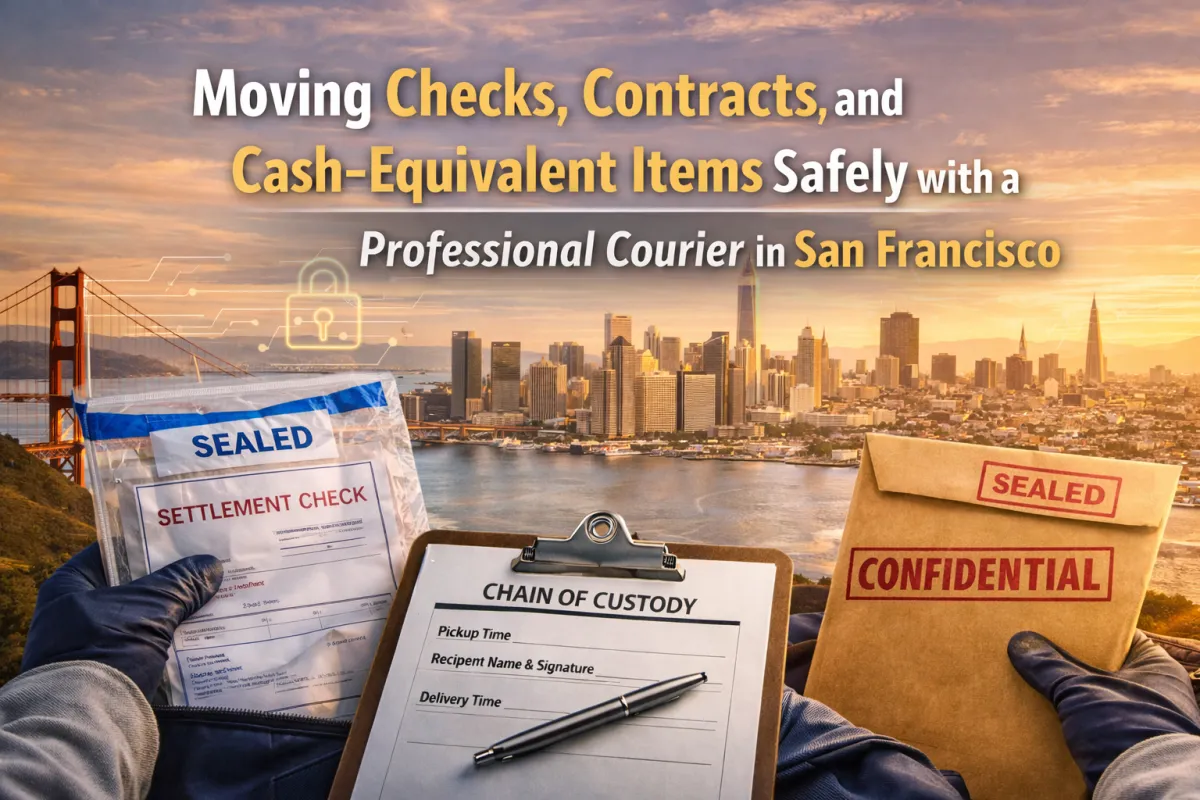
Moving Checks, Contracts, and Cash-Equivalent Items Safely with a Professional Courier in San Francisco
In San Francisco, “important” deliveries are not always big boxes. A single envelope can contain a settlement check, a signed contract that unlocks funding, an escrow packet that needs same-day delivery, or a time-sensitive agreement that cannot sit in a mailroom overnight. These items are cash-equivalent in practice, even if they are technically paper, because losing control of them creates real financial exposure.
If you have ever had a check go missing, arrive late, or show up with questions like “who signed for this,” you already understand the problem: speed matters, but custody matters more. The safer approach is not hoping the mail behaves. It is using a professional courier workflow designed for traceability, verified handoffs, and defensible proof of delivery.
This guide breaks down what “safe” really means for checks, contracts, and cash-equivalent items, and how to set up a courier process that works in the real San Francisco environment.
For a quick overview of secure same-day and route-based courier options across California, start here.
Why you should treat checks and cash-equivalent items differently than “regular” deliveries
A lot of businesses still use basic mail processes for high-value paper because it feels normal: print, seal, stamp, drop. The risk is that mail theft and check fraud are not theoretical anymore. FinCEN issued an alert describing a nationwide surge in mail theft-related check fraud schemes, and later published trend analysis showing the scale of reported activity in financial system data.
The FBI and U.S. Postal Inspection Service have also warned that check fraud is on the rise and a meaningful portion is enabled through mail theft.
Even if you never mail checks, “cash-equivalent” items show up in day-to-day operations across San Francisco:
Settlement checks and disbursement checks
Escrow packets and title documents
Signed contracts that trigger payment or performance
Deposit bags, lockbox materials, and banking documents
Gift cards, prepaid cards, or other stored-value items used for programs or reimbursements
Sensitive originals that are costly to recreate, like notarized paperwork
Once you accept that these items represent money or enforceable obligations, the delivery standard changes. You are no longer optimizing for “fastest.” You are optimizing for “controlled, provable, and recoverable if something goes sideways.”
The San Francisco reality that makes custody harder
San Francisco is not a simple “pickup and drop” city. Even short distances can be unpredictable because of day-part congestion, bridge traffic, construction, and building access constraints. Express Courier Services’ own discussion of inter-office logistics calls out how Bay Area mobility can turn small mileage into big time variance during peak hours, and why visibility and escalation matter.
On top of traffic, many deliveries in the Financial District, SoMa, Mission Bay, and high-rise corridors include:
controlled lobby entry and security desks
elevator delays
strict receiving windows
“no drop-offs” policies
mailrooms that are not authorized for sensitive handoffs
This is where regular delivery methods break down. A professional courier process, done right, is built for these constraints.
What “safe transport” means for checks, contracts, and cash-equivalent items
When you hire a professional courier for high-value paper, you are not just buying transportation. You are buying a chain of accountability. The “safe” standard usually includes six components:
1) Controlled pickup, with clear release authority
A high-value run should start with a known releasing person or controlled pickup point. The goal is to remove ambiguity about when custody transferred.
2) Direct drive or controlled routing
The more stops you add, the more custody points you create. For checks and contracts, many businesses prefer dedicated or priority handling over pooled multi-stop routes.
Express Courier Services describes on-demand and time-critical service options designed for urgent items, along with scheduled route programs for recurring workflows.
3) Tamper-evident packaging and seal discipline
Tamper-evident bags, seal numbers, and sealed inner envelopes create a simple truth: if the seal is intact, the contents were not accessed in transit. If it is not intact, you know immediately and can escalate.
Express Courier Services’ financial services page specifically references tamper-evident seals and chain-of-custody expectations for financial items.
4) Real-time visibility
If you cannot see where your critical item is, you do not have control, you have hope.
ECS highlights real-time GPS tracking, exception alerts, and customizable dashboards for visibility and accountability.
5) Proof of delivery that reduces disputes
For cash-equivalent items, proof of delivery should not be “left at front desk.” It should be tied to the correct receiving party, with a timestamp, and ideally a signature or other confirmation.
ECS notes automated proof of delivery that can include digital signatures, photos, and timestamps.
Their FAQs also reference electronic proof of delivery with recipient signature and delivery confirmation.
6) Exception handling that protects custody
This is the hidden difference between a true professional operation and a basic delivery vendor. When the receiver is unavailable, the building denies access, or the instructions are unclear, the courier must escalate and document, not improvise.
ECS describes active oversight and exception ownership as part of how their team operates.
When a professional courier makes the biggest difference in San Francisco
Here are common SF scenarios where using a courier process pays for itself quickly:
Bank runs and deposits: If you are moving deposit bags, lockbox materials, or time-sensitive banking paperwork, the risk is not just theft. It is also delay, and the internal “who dropped it off” blame game.
Legal and contract deadlines: Signed agreements and filing packets often have real downstream costs if delayed. If you work with law offices or corporate legal teams, a courier partner that understands chain-of-custody expectations matters.
Financial services workflows: Branch support, secure document movement, card kits, and similar tasks benefit from consistent handling protocols and a clear audit trail.
Multi-office internal transfers: If your contract approvals or check runs bounce between SF, South San Francisco, Oakland, and other Bay Area points, reliable inter-office routes plus on-demand “priority exceptions” usually outperform ad hoc staff errands.
A practical security playbook for moving checks and high-value paper
You do not need a complicated system. You need repeatable habits.
Packaging that prevents “silent failure”
For checks, cashier’s checks, or sensitive originals:
Use a tamper-evident security bag for the outer layer whenever possible.
Put the document in an inner envelope marked “Confidential” with a recipient name and department.
If you use seal numbers, log the seal number at pickup and confirm it at delivery.
Avoid labeling the outside with “check,” “cash,” “deposit,” or anything that signals value.
Instruction discipline
High-value items should always have delivery instructions that answer:
Who is authorized to receive (named person or role)
Whether a signature is required
What to do if the receiver is unavailable (call, return, alternate recipient, or hold)
Chain-of-custody logging that is actually useful
A good record is short, clear, and retrievable:
job reference
pickup time and location
courier ID or driver assignment (at minimum internally)
delivery time, location, and receiving party confirmation
exception notes if anything deviated
Technology helps here. ECS highlights proof-of-delivery documentation tied to each order plus exception alerts and dashboards for reporting.
What to ask a courier before you trust them with checks and contracts
If you are evaluating a courier partner for San Francisco, ask questions that force operational clarity:
“How do you handle named-recipient deliveries?”
You want to hear that they do not leave it with “anyone at the desk” unless explicitly authorized.
“What does your proof of delivery include?”
Digital signature, timestamp, and ideally additional confirmation for high-value runs.
“What happens when there is an exception?”
Look for a real escalation process, not “the driver will figure it out.”
“Do you support tamper-evident seals or custody controls?”
Especially relevant for deposits, lockbox runs, and financial items.
“Can we get reporting by location, service type, or date range?”
This matters for audit readiness and internal reconciliation.
Why “just use the mail” is increasingly hard to defend
Some teams still ask, “Why not just mail it certified?” The honest answer is that mail is not designed around your specific custody needs. You can improve mail safety, but you cannot turn it into a controlled handoff system.
The U.S. Postal Inspection Service provides prevention guidance for mail and package theft, including recommendations like promptly picking up mail and being proactive about overdue checks.
Meanwhile, FinCEN’s alert on mail theft-related check fraud underscores how stolen checks can become part of organized fraud pipelines.
If a check or contract is valuable enough to cause a serious problem if it disappears, it is valuable enough to justify a professional custody workflow.
How Express Courier Services supports secure, trackable deliveries in San Francisco
If your use case includes checks, contracts, deposits, or other cash-equivalent items, the pages below align closely with the controls discussed in this article:
Courier options (on-demand, same-day, and route-based)
Real-time tracking, proof of delivery, exception alerts, reporting dashboards
Financial services and banking handling expectations
Legal delivery support for sensitive contracts and time-critical documents
If you want a local reference point for how ECS frames “risk controls” in San Francisco operations, their SF-focused post on risk controls (written for clinical trials) still reflects the same operational discipline: custody, visibility, proactive escalation.
Closing thought
Moving checks, contracts, and cash-equivalent items safely in San Francisco is not about paranoia. It is about designing out uncertainty. The safest courier process is the one that makes the story simple later: who released it, who carried it, who received it, when it happened, and what proof exists.
