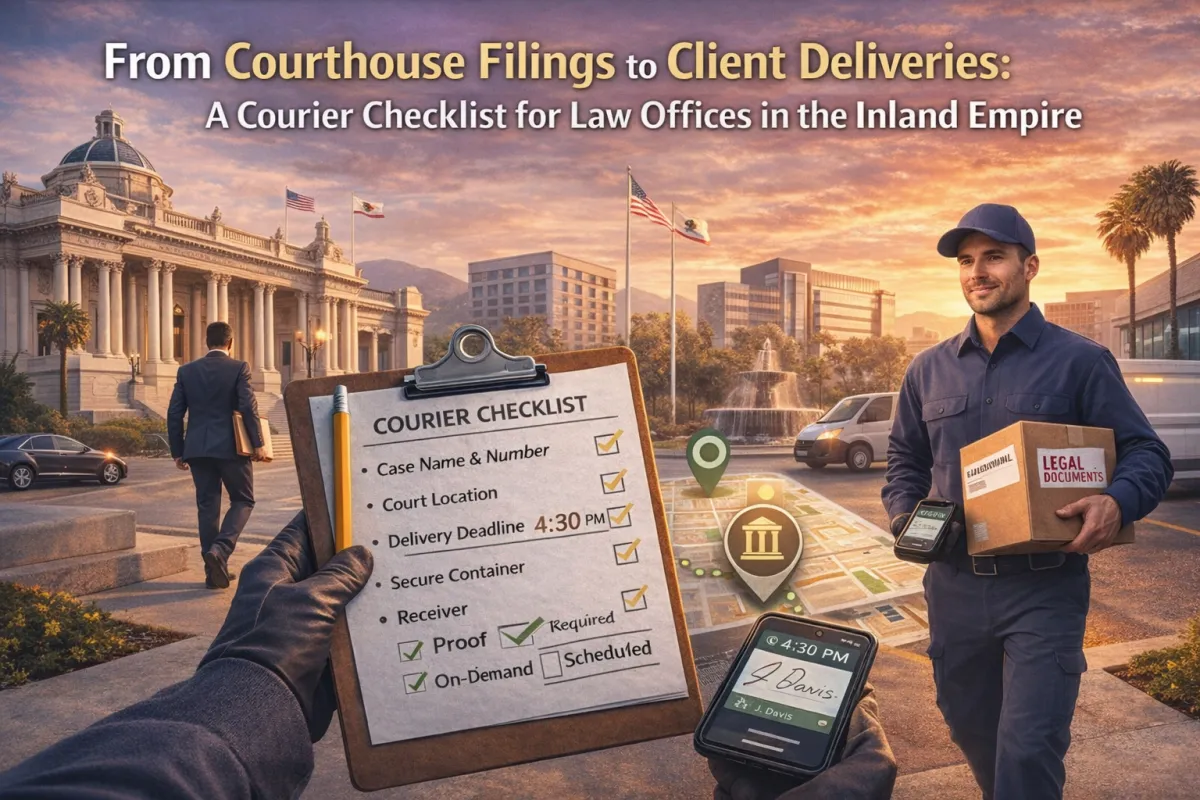
From Courthouse Filings to Client Deliveries: A Courier Checklist for Law Offices in the Inland Empire
In the Inland Empire, law offices deal with two delivery pressures at the same time: courthouse runs that demand precision and timing, and client deliveries that demand professionalism, confidentiality, and proof. One missed filing window or one disputed handoff can cost far more than the courier run itself.
If you want a courier partner built specifically for legal work like court filings, secure contract delivery, and evidence-style transport, start here.
If you want regional Inland Empire coverage across Riverside and San Bernardino Counties, use this page.
1) First, classify the run you are requesting
Before you place the order, identify the run type because it determines the service level, instructions, and proof you need.
Courthouse filing run: Deliver to the correct clerk filing window or division, often time-sensitive and location-specific. For San Bernardino County filing location guidance, use this.
Records run: Pick up conformed copies, certified copies, or retrieve filed documents from a records window. (Rules vary by courthouse and division.)
Client delivery: Deliver settlement packets, executed contracts, discovery binders, or other sensitive materials directly to a client or authorized recipient.
Evidence-style transport: Exhibits or sealed materials requiring custody documentation and verified handoffs. NIJ’s chain-of-custody overview is a strong baseline reference for why documentation matters.
2) Confirm the correct court location and whether eFiling changes the plan
The Inland Empire is served primarily by San Bernardino County and Riverside County, and each county has multiple locations and filing rules.
For San Bernardino County, start with the official “Where Can I File?” page to avoid sending a runner to the wrong building.
For Riverside County, use “Where to File” guidance to determine the correct filing location by case type.
Also confirm whether your filing should be electronic. San Bernardino Superior Court implemented mandatory eFiling for attorneys in civil case types effective September 2, 2025, which can change whether you need a physical courier run at all.
If you want the Civil eFiling requirements page itself, use this.
Riverside County also supports civil eFiling through approved providers, which can reduce physical runs for many documents.
3) Use a standard “Courier Instruction Sheet” for every run
A courier can only be as precise as your instructions. Your office should attach a consistent instruction sheet to every request, even if it’s a simple internal form.
Your instruction sheet should include:
Matter identifiers: Case name, case number, and internal reference.
Exact destination: Court name, district or division, address, and window or department when applicable.
Success definition: “File-stamp and return conformed copy” or “deliver to named recipient and obtain signature.”
Return instructions: Where conformed copies must go, who receives them, and by when.
Contact chain: Primary and backup contact for decisions and exceptions.
If you want your courier partner to provide real-time visibility and documentation, make sure the run is placed through a service that offers tracking, proof of delivery, and exception alerts.
4) Courthouse filing checklist
Courthouse runs are where details matter most, so treat every filing request like a repeatable checklist.
Filing packet checklist
Confirm the correct filing set, cover sheets, and any required attachments.
Confirm signatures and verification pages are complete.
Confirm copies and exhibits are included in the correct order.
Confirm filing fee method is ready if applicable.
Include a clearly labeled conformed set if you need stamped copies returned.
Location and timing checklist
Confirm the exact filing location before dispatch using the court’s official guide.
For Riverside filing location guidance, use this “Where to File” page.
Proof and outcome checklist
Require time-stamped confirmation of the drop-off attempt.
Require documentation of the result, including any rejection reason if the clerk does not accept the filing.
Require return delivery of conformed copies to the right person, not “left at front desk.”
If you want the run to be trackable end-to-end with time-stamped proof, use a courier service that provides GPS tracking and automated POD.
5) Client delivery checklist
Client deliveries are part of your client experience, and they also create confidentiality and dispute risk if handled casually.
Confidentiality checklist
Use sealed packaging for sensitive materials.
Avoid labeling the outside with anything that signals value or sensitive content.
Deliver directly to the intended recipient or authorized representative when required.
California attorneys’ duty of confidentiality is reflected in Rule 1.6, which is a useful reference when setting internal handling standards.
Delivery verification checklist
Always specify whether a signature is required.
For high-stakes packets, require named-recipient delivery and signature capture.
Require timestamped proof and clear receiving details.
For proof of delivery standards like digital signature, photos, and timestamps, see this technology overview.
For a clear explanation of why tracking and POD are now baseline expectations, use this.
Exception handling checklist
State what happens if the recipient is unavailable.
State whether mailroom or reception is allowed.
State when the courier must call your office before any alternate handoff.
6) Evidence and exhibits checklist
Even when you’re not moving criminal evidence, law offices often move exhibits, sealed materials, or sensitive originals that should be handled with evidence-style discipline.
NIJ describes what a chain-of-custody record should contain, including verifying that items were packaged and appropriately sealed.
Practical checklist for your courier notes:
Use tamper-evident packaging where appropriate.
Document seal condition at pickup.
Require signature and recipient identification at delivery.
Require time-stamped custody events and exception notes.
If you want a courier partner that explicitly supports legal evidence transport and chain-of-custody handling, use this legal services page.
7) Decide if the run should be on-demand or scheduled
Law offices often default to rush service for everything, which drives cost and increases chaos. A better structure is separating routine movement from urgent movement.
Use scheduled routes for recurring courthouse drops, inter-office transfers, and predictable records runs.
Use on-demand for true urgency like same-day deadlines and last-minute filings.
For service options that include both scheduled routes and on-demand, start here.
If your office is still using staff for recurring runs, it helps to understand the hidden vehicle cost. The IRS standard mileage rate is one common proxy for business driving costs (72.5 cents per mile for business use in 2026).
8) Require visibility and documentation every time
The fastest way to reduce disputes and internal stress is making visibility standard.
Minimum expectations:
Pickup confirmed, in transit, delivered.
Proof of delivery with timestamps and recipient confirmation.
Exception notes for anything that deviates.
For confirmation that ECS provides electronic POD including recipient signature and delivery confirmation, see the FAQ entry here.
9) Protect checks and cash-equivalent packets like high-value items
Law offices often move retainers, settlement checks, and other cash-equivalent items. These should not be treated like normal mail.
Best-practice checklist:
Avoid mailroom drop-offs for cash-equivalent items.
Require direct-to-recipient delivery when possible.
Require signature and proof of delivery.
For general mail theft prevention guidance (including “inquire about overdue checks”), this USPS Inspection Service page is useful context when comparing mail vs courier custody.
10) Make it easy for your courier partner to execute perfectly
The best courier relationship reduces back-and-forth by making requests complete and consistent. Include these details on every order:
Pickup and delivery zones, plus time windows.
Whether the run is on-demand or scheduled route work.
Special handling requirements like signature and named recipient.
Chain-of-custody requirements when applicable.
The Inland Empire coverage page specifically suggests including pickup and delivery zones, time windows, and whether you need on-demand vs scheduled routes to speed quoting
To request service or get a quote, use this.
Closing: turn your courier runs into a system, not a scramble
Court filings and client deliveries are too important for vague instructions and informal handoffs. The Inland Empire law office that runs smoothly is the one that makes these runs repeatable: correct courthouse location, sealed handling when needed, named recipient delivery, and proof you can retrieve later.
If you want a legal-focused courier partner across California, start here.
