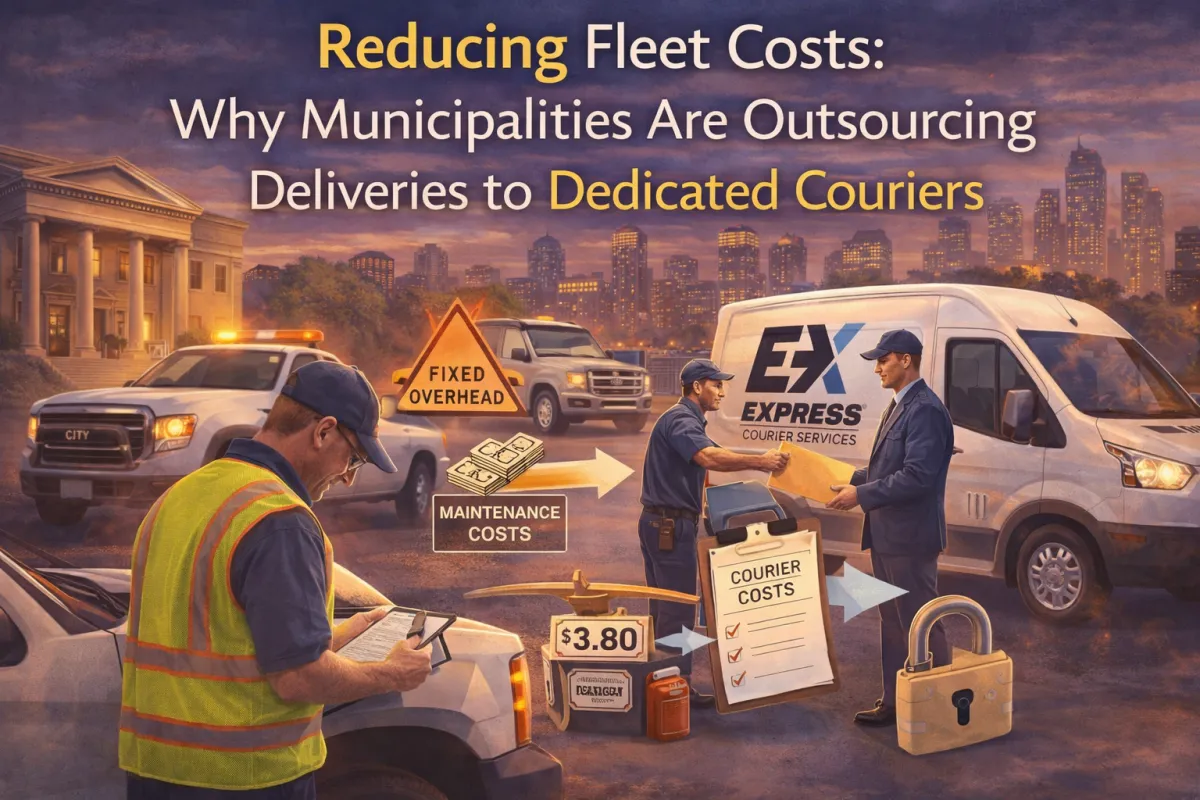
Reducing Fleet Costs: Why Municipalities Are Outsourcing Deliveries to Dedicated Couriers
Municipal fleets are built for essential public services. Snow response, public works, utilities, inspections, parks, and emergency support all require vehicles that are available and ready. The problem is that many cities also use those same vehicles, or city staff in personal vehicles, for routine “messenger” work: inter-office mail, records transfers, supply runs, plan sets, procurement packets, bank deposits, and other daily deliveries.
That is where costs quietly inflate. Not because any single run is expensive, but because fleet ownership has fixed overhead, and ad-hoc delivery work creates low utilization, unpredictable mileage, more maintenance demand, and constant scheduling friction.
A growing number of municipalities are reducing these hidden costs by outsourcing routine deliveries to dedicated couriers, usually through scheduled route programs plus on-demand coverage for exceptions. This shifts routine delivery work from “fleet burden” to a trackable, service-level-driven logistics program.
If you want a reference example of how route-based courier programs modernize municipal inter-office mail, use this.
If you want to see a government-agency courier service overview, use this.
The real cost of “just using city vehicles” is bigger than fuel
Fuel is the cost people notice first, but it is rarely the biggest cost driver over time. The bigger costs are:
Vehicle acquisition or lease payments, depreciation, insurance, and registration
Maintenance, repairs, tires, downtime, and replacement cycles
Administrative overhead for scheduling, dispatching, and fleet reporting
Workforce time lost when staff are driving instead of doing their actual job
Risk exposure when deliveries are disputed and there is no documented proof of delivery
Many municipal organizations also struggle with total cost of ownership visibility, especially as fleets age and maintenance planning gets harder without modern tools.
A practical way to explain this to leadership is to separate costs into two buckets:
Fixed costs you pay even when vehicles sit.
Variable costs that increase with mileage and usage.
Routine deliveries tend to increase both, without improving core service delivery.
Why outsourcing is a budgeting win: fixed cost becomes variable cost
When a municipality runs routine deliveries with city vehicles, costs behave like fixed overhead. The vehicle exists, the insurance exists, the management exists, and the staffing exists whether or not the vehicle is being fully utilized.
When routine delivery work is outsourced, costs behave like a service line. You pay for routes and runs you actually need, you can scale up or down, and you can attach service-level expectations and reporting requirements.
This is why route-based courier programs tend to show quick savings. They turn scattered “whenever” messenger trips into predictable loops with defined pickup and drop-off windows and measurable performance.
A simple cost reality check using public benchmarks
Two benchmarks help explain delivery economics in plain terms.
First, some fleet analytics providers estimate that government fleets can cost roughly $0.27 per mile to operate (including broad cost components, depending on methodology).
Second, for staff using personal vehicles, the IRS business mileage rate is a common proxy for what driving actually costs when you include fuel, maintenance, and depreciation. The IRS set the 2026 business standard mileage rate at 72.5 cents per mile.
The point is not that every city’s cost-per-mile is exactly those numbers. The point is that routine driving is not cheap when you include the full cost of operating a vehicle, and those costs are often invisible inside department budgets.
Dedicated couriers fix the operational problems that drive municipal costs
1) Predictable schedules replace “ad-hoc trips”
Most municipal messenger work is repeatable. City Hall to planning. HR to public works. Finance to a satellite office. Library branches to a central facility. These are routable movements.
Route-based courier programs consolidate stops into efficient, predictable loops rather than random point-to-point trips.
2) Proof of delivery replaces disputes and rework
One of the most expensive delivery failures is a dispute. “We never received that packet.” Then staff spend hours reconstructing events, calling departments, checking desks, and re-sending documents.
A modern courier model reduces that cost by providing real-time tracking and proof of delivery records (timestamps, recipient confirmation, and exception notes).
3) Chain of custody becomes practical for sensitive items
Cities move sensitive documents constantly: HR files, procurement submissions, benefits paperwork, city attorney packets, sealed records, and sometimes evidence-style materials.
A defensible chain-of-custody mindset is based on documenting who handled an item, when, and for what purpose.
Couriers can support this with scan events at pickup and drop-off and controlled handoff rules.
4) Fleet risk exposure decreases
Every extra mile driven by staff increases risk exposure and administrative load if incidents occur. Many organizations also have to manage reimbursement obligations for employee vehicle use.
If a city is relying on personal vehicles for business driving, it should understand reimbursement and expense obligations. IRS mileage rates are commonly used as a benchmark for those costs.
For safety program expectations around work-related driving, OSHA provides employer guidance on motor vehicle safety.
What municipal deliveries are best to outsource
Municipalities usually get the strongest ROI outsourcing these categories first:
Inter-office mail and pouch runs between buildings and departments.
Route-based programs are designed for this exact problem.
Records and document transfers such as plan sets, permitting packets, and internal review packages.
Visibility and proof-of-delivery reduce disputes and rework.
Time-sensitive packets including procurement submissions and deadline-driven drop-offs.
On-demand courier service tiers handle exceptions without breaking route schedules.
Multi-site supply movement between facilities, storage locations, and satellite offices.
Dedicated routes reduce the number of “someone drive it over” moments.
High-sensitivity items where chain of custody matters, such as sealed documents or restricted materials.
Government agency courier services are often structured around secure handoffs and documented delivery records.
When it still makes sense to keep work in-house
Not everything should be outsourced. Cities typically keep these in-house:
Emergency response, field response, and safety-critical operations
Work requiring specialized vehicles or tools that are integrated into public works workflows
Situations where staff are already on-site and moving items does not create added mileage or scheduling disruption
The sweet spot for outsourcing is repeatable messenger work that consumes fleet capacity and staff time without advancing core service missions.
What to demand from a dedicated courier partner in an RFP
If your city is considering outsourcing, your RFP should demand operational proof, not marketing language.
You want service tiers that separate route-based work from on-demand work.
You want measurable KPIs: on-time pickup, on-time delivery, exception resolution time, and POD completion rate.
You want proof of delivery standards and retention requirements.
You want chain-of-custody procedures for sensitive items. A useful reference definition is NIST’s chain-of-custody glossary.
You want a driver safety program and incident process. OSHA provides a practical starting point for employer driving safety expectations.
If you want a city-focused list of questions to include in courier procurement, this companion RFP guide is designed for municipalities.
The simplest implementation plan cities use
Most municipalities roll this out successfully in three steps:
Step 1: Identify routable stops.
Map the recurring pickups and drop-offs across departments and buildings.
Step 2: Launch a route program for the baseline.
Start with one or two daily loops (morning and afternoon), then adjust frequency.
Step 3: Add on-demand for exceptions.
Reserve on-demand for true urgency: deadline packets, access issues, and rare spikes.
A courier service model overview that supports both route and on-demand tiers is here.
Closing: outsourcing is less about convenience and more about control
Municipalities outsource deliveries to dedicated couriers for the same reason they outsource other non-core functions: it reduces total cost, improves accountability, and prevents routine work from consuming mission-critical resources.
Route-based couriers convert scattered messenger trips into predictable schedules. Tracking and proof of delivery reduce disputes and internal rework. Chain-of-custody discipline improves audit readiness for sensitive documents. And leadership gets visibility into a workflow that is often invisible until it fails.
If your city wants to explore a route-based courier program, define service tiers, and set reporting requirements, start here.
