
Beyond Court Runs: Building a More Reliable Delivery Process for Busy Law Offices in San Francisco
Discover how San Francisco law firms improve document delivery with real-time tracking, proof of delivery, and reliable legal courier services.
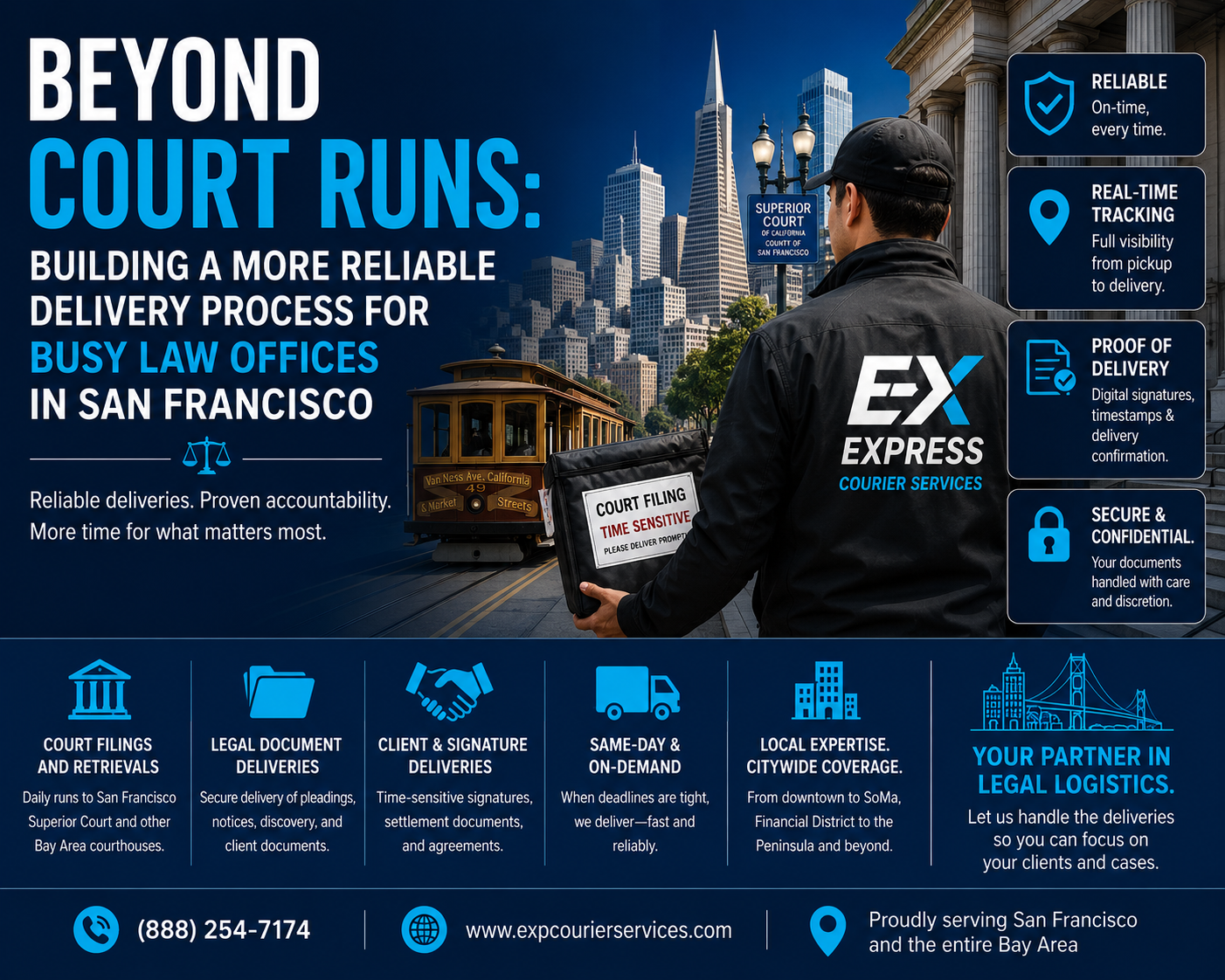
San Francisco law firms operate in one of the most demanding legal environments in California. Attorneys and legal support teams manage strict court deadlines, complex litigation schedules, client expectations, and a constant flow of documents that must move quickly and securely between offices, courthouses, clients, government agencies, and third-party service providers.
For many firms, deliveries still revolve around a familiar process: someone in the office drops everything and makes a court run.
While this approach may seem manageable, it often creates hidden costs, operational disruptions, and unnecessary risk. As firms grow, they increasingly recognize that a reliable legal delivery process requires more than occasional courthouse trips. It requires structure, visibility, accountability, and consistency.
If you want legal courier solutions designed for law firms, start here.
If you want same-day, route-based, and scheduled courier services, start here.
If you want real-time tracking and proof-of-delivery technology, start here.
Why San Francisco law firms face unique delivery challenges
San Francisco presents delivery challenges that many smaller markets do not.
Legal teams frequently deal with:
Heavy traffic congestion
Limited parking availability
Courthouse access procedures
High-density office environments
Multiple agency and court locations
Tight filing deadlines
Time-sensitive client requests
A simple delivery can quickly become a significant interruption.
What starts as a thirty-minute errand often turns into a multi-hour disruption that pulls valuable staff away from legal work.
The hidden cost of staff-driven court runs
Many law firms underestimate the true cost of internal deliveries.
When a legal assistant, paralegal, or administrative staff member leaves the office to make a filing run, several things happen:
Current work pauses
Client communication slows
Administrative tasks accumulate
Scheduling becomes more difficult
Productivity declines
The visible expense may only be mileage or parking.
The hidden expense is lost operational capacity.
California employers should also understand reimbursement obligations related to necessary work-related vehicle use under Labor Code 2802.
The IRS standard mileage rate is commonly used as a benchmark for operating costs associated with employee vehicle use.
When fully evaluated, staff-run deliveries are often far more expensive than firms initially realize.
Court runs are only one piece of legal logistics
Many firms think of legal deliveries primarily as courthouse filings.
In reality, legal operations involve much more.
Examples include:
Court filings and conformed copy retrieval
Service documents
Client signature packets
Settlement agreements
Settlement checks
Records requests
Discovery materials
Medical records
Financial documents
Inter-office transfers
Confidential legal files
Each delivery type carries different requirements and levels of urgency.
A reliable delivery process should support all of them.
Why visibility matters more than ever
One of the most common delivery questions inside law firms is:
"Has it been delivered yet?"
Without visibility, staff often spend time:
Making phone calls
Checking with recipients
Contacting drivers
Searching for updates
Reconstructing delivery timelines
Real-time tracking eliminates much of this uncertainty.
Benefits include:
Live shipment visibility
Reduced follow-up calls
Faster issue identification
Better attorney communication
Improved client updates
Modern courier technology allows firms to monitor deliveries from pickup through completion.
Proof of delivery protects law firms
For legal deliveries, a simple "delivered" notification is often not enough.
Law offices frequently need documentation showing:
Delivery time
Recipient name
Signature confirmation
Delivery notes
Exception details
Proof of delivery (POD) creates accountability and reduces disputes.
Modern POD systems often include:
Digital signature capture
Timestamped records
Recipient verification
Delivery documentation
Exception reporting
When questions arise later, firms have documentation readily available.
Chain of custody for sensitive legal materials
Many legal documents contain confidential or highly sensitive information.
Examples include:
Original signed contracts
Settlement documents
Medical records
Financial records
Litigation exhibits
Evidence materials
Confidential client files
For these deliveries, chain-of-custody procedures become increasingly important.
Chain of custody helps document:
Who handled materials
When transfers occurred
Delivery verification
Custody changes
Any exceptions during movement
NIST defines chain of custody as documentation used to preserve traceability and integrity through handling and transfer records.
Strong documentation helps protect both firms and clients.
Building a better legal delivery process
A more reliable delivery process begins with structure.
Step 1: Separate routine deliveries from urgent requests
Routine deliveries often include:
Scheduled courthouse runs
Records retrieval
Daily office transfers
Client packet movement
Urgent deliveries may include:
Same-day filings
Emergency notices
Last-minute signatures
Time-sensitive court submissions
Separating these categories allows firms to create efficient workflows while preserving flexibility.
Step 2: Implement route-based delivery where possible
Many firms have recurring delivery patterns.
Examples include:
Daily courthouse filings
Records pickup schedules
Office-to-office document movement
Route-based service provides:
Predictable timing
Reduced cost per stop
Consistent service levels
Improved planning
Step 3: Use on-demand service for true urgency
Not every delivery should be rushed.
On-demand courier service works best for:
Deadline-driven filings
Emergency document delivery
Rush client requests
Time-sensitive legal notices
This keeps urgent work moving without disrupting routine workflows.
Step 4: Standardize delivery instructions
Every delivery request should include:
Recipient name
Department or suite
Signature requirements
Delivery deadline
Escalation contact
Return instructions if applicable
Standardization reduces errors and improves consistency.
Step 5: Define exception procedures
Even the best delivery systems encounter challenges.
Examples include:
Recipient unavailable
Access restrictions
Address discrepancies
Courthouse cutoff issues
Delivery refusals
Courier partners should have clear escalation procedures to address these issues quickly.
Questions San Francisco law firms should ask courier providers
Before selecting a courier provider, ask:
Do they support same-day and scheduled service?
Is real-time tracking available?
Is proof of delivery included?
Can they support chain-of-custody requirements?
How are exceptions communicated?
Can they support recurring courthouse schedules?
Do they understand legal workflows?
A courier should function as an extension of the legal team rather than simply a transportation vendor.
How Express Courier Services supports San Francisco law offices
Express Courier Services helps San Francisco law firms build reliable delivery systems through same-day courier services, scheduled routes, proof of delivery, real-time tracking, and secure document handling.
Contact us
Closing
San Francisco law firms face unique logistical challenges that make reliable document movement more important than ever.
Moving beyond simple court runs allows firms to create delivery processes built on visibility, accountability, proof of delivery, and structured workflows. The result is fewer interruptions, stronger deadline protection, better client service, and a more efficient legal operation.
By treating delivery as an operational system rather than an occasional task, law firms can spend less time chasing documents and more time focusing on their clients and cases.