Building a Multi-Industry Courier Program: Serving Healthcare, Legal, and Retail Under One Roof in Moreno Valley
Learn how Moreno Valley organizations unify healthcare, legal, and retail deliveries with one courier program using tracking, POD, and route management.
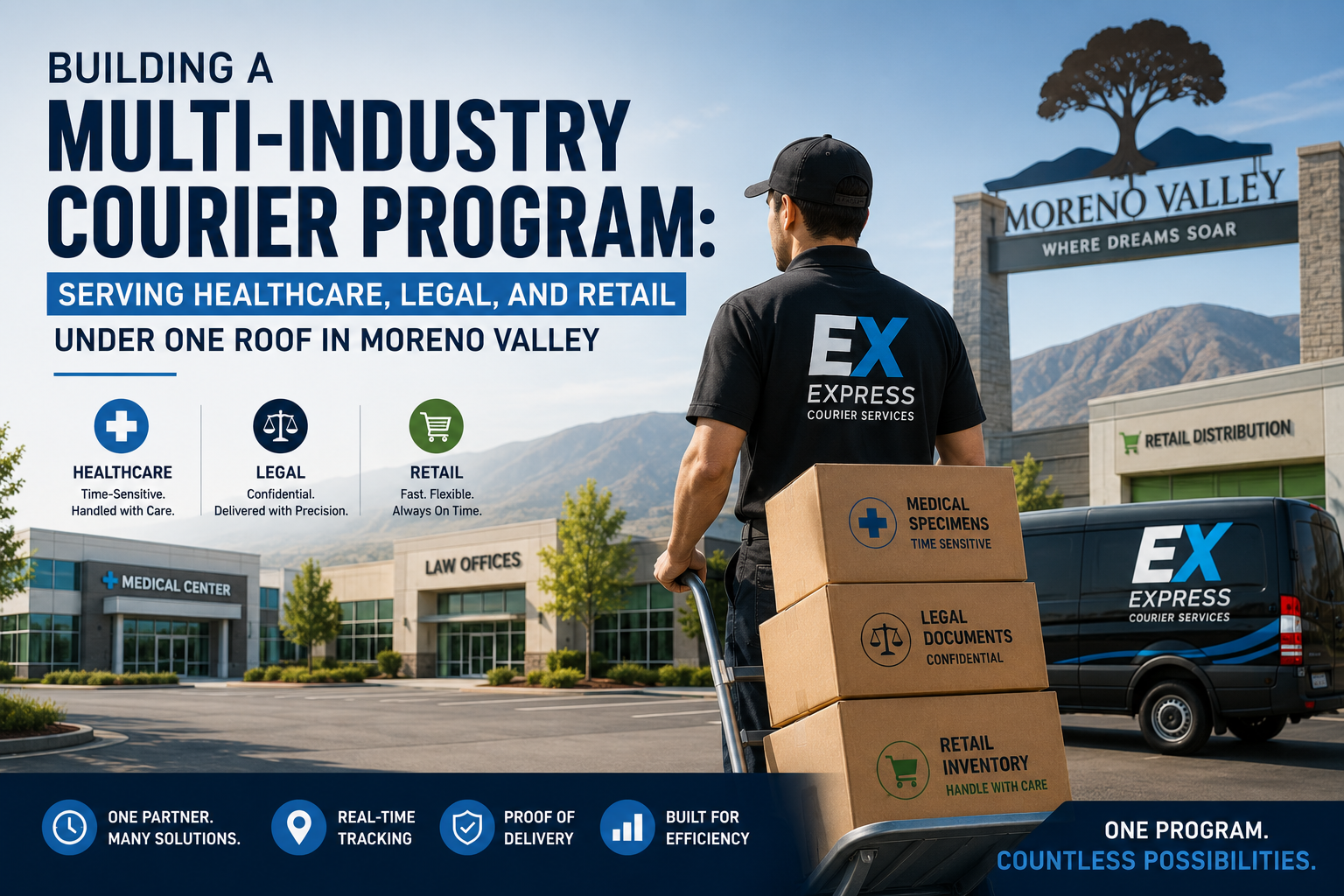
Many organizations begin with delivery needs that seem simple. A healthcare office needs specimen transfers. A law firm requires same-day legal document movement. A retailer wants inventory moved between stores. At first, each operation handles these needs independently. Staff make occasional runs, different vendors are used, and urgent deliveries are solved one issue at a time.
Over time, the process becomes fragmented.
Multiple vendors create inconsistent communication. Staff spend time coordinating deliveries. Reporting becomes difficult. Visibility disappears. Eventually organizations realize they are not managing deliveries. They are managing delivery problems.
This is why many organizations in Moreno Valley are moving toward multi-industry courier programs that centralize operations under one delivery framework. Instead of building separate systems for healthcare, legal, and retail logistics, they create one structured program with shared visibility, tracking, proof of delivery, and service standards.
If you want a full overview of same-day, scheduled, and route-based courier services, start here.
If you want real-time tracking, proof of delivery, and delivery visibility tools, start here.
If you want industry-specific courier solutions, start here.
Why delivery programs become fragmented over time
Many businesses grow department by department.
Healthcare operations create their own delivery process.
Legal teams create another.
Retail divisions create something separate.
Soon the organization has:
Different vendors
Different pricing structures
Different communication methods
Different proof-of-delivery systems
Different escalation processes
Different reporting methods
This creates operational friction.
Instead of one courier strategy, leadership manages multiple disconnected systems.
Why Moreno Valley organizations are ideal for centralized courier programs
Moreno Valley continues to grow as a logistics, healthcare, and business hub. Organizations frequently operate across multiple facilities and departments spread throughout the region.
Examples include:
Medical groups with multiple clinics
Retail chains with several locations
Law offices and support services
Distribution operations
Professional service organizations
Government agencies
These organizations often have repeatable delivery patterns.
Examples:
Daily specimen movement
Legal filings and records transfers
Store-to-store inventory balancing
Inter-office document movement
Signature-required deliveries
Same-day emergency runs
When analyzed together, these movements often support one structured route network.
What a multi-industry courier program actually looks like
A multi-industry courier program does not mean using one service level for everything.
Instead, it creates one delivery framework with different workflows inside it.
The structure often includes:
Shared infrastructure
Dispatch team
Tracking system
Proof-of-delivery standards
Reporting dashboard
Escalation procedures
Driver communication platform
Industry-specific workflows
Healthcare:
Specimens
medical records
pharmacy movement
chain-of-custody procedures
Legal:
Court filings
legal notices
records movement
signature requirements
Retail:
Store inventory balancing
replacement shipments
urgent transfers
customer delivery support
One system. Multiple workflows.
Healthcare delivery requirements are different
Healthcare deliveries often involve sensitive materials and strict timelines.
Examples include:
Laboratory specimens
Prescription movement
Medical records
Imaging documents
Inter-clinic transfers
Healthcare delivery workflows usually require:
Time-sensitive movement
Chain-of-custody documentation
Recipient verification
Immediate exception escalation
Delivery accountability
The healthcare industry increasingly relies on documented transfer standards and accountability for sensitive materials.
Organizations handling protected information should understand privacy and handling expectations under HIPAA requirements.
Legal workflows require accountability and urgency
Legal deliveries operate differently.
Law offices often require:
Same-day filing runs
Signature-required delivery
Conformed copy returns
Confidential handling
Named-recipient delivery
Many legal offices still rely on staff “runner” workflows.
Problems often include:
Lost productivity
parking delays
missed deadlines
unclear delivery status
internal stress
Real-time tracking and proof of delivery reduce many of these problems.
Retail delivery needs revolve around speed and visibility
Retail movement is different again.
Retail operations frequently require:
Store-to-store inventory transfers
Same-day customer delivery
Replacement shipments
High-volume movement
Scheduled route service
Store transfers often become unpredictable when staff create ad hoc delivery processes.
Retail courier programs work best with:
Baseline route movement
Predictable daily transfers
Lower cost per stop
Repeatable schedules
On-demand exception support
VIP requests
emergency inventory needs
customer issue resolution
urgent transfers
Why real-time tracking becomes critical
Without visibility, organizations create their own tracking process:
"Did someone call?"
"Can somebody check?"
"Where is the driver?"
"Who received it?"
These status questions create operational drag.
Modern courier programs increasingly rely on:
Real-time driver location
Delivery status updates
Time-stamped proof of delivery
Signature capture
Exception notifications
Real-time tracking reduces “Where Is My Order” inquiries and improves customer confidence.
Why proof of delivery matters across industries
Proof of delivery is no longer a “nice feature.”
Healthcare wants accountability.
Legal wants documentation.
Retail wants dispute prevention.
A strong POD system often includes:
Recipient signatures
Delivery timestamps
Photo confirmation
Delivery notes
Exception reporting
These records reduce disputes and create operational confidence.
How to build a centralized courier framework
Step 1: Identify repeatable movement
Track:
What moves
Between where
How often
Required timelines
Delivery sensitivity
Step 2: Build route structure first
Create:
Scheduled baseline routes
Repeatable loops
Pickup windows
Step 3: Reserve on-demand service for exceptions
Use immediate dispatch only for:
Emergencies
Deadline-sensitive movement
Time-critical deliveries
Step 4: Standardize documentation
Create common standards for:
POD
escalation
communication
reporting
Step 5: Measure performance
Track:
On-time delivery
Exception rates
POD completion
First-attempt success
Delivery volume
How Express Courier Services supports multi-industry operations in Moreno Valley
Express Courier Services supports healthcare, legal, retail, and multi-industry delivery programs through one centralized framework backed by real-time tracking, proof of delivery, scheduled routes, and on-demand service.
Closing
Organizations in Moreno Valley increasingly recognize that healthcare, legal, and retail deliveries do not need separate disconnected systems.
A centralized courier program creates consistency, visibility, and operational efficiency while allowing industry-specific workflows to operate under one roof.
The result is fewer delivery problems, less internal coordination, and a system designed to scale as operations grow.