
How to Evaluate a Courier Service: 12 Questions Every Business Should Ask Before Choosing a Courier Partner
Evaluate any courier service with these 12 questions on service levels, tracking and POD, exception handling, chain of custody, safety, insurance, and reporting.
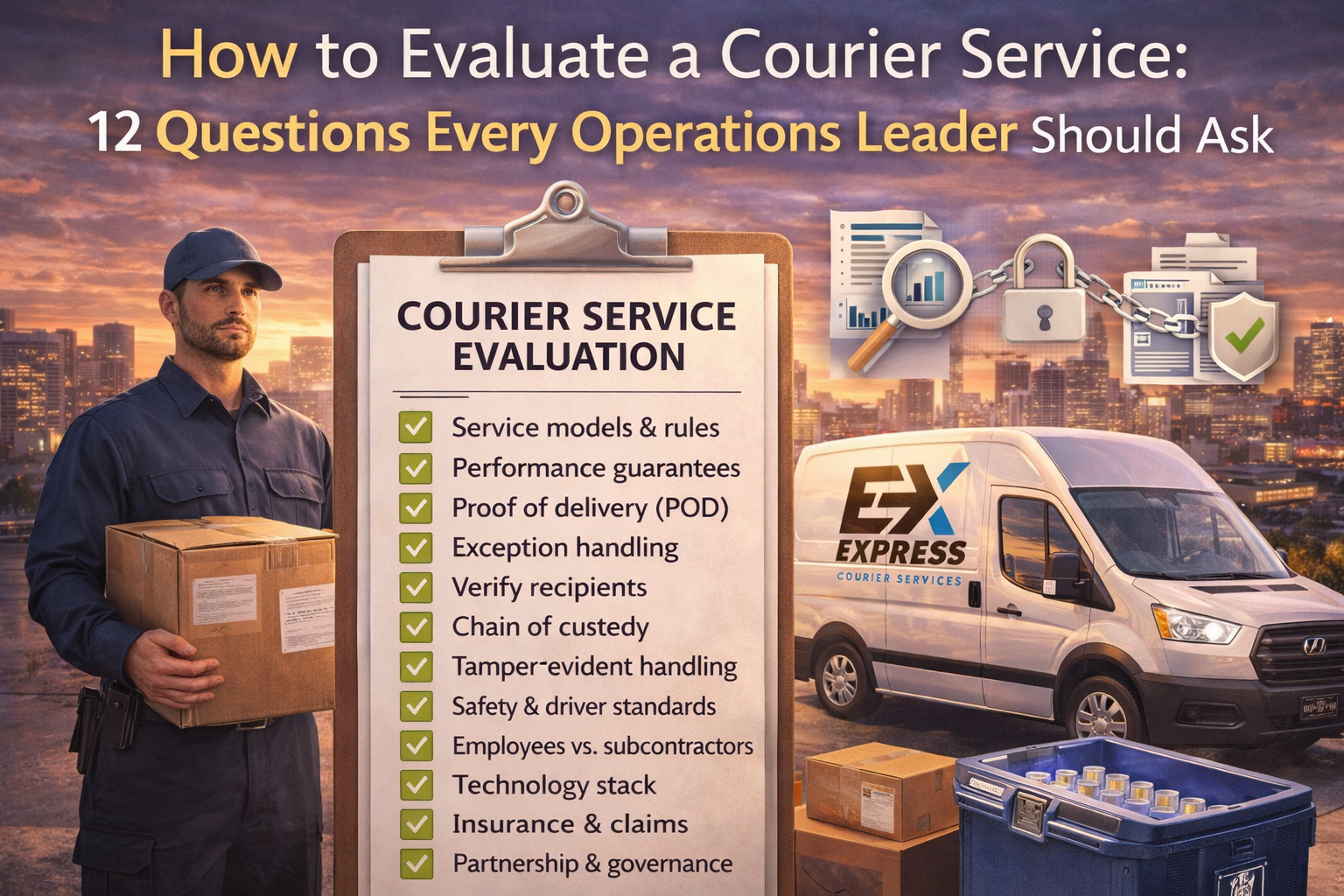
Most problems with a courier company do not appear on day one. They usually emerge as delivery volume increases, a shipment is disputed, a same-day delivery misses its service window, or a sensitive item is handed off incorrectly. That is why evaluating a business courier service should never be treated as a simple pricing exercise. Choosing the right courier provider is an operational decision that affects customer satisfaction, internal productivity, and long-term business performance.
The best delivery partner is one that can demonstrate measurable performance, document every handoff, and resolve delivery exceptions without forcing your staff to become a dispatch center. A professional commercial courier service should improve operational efficiency while reducing delivery risk across your organization.
Choosing the right courier service is one of the most important operational decisions a business can make. Whether you're evaluating same-day courier services, scheduled delivery providers, route-based logistics, or a long-term B2B courier service, the right partner should improve visibility, reduce operational risk, and become an extension of your workflow rather than another vendor to manage.
If you want to compare service models first (scheduled routes, on-demand, same-day, dedicated vehicle), start here.
If you want to confirm a partner’s visibility layer (real-time tracking, exception alerts, proof of delivery), start here.
1) What service model fits our workflow, and what are the rules?
Ask each courier provider to clearly separate deliveries into service tiers such as scheduled routes, on-demand delivery, same-day courier service, and urgent or STAT deliveries. A mature business courier service should be able to explain exactly which requests belong in each category and how those service levels affect pricing and performance.
2) What do you guarantee for pickup and delivery performance, and how do you measure it?
Do not accept "we're reliable" as a sufficient answer. A professional commercial courier service should support its claims with measurable KPIs including on-time pickup, on-time delivery, proof-of-delivery completion, and exception response times. Performance data separates experienced courier companies from providers that rely only on promises.
A useful perspective is that last-mile delivery is widely recognized as the most expensive and complex stage of shipping, so performance measurement matters.
3) What does proof of delivery include, and how quickly can we retrieve it?
Ask your courier provider exactly what proof of delivery includes. Modern courier technology should provide recipient verification, delivery timestamps, signatures when required, exception notes, and records that can easily be retrieved during audits or customer disputes.
4) How do you handle exceptions, and who owns escalation to closure?
Exception handling often separates an average delivery partner from an outstanding one. Ask every courier company to explain how failed deliveries, address issues, recipient unavailability, and service interruptions are escalated and documented.
5) How do you verify recipients and prevent unauthorized drop-offs?
Receiving rules vary widely: some sites accept mailroom deliveries, others require named recipients, and some have strict “no reception” policies. Ask how your courier ensures the correct person receives the item, especially for sensitive materials.
6) What is your chain-of-custody process for sensitive items?
Organizations moving checks, contracts, HR documents, legal filings, healthcare materials, prototypes, or sensitive equipment should expect their B2B courier service to maintain documented chain-of-custody procedures throughout every stage of transportation.
7) Do you support tamper-evident handling, and what is your seal protocol?
For cash-equivalent and sensitive items, ask if they support tamper-evident bags or seals, whether seal integrity is verified at pickup and delivery, and what happens if a seal appears compromised. This is a practical control that prevents silent mishandling.
8) What are your driver standards, training, and safety program?
Ask how drivers are screened and trained, and how often training is refreshed. Also ask about the safety program. Driving for work is a workplace safety issue, and OSHA provides employer guidance for motor vehicle safety programs.
9) Are drivers employees or contractors, and do you use subcontractors?
Subcontracting is not automatically bad, but hidden subcontracting is. Ask whether subcontractors are used, under what conditions, and whether subcontractors meet the same standards and documentation requirements. Require disclosure and controls.
10) What is your technology stack, and what happens if the tech fails?
Modern courier technology should do far more than provide basic tracking. Ask whether the provider supports:
GPS tracking
Delivery notifications
Proof of delivery
Customer portals
Dispatch dashboards
Historical delivery reports
Route optimization
Exception alerts
The stronger the technology platform, the easier it becomes to manage last-mile delivery while maintaining accountability across your organization.
11) What insurance do you carry, and how does claims handling work?
Ask for proof of insurance and coverage limits. Then ask for the claims process and typical resolution timelines. If they cannot explain claims handling clearly, you will feel it later when something goes wrong.
12) How will you implement and govern the partnership after we start?
Ask who owns onboarding, who your account manager is, how performance reviews are structured, and what the reporting cadence is. The strongest courier relationships include quarterly business reviews and continuous improvement, not “set it and forget it.”
A quick way to score courier vendors using these questions
If you want a simple scoring system:
Give each question a score from 1 to 5
Weight questions 3, 4, 6, and 12 higher if you move sensitive or time-critical items
Ask for evidence, not narrative: sample POD record, sample exception report, sample monthly KPI report
This forces operational clarity early and prevents the “great proposal, weak execution” trap.
Closing
Choosing the right courier company is about much more than transportation. The best business courier service becomes a strategic logistics partner, helping your organization improve delivery visibility, reduce operational risk, and build a more reliable last-mile delivery operation.
Whether your business needs same-day courier service, scheduled delivery routes, route optimization, or a complete B2B courier service, asking these twelve questions will help you identify providers that support long-term operational success rather than simply moving packages.
Explore our Courier Services, learn more about our Technology & Tracking, or Contact Us to discuss a delivery strategy tailored to your organization's needs.