Courier Planning for Biotech Teams Moving Samples, Kits, and Time-Sensitive Materials in Chula Vista
Learn how biotech teams in Chula Vista reduce delivery risk when moving samples, kits, and time-sensitive materials with tracking, chain of custody, and reliable courier planning.
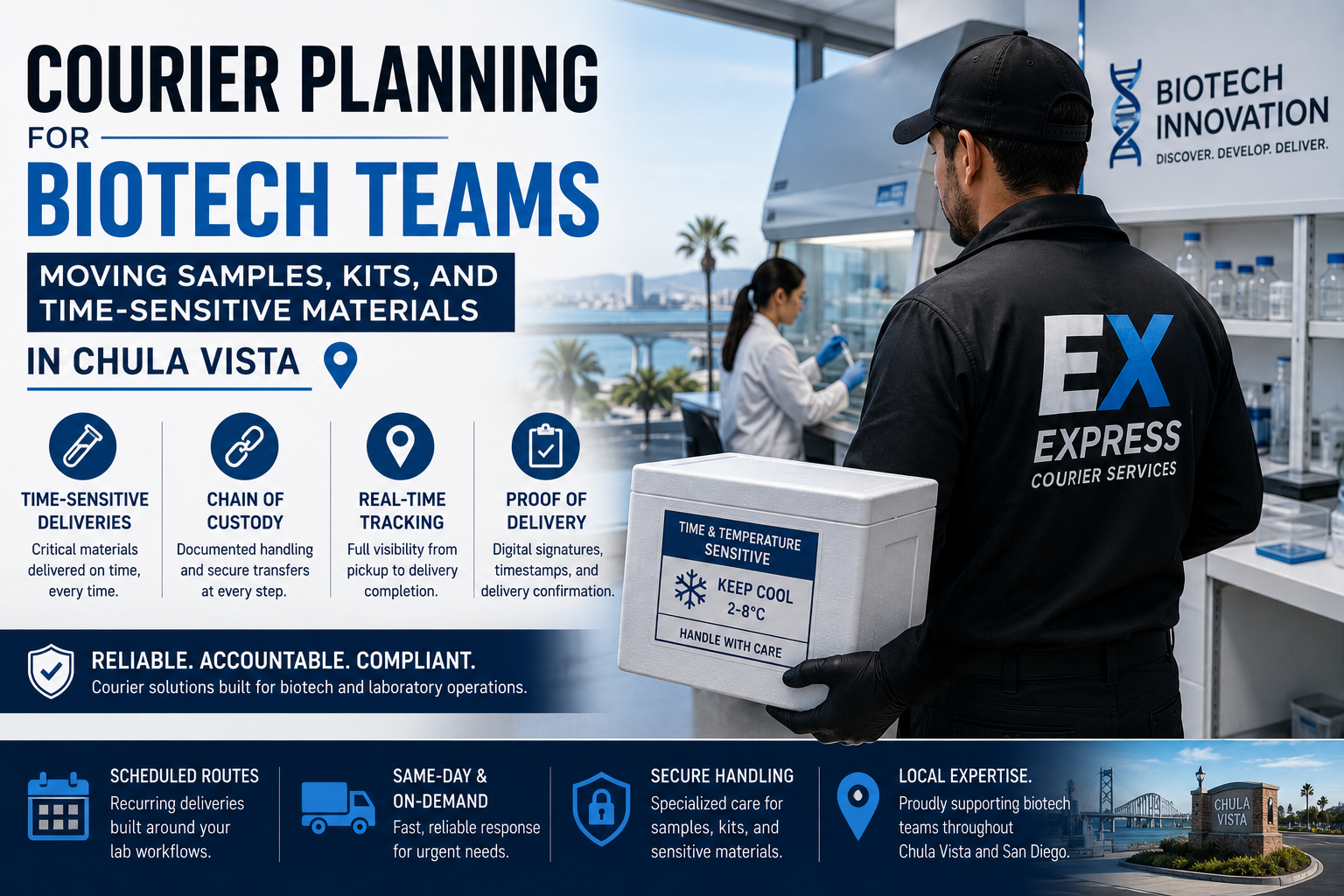
Biotech operations move fast. Research timelines, laboratory schedules, clinical activities, and product development milestones often depend on materials arriving exactly when and where they are needed. Whether transporting research samples, diagnostic kits, laboratory supplies, testing materials, or sensitive documentation, delays can create operational disruptions that extend far beyond transportation.
For biotech companies and laboratory teams in Chula Vista, courier planning is not simply a logistics exercise. It is a critical component of operational reliability.
The most successful biotech organizations treat transportation as part of their workflow rather than an afterthought. They build delivery systems designed around visibility, accountability, chain-of-custody procedures, and contingency planning.
If you want same-day, scheduled, and dedicated courier services, start here.
If you want real-time tracking, proof of delivery, and delivery visibility tools, start here.
If you want healthcare and laboratory-focused courier solutions, start here.
Why biotech deliveries require specialized planning
Many industries can tolerate minor delays.
Biotech operations often cannot.
Organizations routinely transport:
Research samples
Laboratory specimens
Diagnostic kits
Clinical trial materials
Testing supplies
Laboratory equipment
Quality assurance materials
Sensitive documentation
Each item may be tied to a schedule, research process, testing cycle, or operational deadline.
Questions biotech teams frequently ask include:
Where is the shipment?
Was delivery completed?
Who received it?
Was chain of custody maintained?
Was the delivery completed within the required timeline?
Can the transfer be documented?
Without those answers, teams lose visibility and confidence.
The true cost of a delayed sample
A delayed package is rarely just a delayed package.
Potential consequences include:
Missed testing windows
Laboratory rescheduling
Delayed research timelines
Increased operational costs
Staff downtime
Customer dissatisfaction
Regulatory concerns
In biotech environments, transportation delays can create downstream effects throughout the organization.
This is why delivery planning should begin before the shipment leaves the facility.
Why visibility matters throughout transport
Many organizations focus on pickup and delivery.
The greatest uncertainty usually occurs between those two points.
Modern courier visibility often includes:
Real-time tracking
Benefits include:
Live shipment status
Reduced follow-up calls
Better planning
Faster issue identification
Greater operational confidence
Delivery notifications
Benefits include:
Automatic status updates
Improved communication
Reduced uncertainty
Better scheduling coordination
Exception alerts
Benefits include:
Immediate awareness of delays
Faster corrective action
Reduced disruption
Visibility helps biotech teams manage risk before problems escalate.
Chain of custody is critical for sensitive materials
Many biotech shipments require documented handling procedures.
Examples include:
Research samples
Laboratory specimens
Clinical trial materials
Diagnostic testing materials
Proprietary research items
Chain-of-custody procedures help document:
Who handled the item
When transfers occurred
Delivery verification
Transfer locations
Any exceptions during movement
NIST defines chain of custody as documentation that records the handling and transfer of items to preserve traceability and integrity.
Proper documentation creates confidence throughout the process.
Proof of delivery reduces uncertainty
Biotech teams need more than a delivery confirmation.
They often require:
Recipient verification
Delivery timestamps
Signature confirmation
Delivery notes
Escalation records
Proof of delivery (POD) helps answer critical questions if issues arise later.
Modern POD systems may include:
Digital signatures
Time-stamped confirmations
Recipient identification
Delivery documentation
Exception reporting
Building a route strategy for recurring movements
Many biotech organizations have predictable transportation patterns.
Examples include:
Daily laboratory transfers
Scheduled specimen movement
Testing kit distribution
Inter-facility movement
Supply replenishment
These movements are often ideal for route-based courier programs.
Benefits include:
Predictable schedules
Reduced transportation costs
Consistent service levels
Better planning
Improved resource allocation
Organizations should identify recurring transportation needs and build routes around them whenever possible.
When on-demand courier service makes sense
Not every shipment belongs on a route.
Some deliveries require immediate movement.
Examples include:
Critical testing materials
Emergency laboratory requests
Time-sensitive research needs
Urgent specimen transfers
Last-minute supply shortages
On-demand courier services allow organizations to respond quickly when timing is critical.
The key is balancing route efficiency with urgent-response capability.
Creating contingency plans for delivery disruptions
Even the best delivery systems encounter challenges.
Examples include:
Traffic delays
Facility access issues
Recipient unavailable
Address discrepancies
Weather impacts
Unexpected operational disruptions
Organizations should establish clear contingency plans that define:
Escalation procedures
Alternate contacts
Delivery priorities
Communication expectations
Exception reporting standards
The goal is not eliminating every issue.
The goal is responding quickly when issues occur.
Questions biotech organizations should ask courier providers
Before selecting a courier partner, ask:
Do they support same-day service?
Can they provide route-based delivery programs?
Is real-time tracking available?
Is proof of delivery standard?
Can they support chain-of-custody procedures?
How are exceptions communicated?
Can they support recurring laboratory schedules?
Do they understand healthcare and biotech workflows?
Transportation providers should function as an extension of operational teams.
Why Chula Vista biotech organizations are investing in structured courier systems
The biotech, healthcare, and life sciences sectors continue to grow throughout Southern California.
Organizations increasingly need:
Faster transportation
Better visibility
Improved accountability
Reduced operational risk
Scalable logistics support
Structured courier programs provide a foundation for growth while reducing transportation uncertainty.
How Express Courier Services supports biotech and laboratory operations
Express Courier Services supports laboratories, biotech organizations, clinics, and healthcare providers with same-day delivery, scheduled routes, real-time tracking, proof of delivery, and chain-of-custody-focused workflows.
Closing
For biotech teams in Chula Vista, transportation is not simply about moving materials from one location to another.
It is about protecting research timelines, supporting laboratory operations, reducing risk, and maintaining confidence throughout the delivery process.
Organizations that combine visibility, chain-of-custody procedures, proof of delivery, route planning, and contingency strategies create delivery systems that support growth while reducing operational uncertainty.