
Reducing Delivery Risk for Clinics, Pharmacies, and Medical Offices Across California
Learn how California clinics, pharmacies, and medical offices reduce delivery risk with real-time tracking, proof of delivery, and secure courier systems.
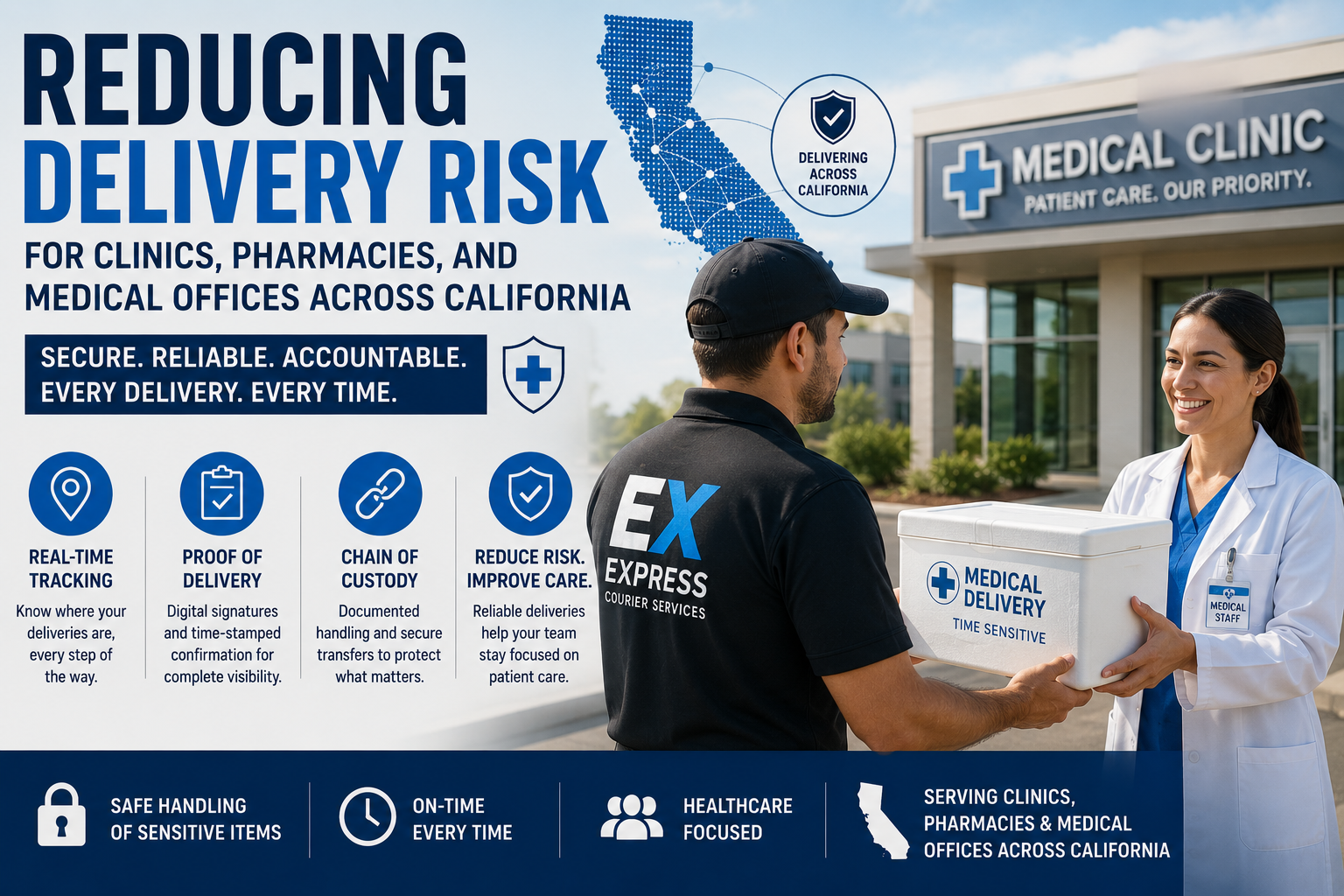
Healthcare delivery is different from ordinary transportation. A delayed retail package may create frustration. A delayed medical delivery can affect patient care, interrupt operations, create compliance concerns, and place staff in reactive mode. Across California, clinics, pharmacies, medical offices, and healthcare groups are increasingly focused on reducing delivery risk through structured courier systems rather than relying on improvised delivery processes.
Whether transporting prescriptions, specimens, medical records, imaging materials, or time-sensitive healthcare documentation, organizations are realizing that speed alone is not enough. Visibility, chain-of-custody procedures, proof of delivery, and proactive communication have become equally important.
This guide explains how healthcare organizations across California can reduce delivery risk while improving operational consistency.
If you want healthcare-focused courier solutions, start here.
If you want same-day, route-based, and scheduled courier services, start here.
If you want real-time tracking, proof of delivery, and visibility technology, start here.
Why healthcare deliveries carry more risk
Healthcare organizations move far more than packages.
Daily movement often includes:
Laboratory specimens
Prescription medications
Medical records
Imaging materials
Internal clinic transfers
Signature-required deliveries
Supplies and time-sensitive inventory
Patient-related documentation
Each item creates operational responsibility.
Questions healthcare teams frequently ask:
Where is the delivery now?
Who received it?
Was delivery completed on time?
Was a signature captured?
Were there exceptions?
Can we verify chain of custody?
Without answers, staff often spend time chasing information rather than focusing on patient care.
The hidden risks behind staff-run deliveries
Many organizations initially solve transportation needs internally.
Examples include:
Front office staff making deliveries
Medical assistants handling runs
Employees using personal vehicles
Informal “quick trips”
Department-specific transportation arrangements
Initially these systems seem flexible.
Eventually problems begin appearing:
Staff productivity loss
Interrupted workflows
Mileage reimbursement concerns
Delayed pickups
Increased stress
Inconsistent documentation
California employers should understand reimbursement obligations related to employee vehicle use under Labor Code 2802.
The IRS standard mileage rate is also commonly used as a benchmark for operational vehicle cost.
The cost is often larger than organizations initially realize.
Why visibility matters as much as speed
Many organizations focus entirely on delivery speed:
"Can it arrive today?"
A better question may be:
"Can we see what happened throughout delivery?"
Modern courier visibility often includes:
Real-time tracking
Benefits:
Live delivery status
Reduced follow-up calls
Better planning
Delivery transparency
Delivery notifications
Benefits:
Proactive updates
Reduced uncertainty
Faster issue identification
Exception alerts
Benefits:
Immediate awareness of delays
Faster resolution
Reduced operational disruption
Healthcare operations increasingly require visibility, not just transportation.
Proof of delivery reduces disputes and uncertainty
Healthcare deliveries often involve accountability requirements.
A delivery should not simply end with:
"Delivered."
Organizations frequently need documentation showing:
Recipient name
Delivery timestamp
Signature confirmation
Delivery notes
Exception details
Transfer verification
Proof of delivery (POD) creates operational confidence and reduces uncertainty.
Modern POD systems often include:
Digital signatures
Time-stamped records
Delivery notes
Photo documentation where appropriate
Recipient verification
Chain-of-custody procedures reduce risk
Healthcare organizations frequently move sensitive materials.
Examples:
Specimens
Controlled materials
Patient records
Prescription movement
Diagnostic materials
For these movements, chain of custody becomes important.
Chain-of-custody procedures document:
Who handled an item
When custody changed
Transfer times
Delivery confirmation
Any exceptions
NIST defines chain of custody as maintaining documented handling and transfer records that preserve traceability and integrity.
Healthcare privacy and compliance considerations
Healthcare deliveries also involve privacy responsibilities.
Organizations managing protected information should understand HIPAA guidance concerning protected health information and privacy procedures.
Delivery systems should support:
Controlled handling procedures
Recipient verification
Confidentiality standards
Delivery documentation
Escalation procedures
The goal is reducing risk throughout the movement process.
Why California healthcare organizations are moving toward structured courier programs
Healthcare groups increasingly operate:
Multiple clinics
Satellite offices
Centralized laboratories
Distribution locations
Shared administrative centers
These organizations frequently have repeatable delivery patterns:
Morning specimen transfers
Scheduled pharmacy movement
Inter-office document transfers
Urgent same-day runs
Inventory movement
Structured courier systems create:
Predictable schedules
Better reporting
Reduced interruptions
Lower operational risk
Centralized visibility
A practical framework for reducing healthcare delivery risk
Step 1: Identify recurring movement patterns
Track:
What moves
Frequency
Locations
Delivery urgency
Documentation requirements
Step 2: Build route programs for predictable movement
Examples:
Daily specimen loops
Scheduled pharmacy deliveries
Clinic-to-clinic transfers
Scheduled routes create consistency and reduce cost.
Step 3: Reserve on-demand delivery for true urgency
Use immediate dispatch for:
Critical medical needs
Time-sensitive transfers
Last-minute requests
Urgent deliveries
This prevents overuse of expensive rush movement.
Step 4: Standardize proof of delivery procedures
Every healthcare delivery should define:
Signature requirements
Recipient requirements
Escalation contacts
Delivery instructions
Consistency reduces disputes.
Questions healthcare organizations should ask courier providers
Before selecting a provider ask:
Do they support same-day and route services?
Can they provide real-time tracking?
Is proof of delivery included?
How are exceptions handled?
Can they support chain-of-custody procedures?
Can they support recurring routes?
Can they handle healthcare workflows?
Courier systems should become operational infrastructure rather than just transportation vendors.
How Express Courier Services supports healthcare organizations across California
Express Courier Services supports clinics, pharmacies, and medical offices with healthcare-focused courier solutions backed by tracking, proof of delivery, route services, and exception escalation.
Closing
Reducing delivery risk in healthcare requires more than moving items quickly.
Organizations across California increasingly recognize that reliable healthcare transportation depends on visibility, accountability, chain-of-custody procedures, and documentation.
The organizations that build structured delivery systems reduce disruption, protect staff time, and create more reliable patient support operations.