
Route-Based Courier Services vs. Random Deliveries: A Smarter Logistics Strategy for Stockton Businesses
Stockton delivery strategy guide: compare route-based logistics vs random deliveries to cut costs, improve timing, add tracking, and reduce exceptions.
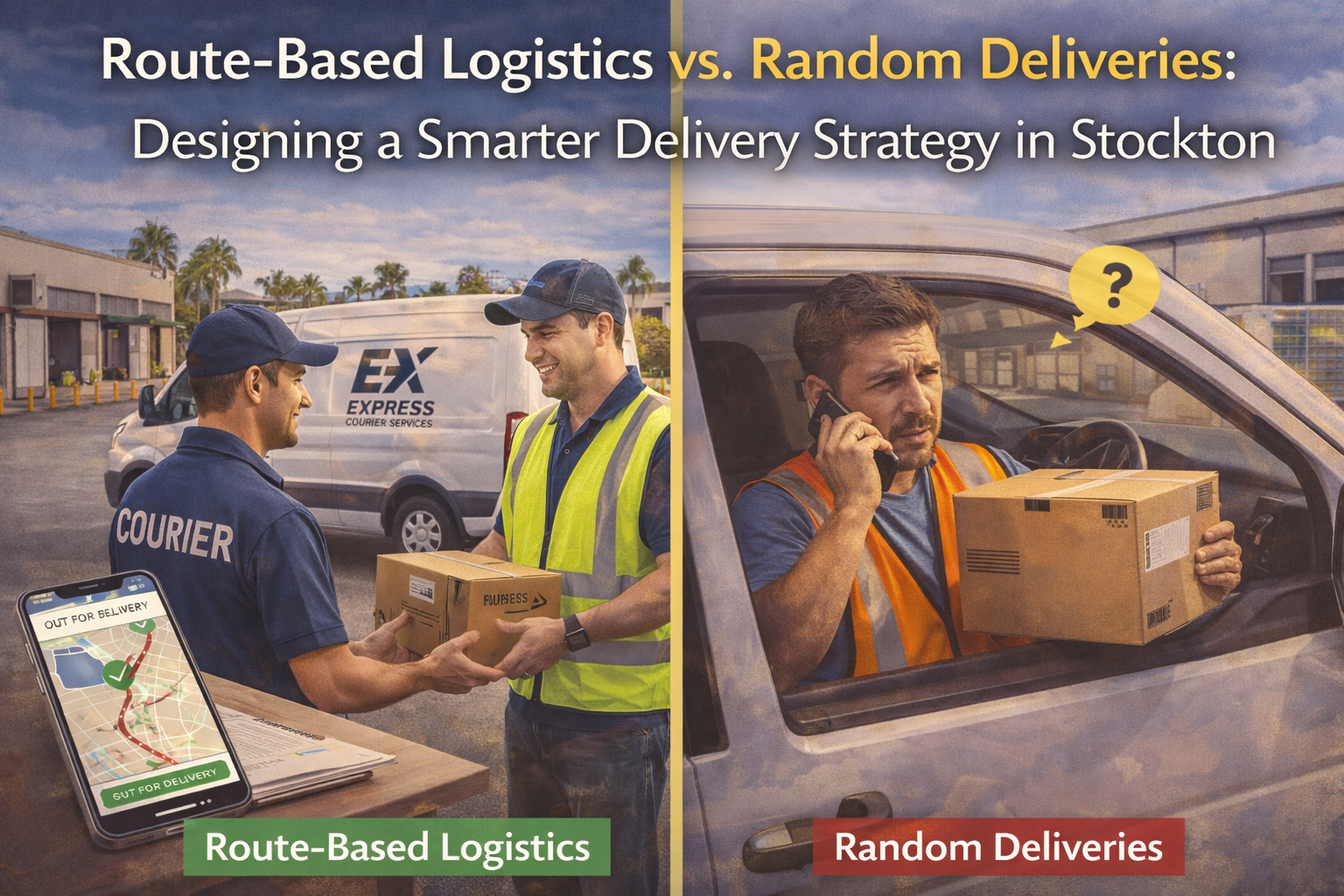
Stockton sits at the center of one of California’s most active logistics corridors. Warehouses, distribution centers, manufacturers, public agencies, healthcare networks, and multi-site businesses all move items daily across Stockton, the Central Valley, and the Bay Area edge. The question is not whether deliveries happen. The question is whether your deliveries run like a system or like a series of interruptions.
Most organizations start with “random deliveries.” Someone requests a pickup, someone finds a driver, and the run happens when it happens. It works at low volume. Then the business grows, delivery volume increases, and the same pattern becomes costly: missed windows, wasted labor, inconsistent handoffs, and constant “where is it?” coordination.
Route-based courier services are the opposite approach. Instead of reacting to random requests one at a time, a structured logistics strategy designs delivery movement into predictable loops with scheduled courier routes, defined pickup windows, repeat stops, and performance reporting. For most Stockton operations, the smartest delivery management strategy is a mix: scheduled delivery service for predictable baseline volume and on-demand courier support for urgent exceptions.
Stockton's economy depends on logistics. Manufacturers, distributors, healthcare providers, government agencies, retailers, professional service firms, and industrial businesses all rely on dependable movement between warehouses, offices, suppliers, customers, and distribution centers. As delivery volume increases, organizations often reach a point where informal transportation methods become operational bottlenecks rather than convenient solutions.
If you want a clear overview of service models including scheduled routes, on-demand, and same-day, start here.
If you want visibility tools like tracking, proof of delivery, and exception alerts, start here.
What “random deliveries” look like in real operations
Random deliveries are not always chaotic. They just lack structure. Common signs include:
Deliveries are requested through calls, texts, or emails with inconsistent details
A delivery happens when a staff member is available, not when the workflow needs it
Drivers take one trip at a time, even when multiple stops could be combined
The receiving side is surprised by arrivals and not ready
Proof of delivery is inconsistent, so disputes take time to resolve
Operations leaders spend time coordinating instead of improving systems
In Stockton, where many operations are spread across industrial parks and multi-site networks, that coordination tax adds up quickly.
What Route-Based Courier Services Actually Mean
Route-based courier services are designed movement. Instead of reacting to requests one by one, your business creates scheduled courier routes that match how your operation actually behaves. This turns delivery management into a planned system instead of a daily scramble.
A route-based delivery program includes:
Scheduled courier routes, daily, weekly, or multiple times per day
Defined stops, pickup windows, and receiving instructions
Service rules for what moves on the route versus what becomes on-demand
Real-time visibility, tracking, and proof of delivery
Reporting that helps improve delivery management over time
This approach is often called a “milk run” in logistics, where a vehicle makes planned stops on a loop rather than running random point-to-point trips.
If you want a practical example of how route programs modernize inter-office delivery workflows, this route-based government logistics article is a useful reference even outside of government.
Which Businesses Benefit Most from Route-Based Courier Services?
Although almost any organization can benefit from scheduled deliveries, some industries see an especially strong return from structured courier programs.
Examples include:
Manufacturing facilities moving parts and production materials
Healthcare providers transporting specimens and supplies
Retail chains balancing inventory between stores
Government agencies moving inter-office documents
Financial institutions transporting confidential documents
Professional service firms exchanging contracts and records
Distribution centers coordinating warehouse transfers
Construction companies moving plans and permits
These organizations often have recurring transportation needs that fit naturally into scheduled courier routes while reserving on-demand delivery for true emergencies.
Why route-based strategy wins in Stockton
1) Less wasted time and less lost productivity
Random deliveries pull people away from core work. A scheduled delivery service reduces the “interruption tax” because everyone knows when pickups happen, when deliveries arrive, and which items belong on the route.
2) Better first-attempt success
Many delivery failures happen at the handoff: the receiving point is closed, the recipient is not available, or the instructions are unclear. Routes create predictability and allow receiving teams to prepare.
Urban logistics research highlights how last-mile complexity increases cost and delay, and how operational design matters. External link: https://reports.weforum.org/docs/WEF_Transforming_Urban_Logistics_2024.pdf
3) Lower cost per stop
Routes consolidate stops. Instead of paying for separate ad-hoc trips, you pay for planned movement. That reduces cost per stop over time.
4) More accountability
When deliveries are scheduled, tracked, and logged, disputes are easier to resolve. Proof of delivery becomes standard rather than optional.
Modern courier systems use real-time tracking and proof of delivery documentation to reduce disputes and support reporting.
For a deeper explanation of why tracking and POD are now baseline expectations, this is a useful reference.
The best strategy is usually hybrid: routes plus on-demand
A common fear is that routes reduce flexibility. That only happens if you design routes without an exception lane.
The smarter model is a hybrid logistics strategy:
Route-based courier services for predictable baseline movement
On-demand courier service for urgent exceptions and true surprises
Scheduled delivery service for recurring warehouse, office, healthcare, retail, and government stops
Same-day courier support for time-sensitive deliveries that cannot wait for the next route
This is how mature delivery programs protect both budget and responsiveness.
If you want service tiers that support this hybrid model, start here. Internal link: https://www.expcourierservices.com/courier-services
Stockton use cases where routes outperform random deliveries
Warehousing and distribution
Daily warehouse delivery between warehouses, overflow storage, fulfillment areas, and processing sites is often ideal for scheduled courier routes. A structured warehouse courier service reduces one-off trips, improves timing, and gives operations teams better visibility into every transfer.
Manufacturing and parts movement
Manufacturing and industrial teams benefit from scheduled courier routes for parts runs, supplier pickups, QA sample movement, plant-to-plant transfers, and documentation delivery. A reliable B2B courier service helps reduce production delays and keeps materials moving between facilities.
Healthcare and pharmacy networks
Routine transfers work well on routes, while STAT needs belong in the on-demand lane.
Government and public agency workflows
Inter-office mail, records transfer, and multi-facility deliveries are classic route-based problems.
Retail and multi-site operations
Store-to-store transfers, returns consolidation, and supply movement often become routable quickly.
How to design a smarter delivery strategy in Stockton
Step 1: Map your delivery week
List all pickups and drop-offs from the last 2–4 weeks. Sort them into:
repeatable stops
repeatable time windows
true one-offs
urgent exceptions
Most organizations are surprised by how repeatable their “random” deliveries actually are.
Step 2: Design two routes to start
Most Stockton operations begin with:
a morning route loop
an afternoon route loop
Then they adjust frequency based on volume and receiving windows.
Step 3: Define your exception lane
Decide what qualifies for on-demand:
deadline-driven runs
production line-down risk
same-day customer commitments
medical or regulated urgency
critical repairs or replacements
Everything else stays on the route.
Step 4: Standardize visibility requirements
If you want fewer internal calls and fewer disputes, make visibility standard:
tracking status events
exception alerts and notes
Step 5: Measure performance like a real program
Track:
on-time pickup and delivery
first-attempt success rate
exception rate
average exception resolution time
proof-of-delivery completion
Reporting is where delivery programs become improvable instead of mysterious.
Common mistakes when switching to routes
Mistake 1: Building routes around geography, not workflow
Routes should match operational patterns, not just map efficiency. If a receiving point only accepts deliveries 10–11 AM, your route must respect that.
Mistake 2: Treating everything as urgent
If everything is on-demand, nothing is. Protect on-demand service for true urgency.
Mistake 3: No standardized delivery notes
Even on routes, you need consistent instructions: suite numbers, contact names, receiving rules, and escalation contacts.
Mistake 4: No proof of delivery standards
If proof of delivery is inconsistent, disputes return.
Build a Smarter Courier Strategy for Your Stockton Operation
Whether your organization needs route-based courier services, scheduled courier routes, same-day delivery, warehouse delivery, inter-office movement, healthcare logistics, retail transfers, or B2B courier service, Express Courier Services can help design a delivery management program that fits your workflow.
Our courier solutions include scheduled delivery service, on-demand courier support, real-time tracking, proof of delivery, exception alerts, and route planning for businesses that need more accountability than random deliveries can provide.
Closing
Random deliveries feel flexible, but they create hidden costs: lost labor, missed windows, inconsistent documentation, and constant coordination. Route-based courier services turn delivery into a predictable system with lower cost per stop, better first-attempt success, standardized proof of delivery, and a scalable logistics strategy for growing Stockton businesses.
In Stockton, where logistics volume and multi-site movement are common, the smartest strategy is usually hybrid: routes for the baseline and on-demand for urgent exceptions.