
Secure Courier Options for Serving Legal Notices and Time-Sensitive Documents in Modesto
Learn how Modesto law firms use secure couriers for serving legal notices, time-sensitive documents, and court filings with tracking, proof of delivery, and reliability.
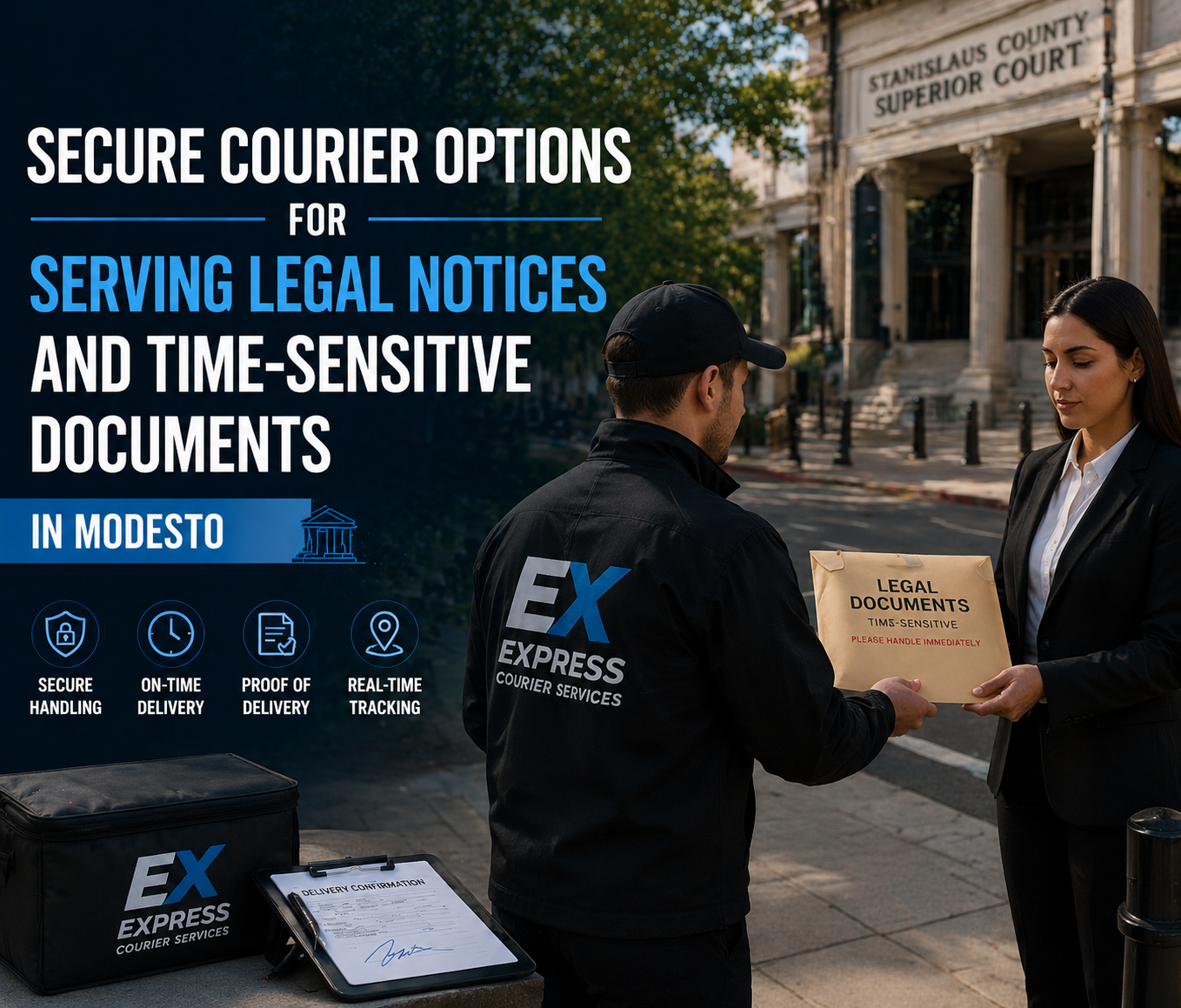
In legal work, timing is everything. A missed filing window, delayed notice, or undocumented handoff can create unnecessary disputes, procedural issues, and stress for law offices already managing strict timelines. In Modesto, where attorneys, process servers, businesses, and legal support teams frequently move documents between courts, offices, clients, and third parties, secure courier services have become an essential operational tool rather than a convenience.
Modern legal deliveries are no longer just about getting documents from Point A to Point B. Clients expect visibility, proof of delivery, chain-of-custody discipline, and fast turnaround for time-sensitive legal materials.
This guide explains how law firms and legal support teams in Modesto can use secure courier options to handle legal notices, filings, settlement packets, records, and other sensitive deliveries safely and efficiently.
If you want courier services designed for legal workflows and sensitive document handling, start here.
If you want same-day, on-demand, and scheduled courier service options, start here.
If you want real-time tracking, proof of delivery, and exception alerts, start here.
Why legal deliveries in Modesto require more than standard shipping
Legal documents are different from standard business deliveries because the consequences of delay or mishandling are often much higher.
Examples include:
Court filings with strict deadlines
Legal notices that must arrive within required windows
Settlement agreements and checks
Evidence packets and exhibits
Confidential records
Signature-required client packets
Urgent inter-office legal transfers
A delayed package in retail may create frustration. A delayed legal document can create procedural risk.
That’s why many Modesto legal offices are moving away from:
staff “runner” trips
standard mail for urgent items
undocumented handoffs
generic parcel services for highly time-sensitive work
Instead, they are using dedicated courier workflows with visibility and proof-of-delivery standards.
The difference between standard parcel delivery and legal courier service
A legal courier workflow focuses on:
speed
accountability
documented handoffs
escalation when something blocks delivery
visibility throughout the delivery process
Standard parcel services are optimized for high-volume package movement. Legal courier services are optimized for time-sensitive and sensitive-document movement.
What legal clients usually expect from a courier
Modern legal clients increasingly expect:
Same-day or scheduled rush delivery
Named-recipient delivery
Real-time tracking
Time-stamped proof of delivery
Signature confirmation
Immediate escalation if delivery fails
Secure handling procedures
Courier systems that provide tracking, POD, and exception alerts help legal offices reduce disputes and improve operational visibility.
For a broader explanation of why tracking and POD are now baseline expectations, see this.
Secure courier options law offices in Modesto should consider
Different legal deliveries require different service models.
1) Same-day on-demand courier service
Best for:
Urgent filings
Last-minute legal notices
Time-sensitive signatures
Emergency document exchanges
Rush court-related deliveries
With on-demand courier service, the delivery is dispatched immediately instead of waiting for a route cycle.
Benefits include:
Faster pickup response
Direct delivery
Reduced handoff risk
Better timeline control
2) Scheduled route service for recurring legal movement
Many law firms have repeatable delivery patterns:
Daily courthouse runs
Inter-office document movement
Records retrieval
Scheduled client packet deliveries
Regular deliveries to process servers or legal partners
A scheduled route program reduces cost per stop and creates predictable delivery windows.
Benefits include:
Lower operational disruption
Predictable pickup and delivery timing
Reduced need for internal staff driving
Better long-term workflow planning
3) Dedicated courier service for high-volume firms
Larger firms or litigation-heavy operations may benefit from dedicated courier support.
This model works best for:
High daily document volume
Multiple office locations
Ongoing litigation support
Complex filing schedules
Confidential materials requiring tighter control
Dedicated courier programs create consistency because the driver understands the firm’s workflow and procedures.
Why proof of delivery matters for legal documents
A legal delivery should never end with “it says delivered.”
Legal offices need documentation that answers:
Who received it?
When was it delivered?
Was a signature captured?
Were there any delivery exceptions?
Was the delivery left with reception or directly with the recipient?
Proof of delivery (POD) becomes critical when:
deadlines are disputed
filings are questioned
notices are challenged
settlement materials are delayed
chain-of-custody concerns arise
A modern POD process may include:
Signature capture
Timestamped delivery records
Recipient confirmation
Delivery notes
Photo confirmation where appropriate
Chain of custody and sensitive legal materials
Some legal deliveries require stronger documentation standards than normal business deliveries.
Examples include:
Sealed records
Evidence packets
Original signed agreements
Confidential medical or financial records
High-value legal exhibits
A chain-of-custody mindset focuses on documenting:
who handled the item
when transfers occurred
where custody changed
any exceptions during movement
NIST defines chain of custody as documentation that records handling and transfer activity to preserve traceability and integrity.
Why Modesto law offices are reducing staff-run deliveries
Many legal offices originally rely on internal staff for document movement:
paralegals
office assistants
intake coordinators
legal secretaries
The problem is that “quick runs” rarely stay quick.
Staff deliveries create:
workflow interruptions
stress around deadlines
parking and travel delays
mileage reimbursement issues
reduced productivity
In California, employers should understand reimbursement obligations for work-related vehicle expenses under Labor Code 2802.
Additionally, the IRS standard mileage rate is commonly used as a practical benchmark for driving cost. The IRS set the 2026 business mileage rate at 72.5 cents per mile.
Courier programs help legal staff focus on legal work instead of driving work.
What law firms should require from a Modesto courier provider
Before choosing a courier provider, ask:
Do they support same-day and scheduled service?
Can they provide real-time tracking?
Is proof of delivery standard?
Do they escalate failed delivery attempts immediately?
Can they support named-recipient delivery?
Do they understand legal deadlines?
Can they handle confidential materials professionally?
Do they provide clear communication during exceptions?
A courier service should feel like an extension of your legal workflow, not a random third party.
How to build a secure legal delivery workflow
Step 1: Separate routine runs from urgent exceptions
Use routes for predictable daily movement and on-demand service for true urgency.
Step 2: Standardize delivery instructions
Every request should include:
recipient name
suite or department
signature requirements
“no mailroom” instructions if needed
escalation contact
return instructions for conformed copies or retrieved records
Step 3: Require proof of delivery standards
POD should be part of the baseline process, not an optional add-on.
Step 4: Define exception handling procedures
The courier should escalate immediately if:
access is blocked
recipient unavailable
instructions unclear
deadlines at risk
How Express Courier Services supports legal deliveries in Modesto
Express Courier Services supports law firms and legal support teams with same-day, scheduled, and secure document delivery services backed by real-time tracking, proof of delivery, and exception escalation.
Closing
Legal document delivery in Modesto requires more than speed. It requires accountability, visibility, and secure handling standards that protect deadlines and reduce disputes.
Whether your office handles court filings, settlement materials, records movement, or time-sensitive legal notices, a structured courier program with tracking, proof of delivery, and documented handoffs can reduce operational stress while helping your team stay focused on legal work instead of logistics.