The Business Delivery Gap: Why Every Industry Needs a More Accountable Courier System in Moreno Valley
Discover why Moreno Valley businesses need more accountable courier systems with real-time tracking, proof of delivery, and visibility across every industry.
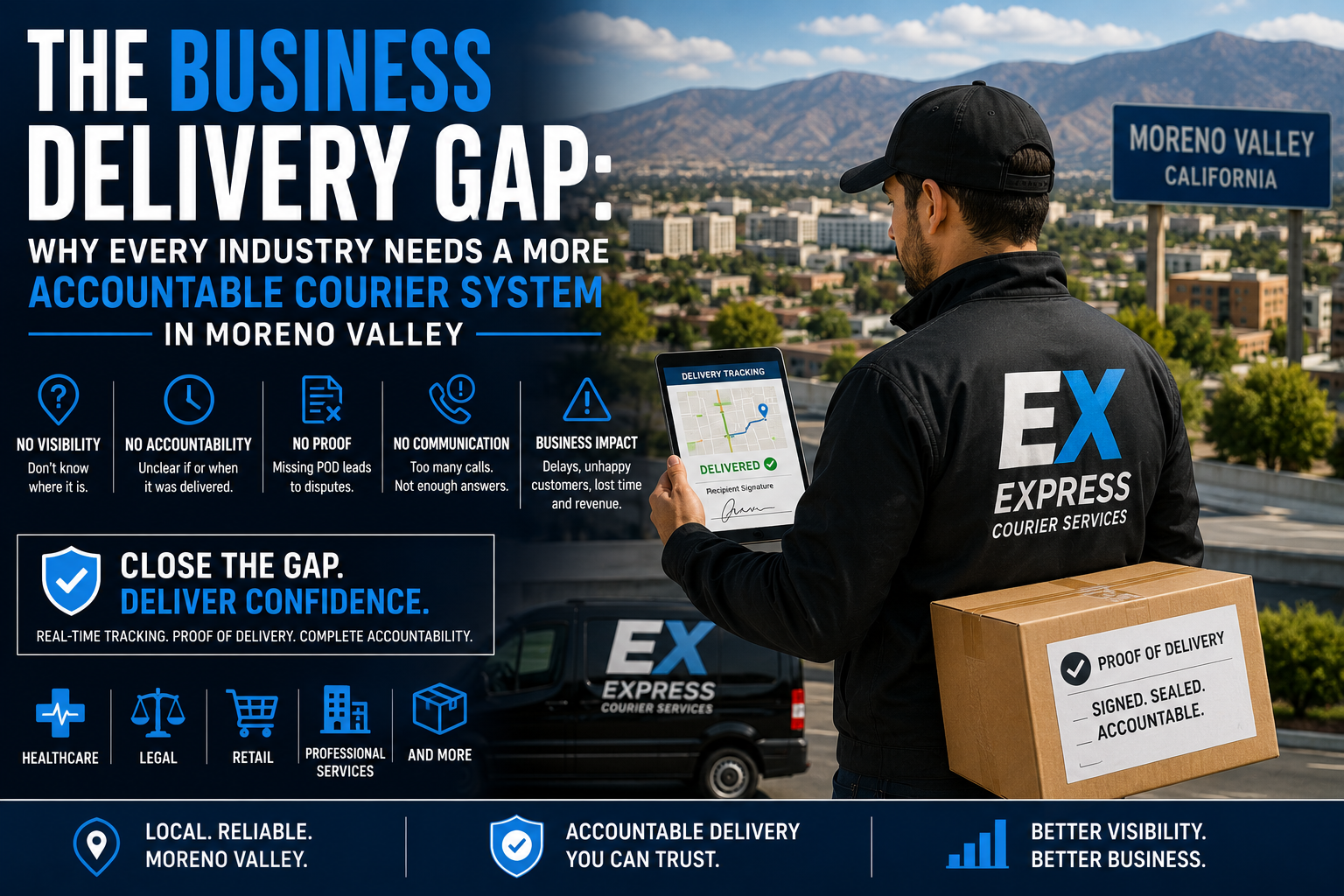
Many businesses believe they have a delivery process until a problem happens. A package goes missing. A customer asks where their shipment is. A legal document arrives late. A clinic cannot confirm when records were delivered. A retail store is waiting for inventory that should have arrived hours ago.
That is when organizations discover the delivery gap.
The delivery gap is the difference between assuming something was delivered and actually knowing what happened. In Moreno Valley, businesses across healthcare, legal, retail, professional services, and logistics are increasingly realizing that delivery speed alone is no longer enough. Accountability has become just as important as transportation.
Modern organizations need courier systems that provide visibility, proof, escalation, and real-time communication, not just drivers.
If you want same-day, route-based, and dedicated courier options, start here.
If you want real-time tracking, proof of delivery, and visibility technology, start here.
If you want industry-specific delivery solutions, start here.
What is the business delivery gap?
The delivery gap exists when organizations lack visibility between pickup and completion.
The process often looks like this:
Someone requests a delivery
Someone dispatches a driver
The item leaves
People wait
Questions begin
Multiple phone calls happen
Teams try reconstructing events
Eventually someone says:
"I think it got delivered."
That uncertainty creates operational friction.
Businesses need systems that answer:
Where is it now?
Who received it?
Was proof captured?
Was there an exception?
What happened during transit?
Did the recipient sign?
Without those answers, organizations create internal work trying to chase information.
Why the accountability problem affects every industry
Most organizations think delivery problems are unique to their industry.
Healthcare believes healthcare is different.
Law firms think legal delivery is unique.
Retail assumes inventory movement has separate challenges.
The reality is that every industry struggles with the same underlying issues:
Lack of visibility
Poor communication
Delivery disputes
Internal coordination costs
Staff interruptions
Missing documentation
The industries may differ.
The accountability problems often do not.
Healthcare organizations need documented movement
Healthcare operations routinely move:
Specimens
Medical records
Prescription materials
Internal clinic transfers
Time-sensitive documentation
Healthcare teams often require:
Delivery verification
Chain-of-custody procedures
Recipient confirmation
Escalation for delays
Real-time visibility
Organizations managing protected information should understand privacy and documentation requirements under HIPAA guidance.
Without accountability systems, staff often spend time trying to verify movement manually.
Legal teams depend on documentation
Law firms and legal support operations face delivery pressure daily.
Examples include:
Court filings
Legal notices
Settlement materials
Records requests
Signature-required packets
Time-sensitive client materials
Legal teams frequently rely on:
staff driving
rush trips
ad hoc solutions
informal updates
Problems appear quickly:
missed deadlines
no proof of delivery
unclear recipient confirmation
internal stress
Legal courier workflows increasingly depend on tracking and documentation.
Retail organizations experience visibility problems differently
Retail businesses often struggle with:
Store inventory transfers
Same-day customer deliveries
Replacement shipments
Rush inventory movement
Inter-store balancing
The challenge usually starts with one question:
"Where is the shipment?"
Retail customers increasingly expect delivery transparency.
Organizations with poor visibility often experience:
customer service overload
delivery disputes
refund requests
inventory confusion
increased labor costs
For broader context, supply chain and urban logistics research continues to emphasize visibility as a key performance driver.
Why staff-driven delivery systems stop scaling
Many businesses begin with internal delivery methods.
Examples:
office staff runs
employee vehicle use
occasional trips
improvised processes
Initially this seems inexpensive.
Eventually organizations discover hidden costs:
employee productivity loss
scheduling disruptions
mileage reimbursement
parking delays
stress
interrupted workflows
California employers should understand reimbursement obligations for work-related driving under Labor Code 2802.
The IRS also publishes standard mileage guidance often used as a benchmark for vehicle operating cost.
The visible cost is driving.
The hidden cost is operational disruption.
What an accountable courier system actually includes
An accountable courier system is more than transportation.
Modern systems often include:
Real-time tracking
Businesses want live visibility from pickup through completion.
Benefits:
fewer status calls
delivery visibility
reduced uncertainty
proactive updates
Proof of delivery
Proof of delivery answers:
who received it
when delivery occurred
delivery notes
signatures
delivery confirmation
Strong POD processes reduce disputes.
Exception management
Delivery systems eventually face:
traffic delays
address issues
recipient unavailable
access restrictions
Modern courier programs escalate problems immediately rather than allowing delays to remain invisible.
Structured communication
Organizations increasingly want:
automatic status updates
delivery notifications
centralized reporting
standardized communication
Why Moreno Valley businesses are moving toward centralized courier systems
Moreno Valley continues to grow across healthcare, logistics, retail, and professional services.
Many organizations now operate:
multiple locations
distributed staff
recurring delivery patterns
same-day requirements
inter-office movement
Centralized courier programs allow organizations to:
standardize reporting
create delivery consistency
reduce staff interruptions
improve accountability
create scalable workflows
Questions organizations should ask when evaluating courier providers
Before selecting a courier partner ask:
Do they provide real-time tracking?
Is proof of delivery standard?
Can they support same-day and route services?
How do they handle exceptions?
Do they provide centralized reporting?
Can they support multiple departments?
Do they understand industry-specific workflows?
Courier systems should become operational infrastructure, not just transportation vendors.
How Express Courier Services supports accountable delivery programs in Moreno Valley
Express Courier Services supports organizations with same-day delivery, route services, proof of delivery, real-time tracking, and industry-specific courier workflows.
Courier services overview
Tracking and POD technology
Industry courier solutions
Contact us
Closing
The biggest delivery problem businesses face often is not speed.
It is uncertainty.
Healthcare organizations, legal offices, retailers, and professional service teams all need systems that provide visibility and accountability throughout the delivery process.
In Moreno Valley, businesses increasingly recognize that the real solution is not simply getting deliveries completed. It is knowing exactly what happened from pickup to proof of delivery.