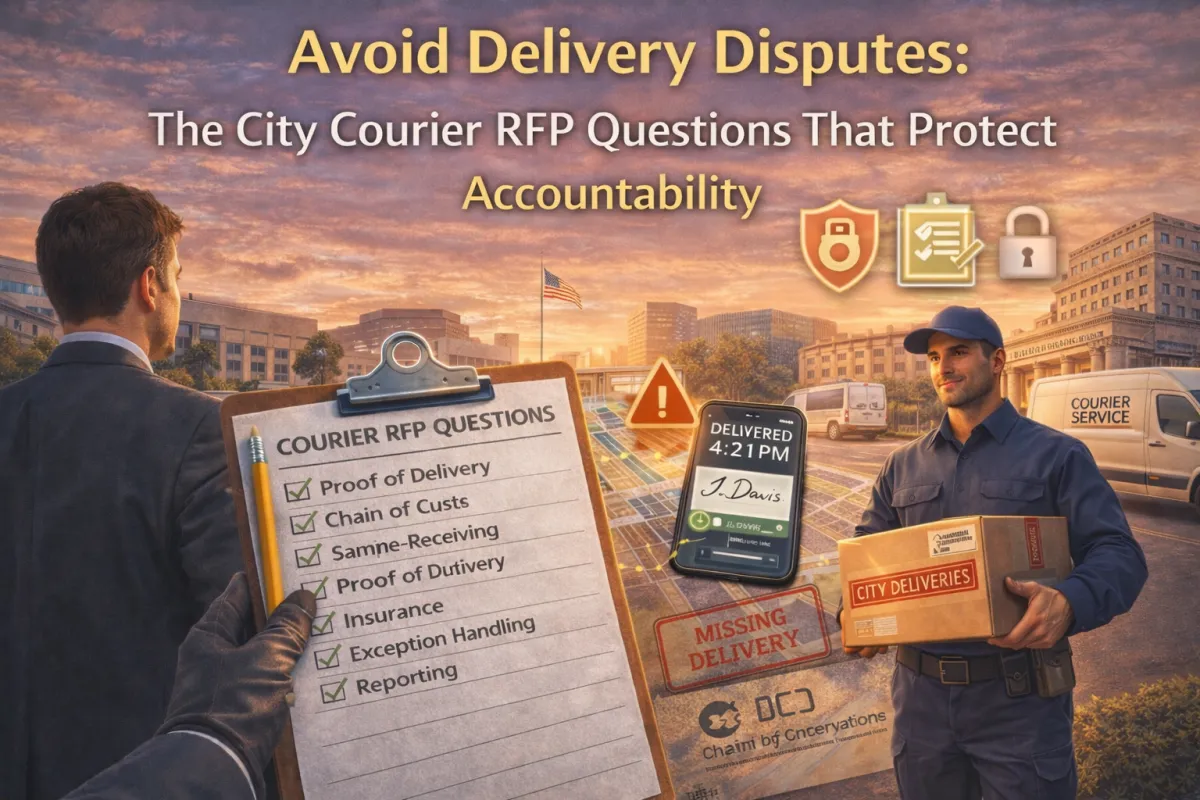
Avoid Delivery Disputes: The City Courier RFP Questions That Protect Accountability
City courier contracts can look simple on paper. Pickups, drop-offs, and a price per stop. The real risk shows up later, when a time-sensitive packet goes to the wrong building, a sealed document is left with an unauthorized receiver, a driver cannot access a facility and nobody is notified until the deadline is missed, or a delivery is disputed and there is no proof of delivery record to resolve it quickly.
A strong RFP prevents those failures by forcing vendors to explain how they actually operate, not just what they promise. It also helps procurement teams evaluate more than price. In federal procurement language, “best value” is defined as the outcome that provides the greatest overall benefit in response to the requirement, which supports evaluating quality and risk alongside cost.
If your city wants an example of how courier programs are structured for public-sector workflows like inter-office routes, records movement, and controlled handoffs, review this government agency courier overview.
Start with scope clarity so pricing is comparable
Before you ask vendor questions, define what you are actually buying. Most city courier needs fall into two buckets, and mixing them in one vague scope leads to messy bids and change orders later.
If your need is predictable movement between known city facilities, define it as route-based service with scheduled pickup windows and recurring stops.
If your need includes deadline-driven or unpredictable requests, define it as on-demand service with response-time expectations and clear priority rules.
You will get better proposals when vendors can price routes and on-demand separately and explain what service levels they can truly meet.
The RFP questions that actually reveal courier capability
1) “How will you classify deliveries and prioritize work when demand spikes?”
Ask vendors to explain their priority system in plain language and how they prevent urgent requests from being delayed behind routine stops. Your RFP should require written service tiers such as scheduled routes, standard on-demand, and urgent or STAT, with examples of what qualifies for each tier.
2) “What service levels do you commit to, and how do you measure them?”
Require specific metrics that can be audited, not vague promises. The best city courier programs track on-time pickup, on-time delivery, average exception resolution time, proof-of-delivery completion rate, and missed-scan rate. Your RFP should require monthly reporting and a quarterly performance review with root-cause notes and corrective actions.
3) “How do you handle facility access restrictions and secure receiving?”
Cities have facilities with security desks, badge access, receiving windows, and restricted areas. Ask vendors to provide a written protocol for denied entry, after-hours access, and situations where the receiving point will not accept a delivery. Your RFP should make it explicit that unauthorized drop-offs are not acceptable and exceptions must be escalated immediately to the city’s designated contact.
4) “What does proof of delivery include, and how long do you retain it?”
A delivery that cannot be proven creates avoidable disputes and staff rework. Require proof of delivery records to include time stamps, delivery location confirmation, recipient identification where required, and exception notes if instructions could not be followed exactly. Ask for the retention period and how the city retrieves POD records later for audits, claims, or public records workflows.
If you want a vendor to show what “modern POD” looks like, require sample artifacts in the proposal, such as a sample POD record and a sample exception report.
5) “What is your chain-of-custody process for sensitive city items?”
Many cities move sensitive documents like HR packets, sealed records, benefits paperwork, procurement submissions, and sometimes evidence-style materials. Ask vendors how they document custody events from pickup to drop-off, what handoff rules apply, and how they prevent informal receiving. A strong definition reference for chain of custody is NIST’s glossary, which emphasizes documenting each handler, date/time, and transfer purpose.
You can also reference CISA’s chain-of-custody guidance for why broken custody processes increase risk and create investigation and audit problems.
6) “Do you support tamper-evident packaging or seals when required?”
Ask vendors whether they support tamper-evident seals, whether seal integrity can be verified at pickup and delivery, and how seal irregularities are documented and escalated. This is especially important for cash-equivalent items, locked pouches, and sealed records.
7) “What is your driver safety program and crash prevention approach?”
Driving is a workplace safety issue when it is job-related. Ask vendors to describe their driver safety policies, training cadence, and incident reporting procedure. OSHA’s motor vehicle safety guidance for employers specifically highlights ensuring workloads and schedules allow safe driving and compliance with applicable rules.
If you want an additional safety-program reference point, OSHA also provides a motor vehicle safety guide for employers that discusses crash risk reduction programs
8) “Are drivers employees or contractors, and do you use subcontractors?”
Ask vendors to disclose whether they use subcontractors, when they use them, and what screening and training standards apply. Your RFP should require that subcontracted labor meets the same requirements as direct drivers, including identification, documentation, and handling rules. This is one of the most important risk-control questions cities forget to ask because subcontracting can change consistency and accountability.
9) “What insurance do you carry, and how does your claims process work?”
Require proof of insurance with limits that match city risk tolerance. Then ask for the claims process in writing, including timelines and what documentation is provided to support a claim. The key here is not only coverage, but the operational ability to produce records quickly when something goes wrong.
10) “What data do you collect, where is it stored, and who can access it?”
Courier operations generate location and delivery data that can be sensitive in a city environment. Ask vendors about data access control, retention, and whether city data is shared with third parties. Require that delivery records can be retrieved and exported for city audit needs.
If your city departments handle protected health information contexts, it is reasonable to ask vendors how they support a compliance posture. HHS summarizes that the HIPAA Security Rule requires administrative, physical, and technical safeguards for protecting ePHI.
11) “Can you operate in CJIS-aligned environments when applicable?”
Not every city courier run touches criminal justice information, but some municipal workflows do. If your police department, courts interface, or CJIS-connected environments require it, ask vendors how they support CJIS security expectations for handling information and restricting access. A current CJIS Security Policy PDF is available from the FBI’s CJIS resource center.
12) “How do you manage exceptions and escalation to closure?”
This is where courier programs either succeed or fail. Ask vendors to describe their exception workflow and require a firm rule that exceptions are owned to closure. Ask who is notified, how quickly, and what documentation is produced.
13) “What coverage area, hours, and surge capacity do you guarantee?”
Cities need clarity on geographic boundaries, cutoff times, weekend and holiday coverage, and how the vendor scales when there is an emergency or a peak demand period. Require vendors to describe surge plans and what happens when multiple urgent requests hit at once.
14) “How will you implement and govern the program after award?”
Cities should require a plan for onboarding, route design, city contact roles, reporting cadence, and quarterly business reviews. This reduces the risk of a “good proposal, weak execution” scenario by tying the vendor to ongoing governance expectations.
How to score responses without overcomplicating the RFP
A practical scoring approach is to separate mandatory compliance items from scored technical factors. Mandatory items often include proof of delivery capability, insurance thresholds, data handling commitments, and an exception escalation process. Scored items can include service levels, reporting quality, technology visibility, safety program maturity, and implementation plan strength.
If your procurement uses a best-value approach, FAR best-value definitions and best-value continuum concepts support evaluating tradeoffs between price and non-price factors when risk or performance matters.
To avoid purely narrative answers, require vendors to provide sample outputs: a sample monthly KPI report, a sample POD record, and a sample exception report.
A city-ready closing paragraph you can include in the RFP
A city courier vendor is not just a transportation provider. They become part of the city’s chain of accountability. Your RFP should ensure vendors can prove deliveries with documentation, resolve exceptions quickly, handle sensitive items with custody discipline, operate safely, and report performance in a way that supports audits and governance.
If your city wants to discuss how to structure route-based inter-office delivery, define service tiers, and write measurable performance requirements, reach out here.
