Same-Day Delivery for E-Commerce Brands in Oakland: Building a Faster Checkout-to-Doorstep Delivery Experience
Learn how Oakland e-commerce brands can build a reliable same-day delivery process from checkout to doorstep with smarter routing, tracking, and local courier support.
Oakland is one of the best cities in the Bay Area for local same-day delivery, but it’s also one of the easiest places to get burned if your process is informal. Orders come in from customers across neighborhoods with very different access realities, traffic can swing quickly, and first-attempt delivery success depends heavily on clear instructions and proactive communication.
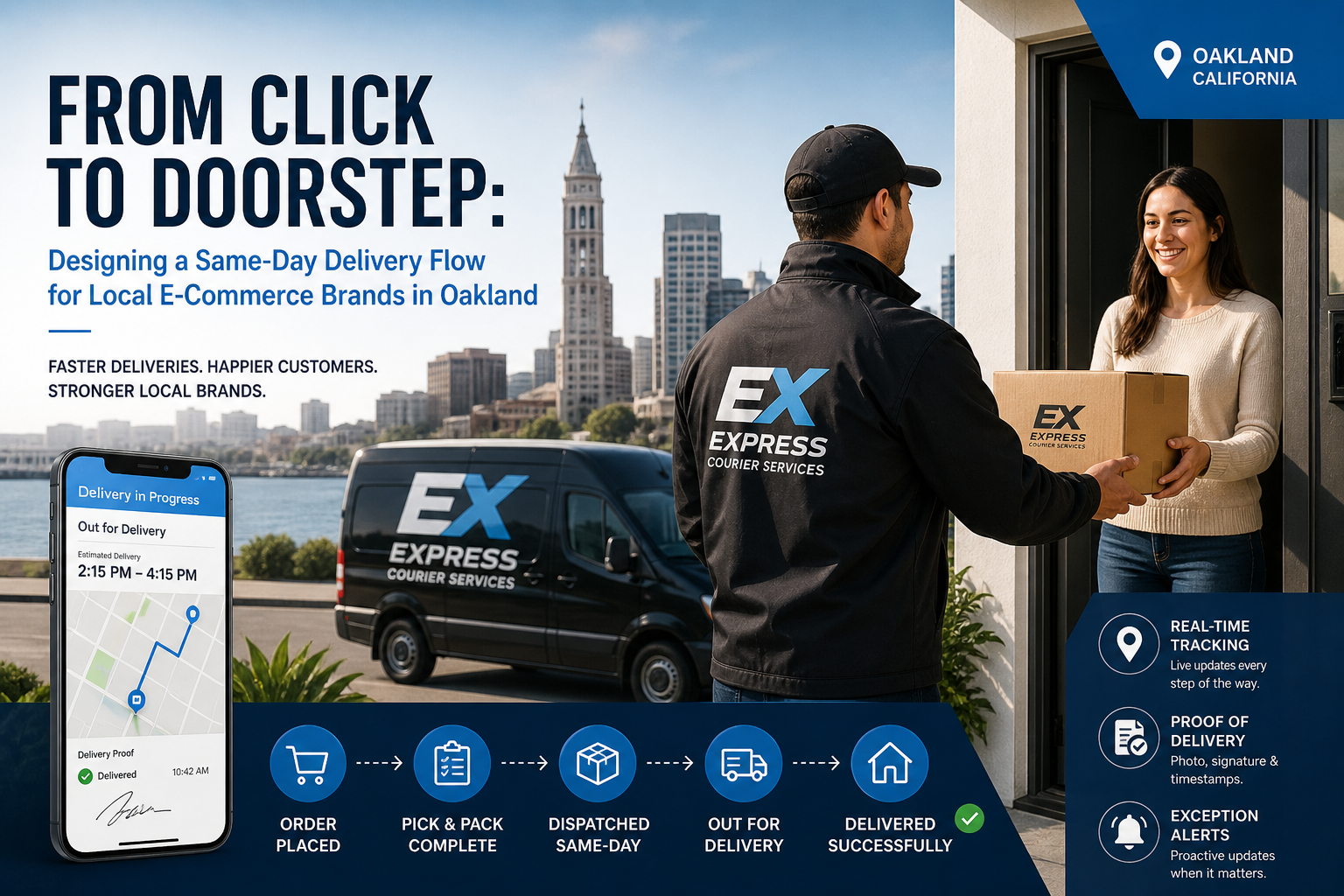
Same-day delivery isn’t a single “driver runs it” moment. It’s a flow: checkout → eligibility → pick/pack → dispatch → tracking → proof of delivery → exception handling. When that flow is designed well, customers trust the brand and support tickets stay low. When it’s not, you get WISMO calls, refunds, and staff burnout.
Oakland's retail and e-commerce businesses compete with national marketplaces every day. Customers expect fast shipping, accurate delivery windows, and complete visibility from checkout through delivery. The advantage for local brands is proximity. A well-designed same-day delivery strategy allows businesses to provide faster local fulfillment while maintaining better customer communication and stronger delivery reliability than national carriers.
If you want a quick overview of courier service tiers (on-demand, same-day, scheduled routes), start here.
If you want real-time tracking, proof of delivery, and exception alerts, start here.
If your business is retail or e-commerce, this industry page is relevant.
Step 1: Define your same-day promise in Oakland terms
Most same-day programs fail because the promise is vague. Customers hear “same-day” and assume “soon.” Operations interpret it as “any time today.”
Start with two non-negotiables:
Cutoff time (example: orders placed before 1:00 PM qualify for same-day)
Delivery windows (avoid “all day,” use 2–3 hour windows or Morning vs Afternoon)
Last-mile analysis consistently highlights that last-mile is the most complex and expensive part of delivery, which is why reducing uncertainty is a major performance lever.
Step 2: Build a clean order-to-dispatch pipeline
Same-day courier service becomes reliable when the order flow is consistent. A successful local fulfillment strategy depends on clear communication between checkout, inventory, packing, dispatch, and delivery.
A practical pipeline looks like this:
Order placed
Payment and inventory confirmed
Address and delivery eligibility verified
Pick and pack started
Courier job created (route or on-demand lane)
Customer receives “Out for delivery” update
Delivered with proof of delivery
Exceptions handled with proactive communication
You don’t need complex software. You need clear rules and a courier partner that supports same-day execution with visibility.
Step 3: Standardize pick and pack to protect same-day speed
The fastest delivery operations are built in the packing area, not on the road.
Same-day pick/pack standards should include:
A same-day staging shelf or bin
A packing checklist that prevents last-minute questions
Consistent labeling (order number + recipient name + delivery window)
Fragile handling rules where needed
Sealed packaging for high-value items
A standardized pick-and-pack process is one of the foundations of efficient e-commerce logistics. When products are staged consistently before pickup, local couriers spend less time waiting, drivers complete more deliveries per route, and customers receive orders faster.
If you ship fragile products, ISTA standards are a common reference for transit testing and packaging robustness.
Step 4: Choose the right courier model for Oakland
The most sustainable local delivery strategy for Oakland retailers combines scheduled route planning with on-demand courier support. This approach balances flexibility with predictable operating costs while improving overall delivery management.
Route-based same-day for predictable daily volume
Best when you have consistent daily orders
Courier does efficient delivery loops
Lower cost per stop and more predictable windows
On-demand for true exceptions
Use on-demand for:
VIP saves
Last-minute cutoffs
Replacement shipments
Orders that must arrive within a tight window
This prevents everything from becoming “rush,” which destroys margin.
Step 5: Design a transparent tracking experience that reduces WISMO calls
WISMO calls happen when customers lose confidence in the delivery process. Strong delivery visibility keeps customers informed from checkout through delivery, reducing uncertainty while creating a better customer delivery experience.
Use a simple notification sequence:
Order confirmed
Packed and ready
Out for delivery + ETA window
Driver en route (tighter ETA)
Delivered + proof of delivery (when needed)
Exception alerts with a revised ETA if something changes
Modern courier systems provide real-time tracking, proof of delivery records, and exception alerts that reduce “where is it?” tickets.
For context on why tracking and POD are baseline expectations now.
Step 6: Optimize for first-attempt delivery success across Oakland neighborhoods
First-attempt success is the hidden driver of cost and satisfaction. Many same-day failures are not “late deliveries,” they are failed handoffs.
Common Oakland first-attempt blockers:
Missing unit numbers
Gate codes not provided
Inaccurate addresses
No contact phone for access issues
Delivery notes missing (where to leave it, signature required, etc.)
Fix this at checkout by collecting:
Apartment/suite number
Gate code (if applicable)
Delivery notes
Delivery preference (leave at door vs signature required)
Contact phone number for access issues
Research consistently shows that last-mile delivery is one of the most expensive and operationally complex parts of the fulfillment process. Improving first-attempt success is one of the simplest ways to reduce costs while improving customer satisfaction.
Step 7: Use proof of delivery to prevent disputes and refunds
A big support cost comes from deliveries marked “delivered” with no proof.
Make proof of delivery match the risk:
Low-risk: timestamp + delivery confirmation
Higher-value: photo or signature
High-value: named recipient signature + “no mailroom” rule
Courier systems that provide POD records help you resolve disputes quickly and reduce refunds.
Step 8: Build a simple exception workflow before you need it
Same-day delivery always has exceptions:
Traffic delays
Address errors
Recipient not available
Access blocked
Package damaged before delivery
Your exception workflow should define:
When to notify customers
Whether you reattempt same-day vs move to next-day
How replacements are handled
How incidents are documented
Effective delivery management isn't about preventing every problem—it's about responding quickly when problems occur. Businesses that communicate proactively during delivery exceptions often maintain higher customer satisfaction even when delays happen.
Exception alerts and dispatch escalation make this manageable.
Step 9: Track the few metrics that actually improve performance
You don’t need a giant analytics program. Track:
On-time delivery rate
First-attempt success rate
Exception rate and top reasons
Order-to-pickup time
Pickup-to-delivery time
WISMO calls per 100 deliveries
Refunds tied to delivery issues
These metrics tell you whether your same-day promise is getting stronger or slowly breaking.
How Express Courier Services supports same-day delivery for local brands
Express Courier Services helps Oakland retailers build reliable same-day courier services, local fulfillment operations, and scalable e-commerce logistics through route planning, real-time tracking, proof of delivery, and delivery visibility designed for growing businesses.
Contact to scope an Oakland same-day workflow
Closing
Same-day retail delivery in Oakland isn't about driving faster. It's about building a smarter local delivery service that combines efficient routing, customer communication, real-time tracking, and reliable courier operations. It’s about designing a flow that removes friction from click to doorstep: clear cutoffs, standardized pick/pack, a route lane for predictable volume, on-demand for true exceptions, and transparent tracking with proof of delivery.