
Reliable Courier & Logistics Solutions
At Express Courier Services, we understand that your deliveries are more than just packages — they represent commitments, deadlines, and trust. That’s why we’ve built a courier system designed for speed, security, and accuracy. From urgent medical supplies to sensitive legal files, we deliver with the highest level of care. Our statewide coverage ensures that no matter where you are in California, dependable service is always within reach. We offer flexible solutions for businesses of every size, from one-time deliveries to long-term dedicated driver programs. Our experienced team and advanced logistics ensure smooth handling and real-time tracking at every stage. We take pride in being the courier service businesses rely on to keep operations running smoothly. With Express Courier Services, you gain a partner who delivers peace of mind with every shipment.
Start Transforming Your
Logistics Landscape
Reliable Courier & Logistics Solutions Across Industries
Your Premier Choice for Critical
Medical Supply Deliveries
Industry Highlights
Healthcare & Pharma
Secure, compliant delivery for clinics, labs, and pharmacies.
Healthcare & Pharma
Cold-chain options, chain-of-custody, and real-time tracking for temperature-sensitive shipments.
Click to Learn More
Legal Services
Time-sensitive filings and confidential document delivery.
Legal Services
Secure handling, proof of delivery, and rush courthouse runs you can trust.
Click to Learn More
Retail & E-commerce
Fast last-mile and same-day delivery for online and in-store.
Retail & E-commerce
Flexible windows, returns management, and live ETAs to delight customers.
Click to Learn More
Manufacturing & Industrial
Critical parts and MRO deliveries to keep lines running.
Manufacturing & Industrial
Expedited hot-shot runs, vendor pickups, and scheduled route coverage.
Click to Learn More
Government & Education
Dependable inter-office and campus courier services.
Government & Education
Audit-ready logs, secure handling of records, and scheduled routes across sites.
Click to Learn More
Food & Beverage Logistics
Fresh, safe, and timely deliveries for perishables.
Food & Beverage Logistics
Temperature-controlled options, HACCP-aware handling, and route optimization.
Click to Learn More
Why
Choose
Express Courier Services?

Speed
Same-day & STAT deliveries

Security
HIPAA, chain-of-custody, tamper-proof handling

Technology
Real-time GPS tracking & proof of delivery

Coverage
Serving all of California with local expertise
Tailored Solutions for Every Specialty Medication
From small parcels to sensitive medical supplies, our tailored courier solutions meet the needs of every industry we serve.

On-Demand & Same-Day Delivery

Scheduled Routes & Recurring Logistics

Temperature-Controlled Transport

Secure & Regulatory-Compliant Handling
Specialized
Logistics
for
Every Industry
We understand that each sector has unique requirements. That’s why our solutions are tailored — whether you’re a pharmacy, law firm, manufacturer, or retailer.
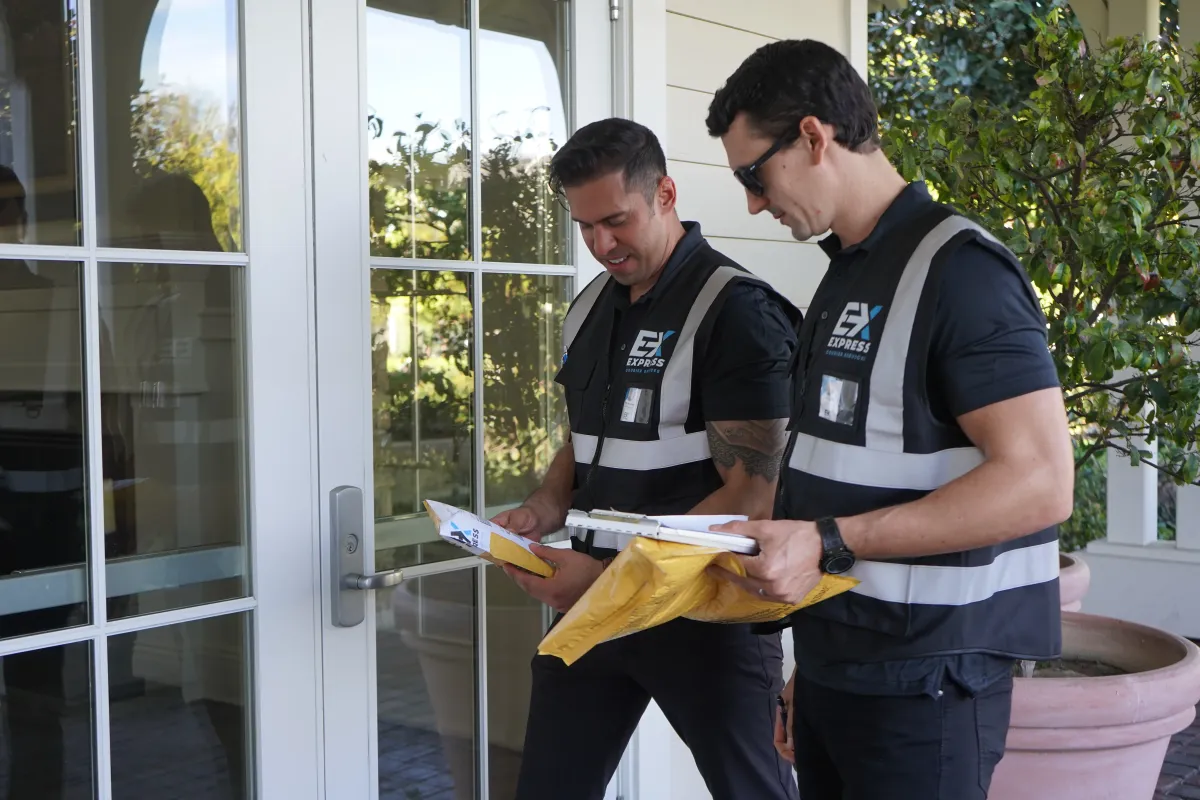
Track
Every
Delivery
in
Real
Time
GPS & route optimization
Proof-of-delivery signatures/photos
Secure client portal
Trusted Across California
Michelle Rodriguez
Pharmacy Manager
"Express Courier Services has seriously transformed the game for us at Central Health Pharmacy. As a Pharmacy Manager, the constant juggling of medical supplies can be a headache. But with these guys, it's like they've taken the stress out of my job.
Now, I don't lose sleep over running out of essentials. Their deliveries are a lifesaver!"

Alex Nguyen
Pharmacist
"These guys at Express Courier Services are next level! Being a pharmacist is no joke, and precision is everything. Unlike other couriers that left us biting our nails, these guys handle our sensitive materials like pros. It's a breath of fresh air - finally, a courier service that gets it right every time! Highly recommended!"
Dr. Jonathan L. Kim
Medical Director
"Express Courier Services is the secret weapon in our urgent care playbook.
As a Medical Director, I can't afford delays. These folks have cracked the code to prompt deliveries. Now, we can focus on what really matters taking care of our patients without the hassle of late shipments. Working with them is always a pleasure."
Need to verify our reliability?
Our Sales team will provide you with letters of recommendations from our current clients.
Logistics Insights & Industry Trends
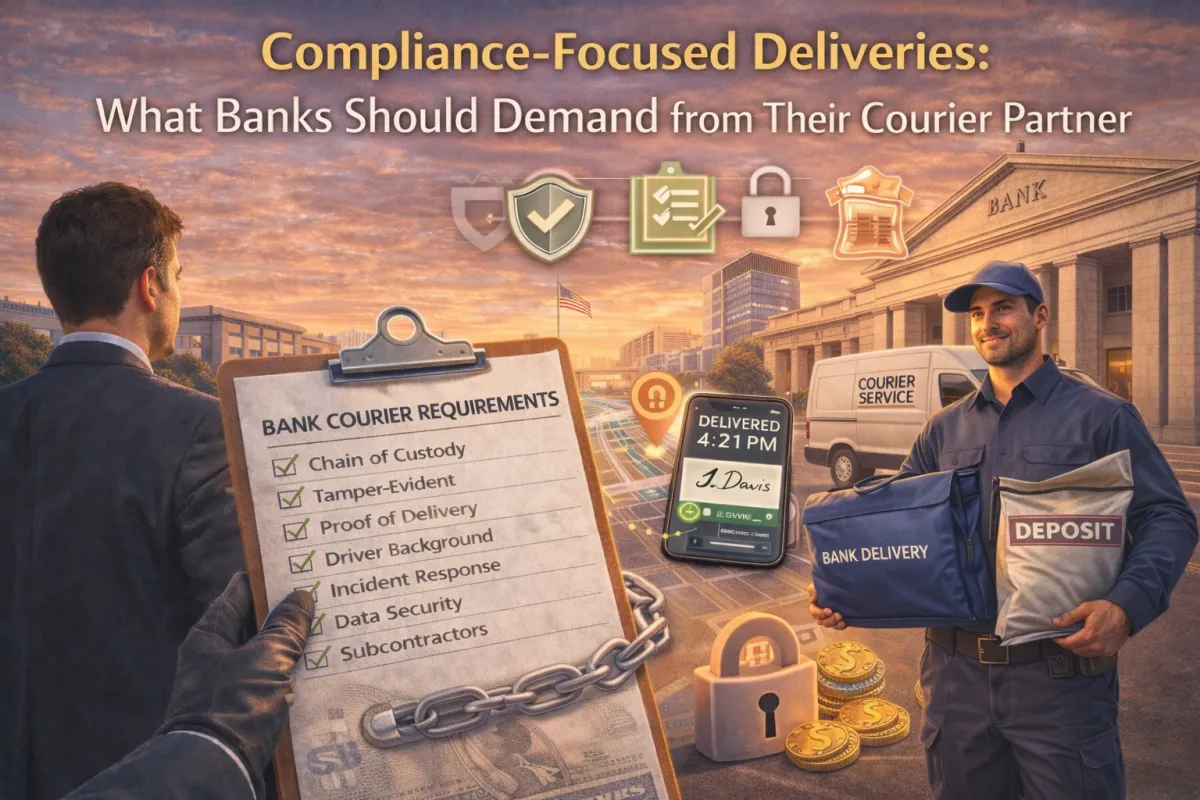
Compliance-Focused Deliveries: What Banks Should Demand from Their Courier Partner
Banks and credit unions move more than packages. They move cash-equivalent items (checks, deposit bags, card kits), sensitive documents (loan files, account records, contracts), and operational materials that create real risk if custody breaks even once. “Fast delivery” is not the standard. The standard is defensible delivery: controlled handling, documented handoffs, and audit-ready records you can pull later without scrambling.
That expectation is reinforced by banking regulators’ emphasis on managing third-party risk across the full lifecycle, from planning and due diligence to contracting, ongoing monitoring, and termination.
If you want an example of how a courier frames financial-services delivery requirements like audit trails, chain-of-custody, and 24/7 oversight, see this service page.
Why “compliance-focused delivery” is now a baseline, not a premium
Financial institutions are operating in an environment where physical instruments and sensitive documents are increasingly targeted. FinCEN has issued both an alert (2023) and a trend analysis (2024) describing the surge in mail theft-related check fraud and the scale seen through BSA reporting.
The FBI and U.S. Postal Inspection Service have also warned that check fraud tied to mail theft is rising, which is one reason banks increasingly prefer controlled courier handoffs for certain items rather than relying on unattended mail flows.
What banks should demand, in plain language
1) Third-party risk management that matches bank expectations
Your courier is a third party that touches sensitive operations. Banking agencies’ interagency guidance emphasizes risk-based third-party risk management across planning, due diligence, contracting, ongoing monitoring, and termination.
What to demand from the courier partner:
A written control set (security, custody, incident response, subcontractor rules) that you can attach to your vendor file
A clear “who owns exceptions” process with escalation contacts
The ability to support audits by producing delivery records, exception logs, and training attestations
If you want a visibility model that supports audit readiness, require real-time tracking and record access.
2) Service-provider safeguards aligned to GLBA information security expectations
Bank regulators’ Interagency Guidelines Establishing Information Security Standards explicitly include requirements for arrangements with service providers, including due diligence and requiring appropriate security measures by contract.
How that translates into courier requirements:
Contract language that requires confidentiality, safeguards, and documented handling standards
Limits on who can access items, vehicles, and delivery records
Clear breach and incident notification expectations
For non-bank financial institutions under FTC jurisdiction, the Safeguards Rule (16 CFR Part 314) also sets standards for administrative, technical, and physical safeguards and reinforces service provider oversight responsibilities.
3) Chain-of-custody discipline for cash-equivalent and sensitive items
If your courier cannot prove custody, you cannot defend delivery. At minimum, you want a documented trail of custody events from pickup to drop-off. NIST’s chain-of-custody definition emphasizes documenting handlers, date/time, and transfer purpose.
What to demand:
Unique job ID for every run
Time-stamped pickup confirmation
In-transit visibility
Time-stamped delivery confirmation with recipient detail (name and signature when required)
Documented exceptions (recipient unavailable, access denied, reattempt required)
A courier technology stack that includes GPS tracking and proof-of-delivery records supports this standard.
4) Tamper-evident handling and “no unattended drop-off” rules
For deposit bags, check packets, card kits, and account documents, you should be able to specify “no mailroom, no reception, no unsecured drop” and require tamper-evident handling when appropriate.
What to demand:
Tamper-evident bags or seals for defined item categories
Seal integrity checks at pickup and delivery when used
Mandatory escalation before any alternate handoff is approved
If you want a courier example that explicitly positions financial delivery around chain-of-custody and audit trails, see this page.
5) Background checks, identification, and driver training that are not optional
Compliance-focused deliveries require compliance-focused people. Your bank should expect:
Driver identification and verification at pickup and delivery sites
Background screening aligned to your risk tier (document it in the contract)
Recurring training on handling sensitive items, secure receiving rules, and exception escalation
Also require a driver safety program. OSHA guidance for employers highlights the importance of motor vehicle safety programs and safe scheduling.
6) Subcontractor controls and transparency
Many courier failures happen when work is silently subcontracted. Your bank should demand:
Clear disclosure if subcontractors are used
The same screening, training, and custody standards for any subcontractor
A “no substitution without approval” rule for high-risk runs
Tie this to the interagency third-party risk lifecycle expectation.
7) A real incident response and notification process
Banks need to know quickly when something goes wrong, including misdeliveries, lost items, seal irregularities, or suspected theft. Regulators have long emphasized response programs for unauthorized access to customer information maintained by the institution or its service providers.
What to demand:
Immediate notification SLAs for critical incidents
A written “containment and recovery” flow (halt route, locate item, notify bank contacts, document timeline)
Preservation of delivery records, GPS logs, and custody events for investigation
8) Secure data handling for delivery records and portals
Courier platforms store addresses, recipient names, signatures, photos, and notes. That data can become sensitive, especially for banking locations and internal operations.
What to demand:
Role-based access to the portal and delivery history
Audit logs for who accessed delivery records
Data retention controls aligned to your policy (how long POD and photos are retained)
Secure sharing controls for third parties
If your courier offers a secure client portal and shipment history access, confirm how access is controlled.
9) Payment card and card-kit considerations
If you transport debit cards, replacement cards, PIN materials, or any payment-card related items, require a specific handling standard. PCI Security Standards Council resources explain that PCI standards exist to protect payment data and provide baseline requirements for environments that store, process, or transmit payment account data.
If your courier partner is connected to systems that touch card environments, PCI SSC has guidance for “connected-to service providers” and how responsibilities should be evaluated and assigned.
Practical demand: treat card kits as high-risk custody items even when no card data is visible. Require direct-to-authorized recipient delivery with signature and exception escalation.
What to bake into your courier contract, so exam questions are easy to answer
A bank-friendly courier contract usually includes:
Defined service tiers (scheduled routes vs on-demand and urgent)
“No unattended drop-off” rules for specified item categories
Mandatory proof-of-delivery fields (timestamp, recipient, signature where required, exception notes)
Chain-of-custody requirements for high-risk items
Subcontractor disclosure and standards
Incident response and notification timeline
Record retention and access control expectations
Right to audit (at least documentation and process audits)
Interagency information security guidelines explicitly call out service provider due diligence and contract requirements tied to safeguarding objectives.
Quick “compliance-ready delivery” checklist you can copy into an RFP or vendor review
If you want a short list that procurement and compliance can align on, require the courier to confirm, in writing:
We provide real-time tracking and time-stamped proof of delivery with retrievable records.
We document custody events and escalate exceptions before changing handoff method.
We support service-provider safeguards expectations through due diligence, contract controls, and monitoring.
We support check and deposit movement controls because check fraud tied to theft remains a real risk environment.
We have a driver safety program and incident reporting process.
How Express Courier Services positions compliance-focused financial deliveries
Express Courier Services frames its financial services work around secure chain-of-custody, compliance-first protocols, audit trails, and real-time visibility.
For tracking, proof-of-delivery, and secure record access, see this page.
For service models (scheduled routes vs on-demand, plus priority options), check this page.
If you want to scope your bank’s delivery categories (deposit runs, branch support, loan docs, card kits) and define the controls, start here.

Alpha Gabriel Marquina
Start Transforming Your
Logistics Landscape
Need a Delivery Partner You Can Rely On?
Get a custom courier solution for your business today.
Ready to Experience Reliable Courier Services?