Reliable Courier & Logistics Solutions
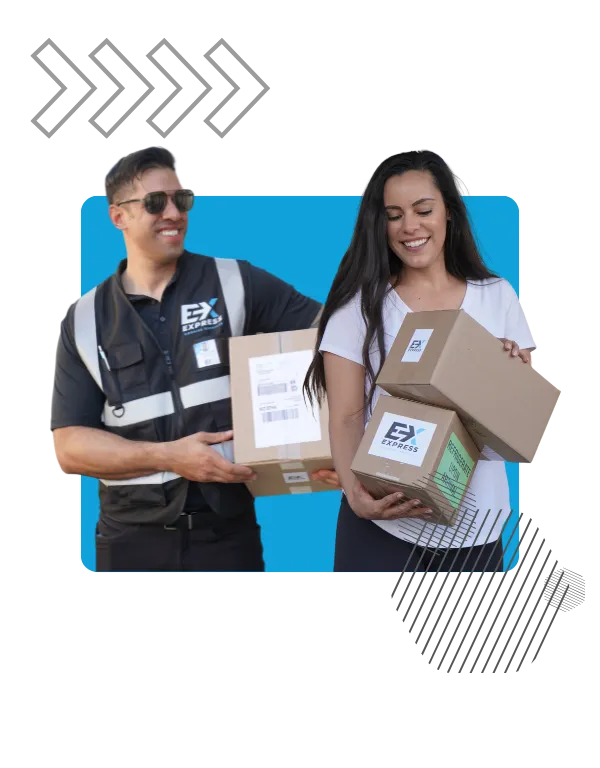
At Express Courier Services, we understand that your deliveries are more than just packages — they represent commitments, deadlines, and trust. That’s why we’ve built a courier system designed for speed, security, and accuracy. From urgent medical supplies to sensitive legal files, we deliver with the highest level of care. Our statewide coverage ensures that no matter where you are in California, dependable service is always within reach. We offer flexible solutions for businesses of every size, from one-time deliveries to long-term dedicated driver programs. Our experienced team and advanced logistics ensure smooth handling and real-time tracking at every stage. We take pride in being the courier service businesses rely on to keep operations running smoothly. With Express Courier Services, you gain a partner who delivers peace of mind with every shipment.
Start Transforming Your
Logistics Landscape
Reliable Courier & Logistics Solutions Across Industries
Your Premier Choice for Critical
Medical Supply Deliveries
Industry Highlights
Healthcare & Pharma
Secure, compliant delivery for clinics, labs, and pharmacies.
Healthcare & Pharma
Cold-chain options, chain-of-custody, and real-time tracking for temperature-sensitive shipments.
Click to Learn More
Legal Services
Time-sensitive filings and confidential document delivery.
Legal Services
Secure handling, proof of delivery, and rush courthouse runs you can trust.
Click to Learn More
Retail & E-commerce
Fast last-mile and same-day delivery for online and in-store.
Retail & E-commerce
Flexible windows, returns management, and live ETAs to delight customers.
Click to Learn More
Manufacturing & Industrial
Critical parts and MRO deliveries to keep lines running.
Manufacturing & Industrial
Expedited hot-shot runs, vendor pickups, and scheduled route coverage.
Click to Learn More
Government & Education
Dependable inter-office and campus courier services.
Government & Education
Audit-ready logs, secure handling of records, and scheduled routes across sites.
Click to Learn More
Food & Beverage Logistics
Fresh, safe, and timely deliveries for perishables.
Food & Beverage Logistics
Temperature-controlled options, HACCP-aware handling, and route optimization.
Click to Learn More
Why
Choose
Express Courier Services?

Speed
Same-day & STAT deliveries

Security
HIPAA, chain-of-custody, tamper-proof handling

Technology
Real-time GPS tracking & proof of delivery

Coverage
Serving all of California with local expertise
Tailored Solutions for Every Specialty Medication
From small parcels to sensitive medical supplies, our tailored courier solutions meet the needs of every industry we serve.

On-Demand & Same-Day Delivery
Scheduled Routes & Recurring Logistics

Temperature-Controlled Transport

Secure & Regulatory-Compliant Handling
Specialized
Logistics
for
Every Industry
We understand that each sector has unique requirements. That’s why our solutions are tailored — whether you’re a pharmacy, law firm, manufacturer, or retailer.
Track
Every
Delivery
in
Real
Time
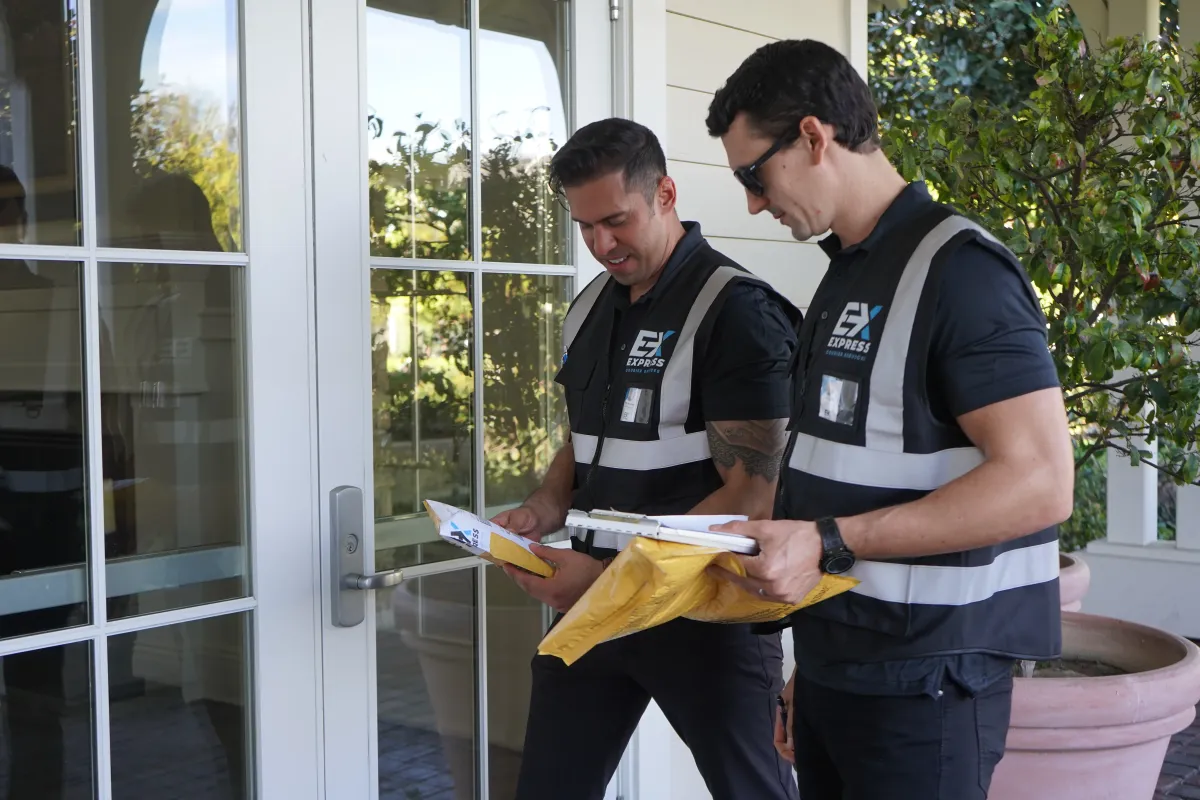
GPS & route optimization
Proof-of-delivery signatures/photos
Secure client portal
Trusted Across California
Michelle Rodriguez
Pharmacy Manager
"Express Courier Services has seriously transformed the game for us at Central Health Pharmacy. As a Pharmacy Manager, the constant juggling of medical supplies can be a headache. But with these guys, it's like they've taken the stress out of my job.
Now, I don't lose sleep over running out of essentials. Their deliveries are a lifesaver!"

Alex Nguyen
Pharmacist
"These guys at Express Courier Services are next level! Being a pharmacist is no joke, and precision is everything. Unlike other couriers that left us biting our nails, these guys handle our sensitive materials like pros. It's a breath of fresh air - finally, a courier service that gets it right every time! Highly recommended!"
Dr. Jonathan L. Kim
Medical Director
"Express Courier Services is the secret weapon in our urgent care playbook.
As a Medical Director, I can't afford delays. These folks have cracked the code to prompt deliveries. Now, we can focus on what really matters taking care of our patients without the hassle of late shipments. Working with them is always a pleasure."
Need to verify our reliability?
Our Sales team will provide you with letters of recommendations from our current clients.
Logistics Insights & Industry Trends
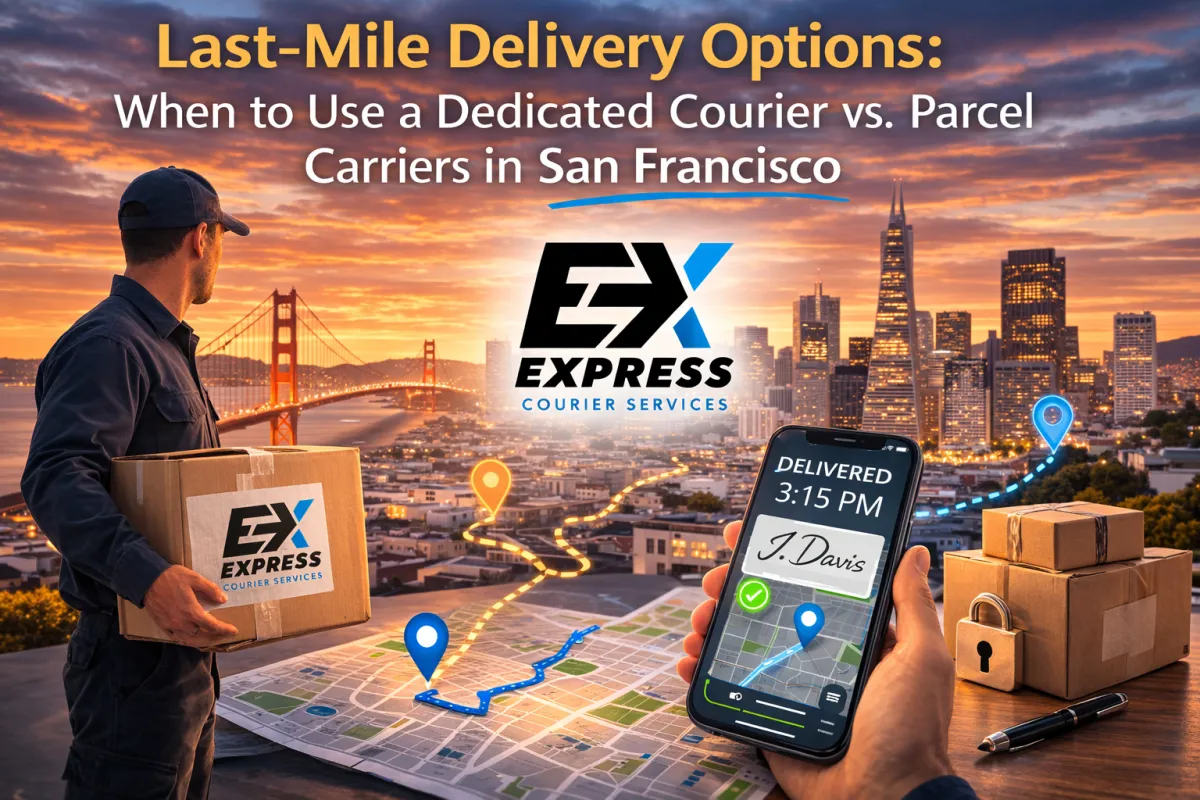
Last-Mile Delivery Options: When to Use a Dedicated Courier vs. Parcel Carriers in San Francisco
San Francisco is one of the best cities in the country for “close distance” deliveries that still feel unpredictable. A five-mile route can turn into a long timeline once you add curb access, parking, elevator wait times, lobby security desks, and strict receiving windows. The city has documented curb and loading challenges tied to high demand for limited curb space, which is why delivery vehicles often end up circling, loading in imperfect spots, or fighting for curb access in dense corridors.
That reality creates a practical question for SF operators: when should you use a dedicated courier (same-day, route-based, controlled handoffs), and when should you use parcel carriers (UPS, FedEx, USPS) that are designed for scale and multi-day delivery?
This guide breaks down the difference, then gives you a clear way to choose the right model for each shipment type and business workflow.
If you want a quick overview of courier service models (on-demand, same-day, dedicated vehicle, scheduled routes), start here. Internal link: https://www.expcourierservices.com/courier-services
If you want visibility like real-time tracking, exception alerts, and proof of delivery records, this is the technology layer to reference.
The core difference, in one sentence
Parcel carriers are optimized for network efficiency at scale, while dedicated couriers are optimized for time-sensitive, high-control deliveries inside your metro area where handoff quality and timing matter most.
This matters because last-mile logistics is widely recognized as the most expensive segment of shipping, with research and industry reports commonly citing that it can account for around half of total shipping cost.
In a dense city like San Francisco, where drivers face increasing difficulty finding curb space, the cost and risk of missed deliveries rises, especially when recipients are not available or building access slows the drop.
Option 1: Parcel carriers in San Francisco
Parcel carriers like UPS, FedEx, and USPS are excellent when you are shipping items that can ride a hub-and-spoke network and do not require a precise same-day window. They also provide a familiar experience for recipients and standardized tracking workflows.
When parcel carriers are usually the right choice
Parcel carriers generally win when delivery timing can be “by end of day” or “within 2 to 5 business days,” and when you can tolerate the reality that the carrier is serving a route, not your single delivery. FedEx, for example, notes that residential packages in its Home Delivery service are typically delivered by 8 p.m., which illustrates the broad delivery window expectation that comes with network delivery.
UPS similarly explains that ground packages are generally delivered within a broad window and that commercial deliveries are typically by close of business, which is helpful context for planning around receiving teams.
Signature requirements with parcel carriers
If the risk level is higher, parcel carriers offer signature services.Multiple signature options such as indirect, direct, and adult signature required, which can help reduce disputes for higher-value shipments.
Where parcel carriers can struggle in San Francisco
Parcel networks do not exist to solve your building-specific receiving rules. If a delivery requires a named recipient, a precise time window, or complex access, you may face multiple attempts, delays, or exceptions. Those problems tend to intensify in dense curb environments where drivers lose time searching for loading space.
Option 2: Dedicated couriers in San Francisco
A dedicated courier is usually the better choice when you need same-day movement, tight control, better exception handling, or stronger documentation around handoffs. This is especially true for business-to-business deliveries with receiving windows, courthouse-style deadlines, or sensitive items where you want a clear chain of custody.
If you need a real SF-specific example of high-control, high-stakes courier work, this STAT courier post explains risk controls and custody discipline for clinical trial logistics in San Francisco.
When dedicated couriers are usually the right choice
Dedicated courier service tends to win in San Francisco when:
The delivery is same-day or time-critical and waiting for the carrier network is not acceptable.
The receiving point has a narrow window, strict access, or a “no mailroom” rule.
The item is cash-equivalent or sensitive and you need defensible proof of delivery.
You need predictable scheduled routes between offices, clinics, branches, or stores.
If you want a SF example that focuses on cash-equivalent items and why chain of custody matters, this blog covers checks and contracts in San Francisco.
The documentation advantage
Modern courier systems often provide real-time GPS tracking, proof of delivery with digital signatures, photos, timestamps, and exception alerts. Those features reduce “where is it” calls and reduce disputes because the custody timeline is recorded.
The San Francisco decision framework: which model should you use?
Here’s the simplest way to choose without overthinking it.
1) How fast does it need to arrive?
If you truly need same-day, a dedicated courier is usually the right tool. Parcel carriers can offer overnight or faster services, but those still depend on network cutoffs and service commitments, and they may not solve your receiving-window problem if the delivery must happen at a specific time. FedEx’s overnight and time-definite options show how carrier speed tiers exist, but they remain network-based. External link: https://www.fedex.com/en-us/shipping/overnight.html
If it can arrive in 1 to 3 days and you just need standard tracking, parcel carriers often win on cost and simplicity.
2) What happens if the delivery fails on the first attempt?
In San Francisco, first-attempt success is often the hidden driver of cost because a missed handoff can turn into delays, reattempts, internal coordination, and customer frustration. Dedicated courier services typically perform better here when you have strict receiving rules, because the delivery is treated as a controlled job, not one stop on a long route.
If your operation values exception alerts and rapid escalation, require visibility features like those described here.
3) Is the item sensitive, regulated, or cash-equivalent?
If you are moving checks, deposit materials, card kits, contracts, or confidential documents, you should strongly consider a courier model built around chain of custody, tamper-evident handling, and documented proof. That approach aligns with financial-services handling expectations described here.
If you ship these items via mail, it is worth acknowledging that mail theft is a known risk category, and USPS Inspection Service prevention guidance explicitly recommends steps like promptly picking up mail and inquiring about overdue checks.
4) Are you delivering to a building with strict access?
High-rises, secure lobbies, and controlled receiving desks often create the worst mismatch with parcel carriers’ broad delivery windows. A dedicated courier is usually more reliable when you need a hand-to-hand delivery with a named recipient, signature, and clear proof of delivery.
5) Are you moving items frequently between the same locations?
If you have repeatable stops, you likely want a route program rather than constant on-demand shipments. That reduces cost per stop and improves predictability. ECS frames this kind of predictable movement in its inter-office logistics content, including real-time visibility and proof-of-delivery expectations.
Common San Francisco scenarios and the best option
If you are moving court filings, time-critical legal packets, or deadline-driven documents, a dedicated courier is usually the safer choice because the delivery is tied to strict windows and defensibility.
If you are shipping low-risk items where timing is flexible and the recipient is fine with end-of-day delivery, parcel carriers usually make sense, especially when you can use signature services for higher-value deliveries.
If you are moving clinical or biotech materials where timing, temperature, and documented custody matter, dedicated couriers are the default choice.
If you are a retailer balancing inventory store-to-store inside the city, a dedicated courier route often outperforms parcel carriers because you need same-day repositioning, not multi-day shipment.
Practical tips to reduce last-mile problems in San Francisco, whichever option you choose
If you use parcel carriers, use signature services for high-value deliveries and set recipient expectations about delivery windows.
If you use dedicated couriers, write better delivery instructions. Named recipient, building access notes, “no mailroom” rules, signature required, and what to do if access fails. Those details reduce exceptions in a curb-constrained city. For reference on exception alerts and proof-of-delivery documentation, see here.
Closing: the right model depends on risk, not habit
In San Francisco, choosing between parcel carriers and dedicated couriers is less about preference and more about matching the delivery tool to the delivery risk. Parcel carriers are efficient and cost-effective for flexible timelines. Dedicated couriers are built for same-day urgency, controlled handoffs, and accountability when failure would be expensive.
If you want help mapping your San Francisco delivery activity into “route work” vs “on-demand exceptions” and defining where parcel carriers still fit, start here.

Alpha Gabriel Marquina
Start Transforming Your
Logistics Landscape
Need a Delivery Partner You Can Rely On?
Get a custom courier solution for your business today.
Ready to Experience Reliable Courier Services?