
Reliable Courier & Logistics Solutions
At Express Courier Services, we understand that your deliveries are more than just packages — they represent commitments, deadlines, and trust. That’s why we’ve built a courier system designed for speed, security, and accuracy. From urgent medical supplies to sensitive legal files, we deliver with the highest level of care. Our statewide coverage ensures that no matter where you are in California, dependable service is always within reach. We offer flexible solutions for businesses of every size, from one-time deliveries to long-term dedicated driver programs. Our experienced team and advanced logistics ensure smooth handling and real-time tracking at every stage. We take pride in being the courier service businesses rely on to keep operations running smoothly. With Express Courier Services, you gain a partner who delivers peace of mind with every shipment.
Start Transforming Your
Logistics Landscape
Reliable Courier & Logistics Solutions Across Industries
Your Premier Choice for Critical
Medical Supply Deliveries
Industry Highlights
Healthcare & Pharma
Secure, compliant delivery for clinics, labs, and pharmacies.
Healthcare & Pharma
Cold-chain options, chain-of-custody, and real-time tracking for temperature-sensitive shipments.
Click to Learn More
Legal Services
Time-sensitive filings and confidential document delivery.
Legal Services
Secure handling, proof of delivery, and rush courthouse runs you can trust.
Click to Learn More
Retail & E-commerce
Fast last-mile and same-day delivery for online and in-store.
Retail & E-commerce
Flexible windows, returns management, and live ETAs to delight customers.
Click to Learn More
Manufacturing & Industrial
Critical parts and MRO deliveries to keep lines running.
Manufacturing & Industrial
Expedited hot-shot runs, vendor pickups, and scheduled route coverage.
Click to Learn More
Government & Education
Dependable inter-office and campus courier services.
Government & Education
Audit-ready logs, secure handling of records, and scheduled routes across sites.
Click to Learn More
Food & Beverage Logistics
Fresh, safe, and timely deliveries for perishables.
Food & Beverage Logistics
Temperature-controlled options, HACCP-aware handling, and route optimization.
Click to Learn More
Why
Choose
Express Courier Services?

Speed
Same-day & STAT deliveries

Security
HIPAA, chain-of-custody, tamper-proof handling

Technology
Real-time GPS tracking & proof of delivery

Coverage
Serving all of California with local expertise
Tailored Solutions for Every Specialty Medication
From small parcels to sensitive medical supplies, our tailored courier solutions meet the needs of every industry we serve.

On-Demand & Same-Day Delivery

Scheduled Routes & Recurring Logistics

Temperature-Controlled Transport

Secure & Regulatory-Compliant Handling
Specialized
Logistics
for
Every Industry
We understand that each sector has unique requirements. That’s why our solutions are tailored — whether you’re a pharmacy, law firm, manufacturer, or retailer.
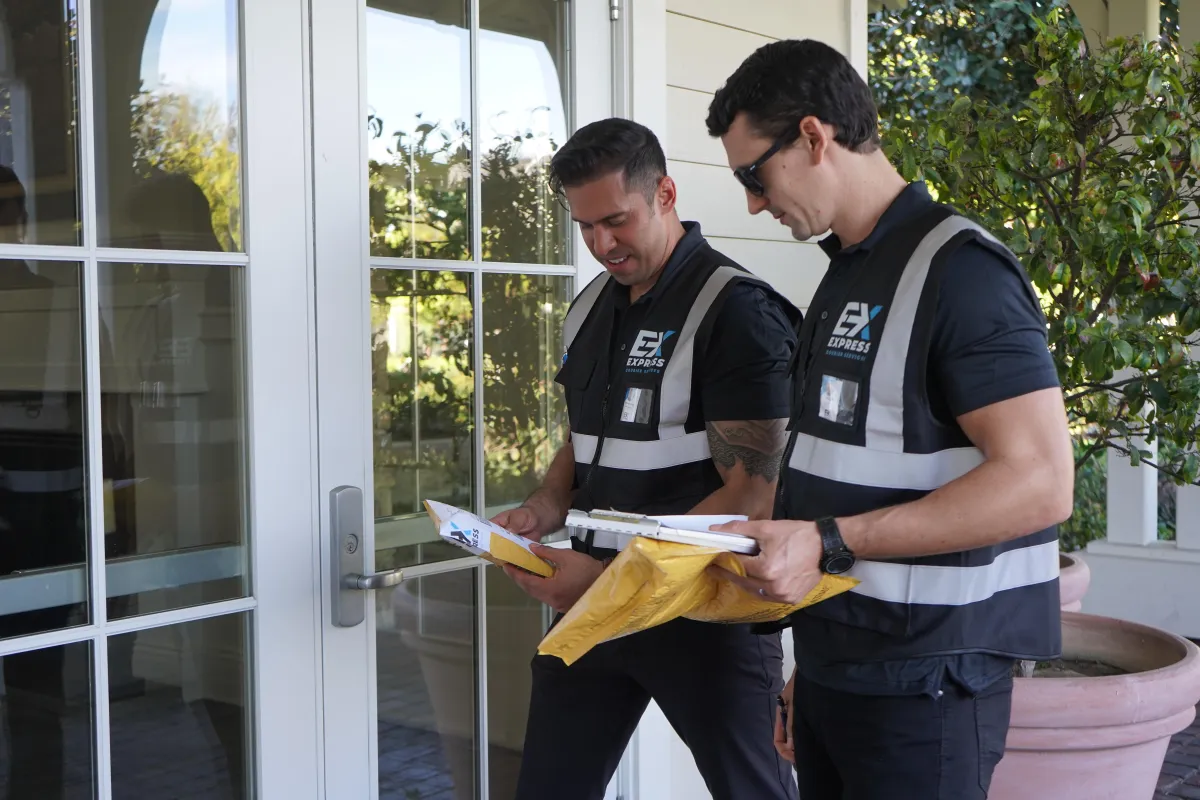
Track
Every
Delivery
in
Real
Time
GPS & route optimization
Proof-of-delivery signatures/photos
Secure client portal
Trusted Across California
Michelle Rodriguez
Pharmacy Manager
"Express Courier Services has seriously transformed the game for us at Central Health Pharmacy. As a Pharmacy Manager, the constant juggling of medical supplies can be a headache. But with these guys, it's like they've taken the stress out of my job.
Now, I don't lose sleep over running out of essentials. Their deliveries are a lifesaver!"

Alex Nguyen
Pharmacist
"These guys at Express Courier Services are next level! Being a pharmacist is no joke, and precision is everything. Unlike other couriers that left us biting our nails, these guys handle our sensitive materials like pros. It's a breath of fresh air - finally, a courier service that gets it right every time! Highly recommended!"
Dr. Jonathan L. Kim
Medical Director
"Express Courier Services is the secret weapon in our urgent care playbook.
As a Medical Director, I can't afford delays. These folks have cracked the code to prompt deliveries. Now, we can focus on what really matters taking care of our patients without the hassle of late shipments. Working with them is always a pleasure."
Need to verify our reliability?
Our Sales team will provide you with letters of recommendations from our current clients.
Logistics Insights & Industry Trends
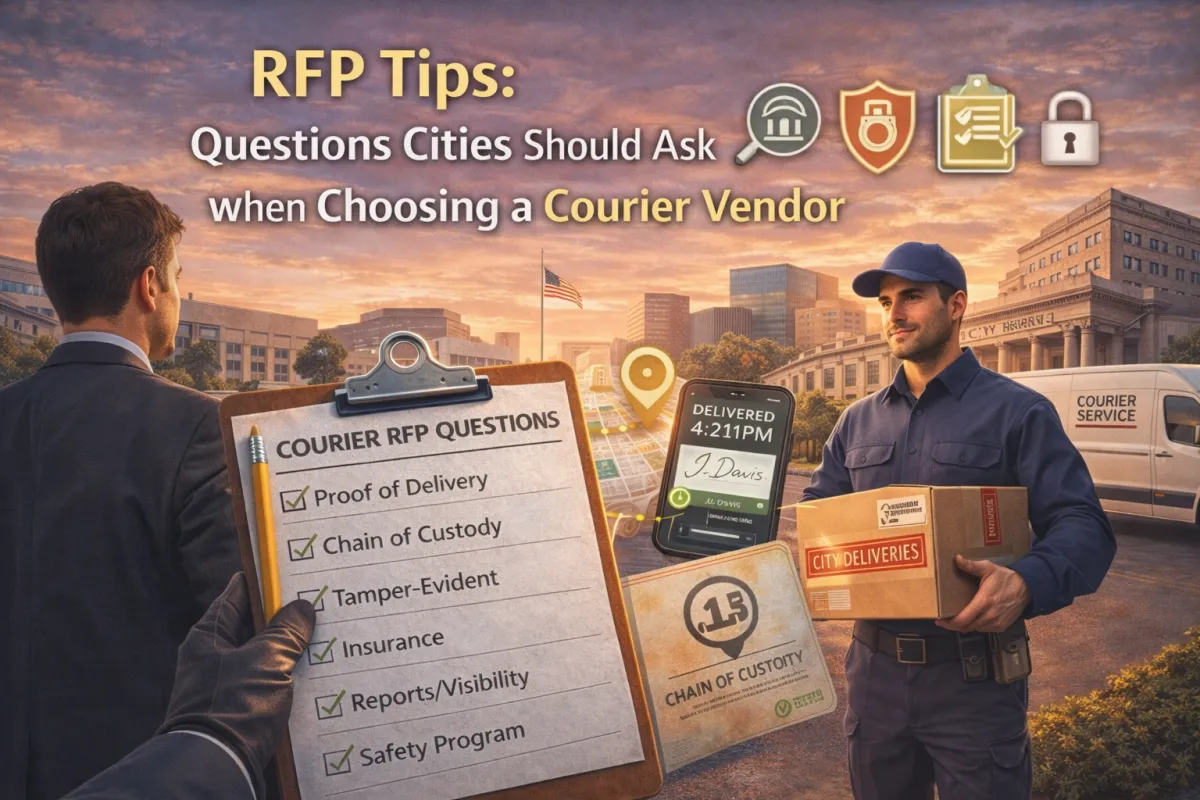
RFP Tips: Questions Cities Should Ask When Choosing a Courier Vendor
City courier contracts look simple until something goes wrong. A time-sensitive packet goes to the wrong building, a sealed item is left with an unauthorized receiver, a delivery gets disputed with no proof, or a driver cannot access a facility and nobody is notified until the deadline has passed.
A strong RFP prevents those issues by forcing operational clarity up front. It also helps you evaluate vendors on more than price, since public agencies often need the greatest overall benefit for reliability, documentation, and risk control. External link (best value definition reference):
If you want to see how courier programs are structured for public-sector workflows like inter-office routes and controlled handoffs, here is a government agency service example.
Start by defining what the city is actually buying
Before you write questions, define the service categories in your scope so vendors price and staff the right model.
If your need is predictable inter-office movement, write it as a route-based program with scheduled stops and receiving windows.
If your need is deadline-driven or unpredictable, separate it as on-demand or priority service with clear response time expectations.
The courier vendor questions that matter most in a city RFP
1) How will you classify and prioritize deliveries?
Ask vendors how they separate routine stops from urgent runs, and how priority is assigned when demand spikes. A city usually needs at least two lanes: scheduled routes for repeatable movement and on-demand for true exceptions.
2) What are your service levels, and how are they measured?
Require specific metrics like on-time pickup, on-time delivery, average exception resolution time, and proof-of-delivery completion rate. Then require monthly reporting with those metrics and root-cause notes.
3) How do you handle buildings with access restrictions?
Cities have facilities with security desks, badge access, and receiving windows. Ask for a written protocol for access issues, after-hours deliveries, and denied entry. Make it clear that unauthorized drop-offs are not acceptable and exceptions must be escalated immediately.
4) How do you verify recipients and document delivery?
Ask what proof of delivery includes: timestamp, recipient name, signature when required, and exception notes when delivery rules cannot be followed. Require that POD records are retrievable later for audits and disputes.
5) What is your chain-of-custody process for sensitive items?
If your city moves sealed records, court-related packets, HR files, or evidence-style materials, require a chain-of-custody workflow with documented custody events and handoffs. A useful definition reference is NIST’s chain-of-custody glossary, which emphasizes documenting who handled the item, the date/time, and the transfer purpose.
6) Do you support tamper-evident handling when required?
Ask whether the vendor supports tamper-evident seals or security bags, whether seal condition is verified at pickup and delivery, and how seal irregularities are escalated. For many city workflows, this is the difference between “delivered” and “defensible.”
7) What training and safety program do you require for drivers?
Driving is a workplace safety issue when it is job-related. Ask vendors to describe their driver safety program, training cadence, and incident reporting procedures. OSHA’s guidance for employers stresses committing resources to roadway safety.
8) How do you staff, and do you use subcontractors?
Ask whether drivers are employees or contractors, whether subcontractors are used, and what standards apply to any subcontracted labor. Require disclosure and require that subcontractors meet the same screening, training, and documentation rules.
9) What insurance do you carry, and what is your claims process?
Ask for proof of insurance, limits, and coverage types relevant to city work. Then ask for the step-by-step claims process and typical resolution timelines.
10) What data do you collect, and how is it protected?
Cities increasingly move information that is regulated or sensitive. Ask how delivery data is stored, who has access, how long records are retained, and whether the vendor can support city retention policies.
If deliveries include protected health information contexts, require alignment with HIPAA Security Rule expectations for administrative, physical, and technical safeguards.
11) Can you support CJIS-aligned environments when applicable?
If any department touches criminal justice information environments, ask how the vendor supports CJIS Security Policy expectations, including safeguarding information in transit and controlling access. calation?
This should be a required written procedure in the response. Ask who is notified, how quickly, what communication channels are used, and what documentation is created. Require that the vendor does not improvise alternate delivery methods without authorization.
13) What coverage area and operating hours do you guarantee?
Cities need clarity on service boundaries, cutoff times, and weekend or after-hours support. Ask for a coverage map, standard hours, and surge capacity plan.
14) How will you support implementation and ongoing governance?
Ask who the account manager is, how onboarding works, what the rollout timeline looks like, and how performance reviews are conducted. Require a quarterly business review with metrics, exceptions, and improvement actions.
RFP structure tips that make vendor answers easier to score
Define mandatory requirements separately from scored requirements. Mandatory items usually include proof of delivery, escalation rules, insurance, and data handling.
Use a best-value approach that evaluates technical capability and past performance alongside price, since price alone often fails to capture risk. , not theoretical. Examples: a sample POD record, a sample exception report, a sample monthly KPI dashboard.
If you’re preparing a city courier RFP and want a second set of eyes on the scope, service levels, and accountability requirements, reach out to Express Courier Services. Share your pickup and delivery locations, expected volume, facility access rules, and whether you need scheduled routes, on-demand response, or both, and the team can recommend an operating plan with tracking, proof of delivery, exception escalation, and reporting standards that fit public-sector workflows.

Alpha Gabriel Marquina
Start Transforming Your
Logistics Landscape
Need a Delivery Partner You Can Rely On?
Get a custom courier solution for your business today.
Ready to Experience Reliable Courier Services?