Reliable Courier & Logistics Solutions
At Express Courier Services, we understand that your deliveries are more than just packages — they represent commitments, deadlines, and trust. That’s why we’ve built a courier system designed for speed, security, and accuracy. From urgent medical supplies to sensitive legal files, we deliver with the highest level of care. Our statewide coverage ensures that no matter where you are in California, dependable service is always within reach. We offer flexible solutions for businesses of every size, from one-time deliveries to long-term dedicated driver programs. Our experienced team and advanced logistics ensure smooth handling and real-time tracking at every stage. We take pride in being the courier service businesses rely on to keep operations running smoothly. With Express Courier Services, you gain a partner who delivers peace of mind with every shipment.
Start Transforming Your
Logistics Landscape
Reliable Courier & Logistics Solutions Across Industries
Your Premier Choice for Critical
Medical Supply Deliveries
Industry Highlights
Healthcare & Pharma
Secure, compliant delivery for clinics, labs, and pharmacies.
Healthcare & Pharma
Cold-chain options, chain-of-custody, and real-time tracking for temperature-sensitive shipments.
Click to Learn More
Legal Services
Time-sensitive filings and confidential document delivery.
Legal Services
Secure handling, proof of delivery, and rush courthouse runs you can trust.
Click to Learn More
Retail & E-commerce
Fast last-mile and same-day delivery for online and in-store.
Retail & E-commerce
Flexible windows, returns management, and live ETAs to delight customers.
Click to Learn More
Manufacturing & Industrial
Critical parts and MRO deliveries to keep lines running.
Manufacturing & Industrial
Expedited hot-shot runs, vendor pickups, and scheduled route coverage.
Click to Learn More
Government & Education
Dependable inter-office and campus courier services.
Government & Education
Audit-ready logs, secure handling of records, and scheduled routes across sites.
Click to Learn More
Food & Beverage Logistics
Fresh, safe, and timely deliveries for perishables.
Food & Beverage Logistics
Temperature-controlled options, HACCP-aware handling, and route optimization.
Click to Learn More
Why
Choose
Express Courier Services?

Speed
Same-day & STAT deliveries

Security
HIPAA, chain-of-custody, tamper-proof handling

Technology
Real-time GPS tracking & proof of delivery

Coverage
Serving all of California with local expertise
Tailored Solutions for Every Specialty Medication
From small parcels to sensitive medical supplies, our tailored courier solutions meet the needs of every industry we serve.

On-Demand & Same-Day Delivery
Scheduled Routes & Recurring Logistics
Temperature-Controlled Transport

Secure & Regulatory-Compliant Handling
Specialized
Logistics
for
Every Industry
We understand that each sector has unique requirements. That’s why our solutions are tailored — whether you’re a pharmacy, law firm, manufacturer, or retailer.
Track
Every
Delivery
in
Real
Time
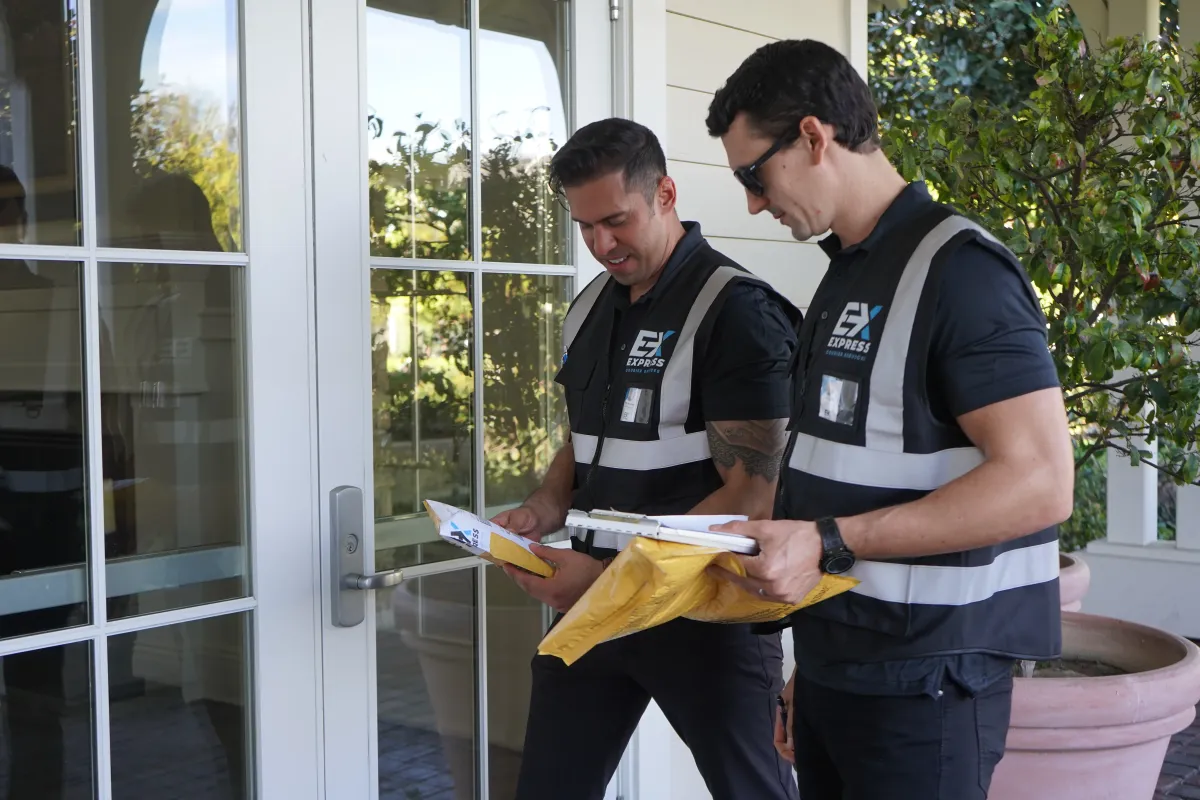
GPS & route optimization
Proof-of-delivery signatures/photos
Secure client portal
Trusted Across California
Michelle Rodriguez
Pharmacy Manager
"Express Courier Services has seriously transformed the game for us at Central Health Pharmacy. As a Pharmacy Manager, the constant juggling of medical supplies can be a headache. But with these guys, it's like they've taken the stress out of my job.
Now, I don't lose sleep over running out of essentials. Their deliveries are a lifesaver!"

Alex Nguyen
Pharmacist
"These guys at Express Courier Services are next level! Being a pharmacist is no joke, and precision is everything. Unlike other couriers that left us biting our nails, these guys handle our sensitive materials like pros. It's a breath of fresh air - finally, a courier service that gets it right every time! Highly recommended!"
Dr. Jonathan L. Kim
Medical Director
"Express Courier Services is the secret weapon in our urgent care playbook.
As a Medical Director, I can't afford delays. These folks have cracked the code to prompt deliveries. Now, we can focus on what really matters taking care of our patients without the hassle of late shipments. Working with them is always a pleasure."
Need to verify our reliability?
Our Sales team will provide you with letters of recommendations from our current clients.
Logistics Insights & Industry Trends
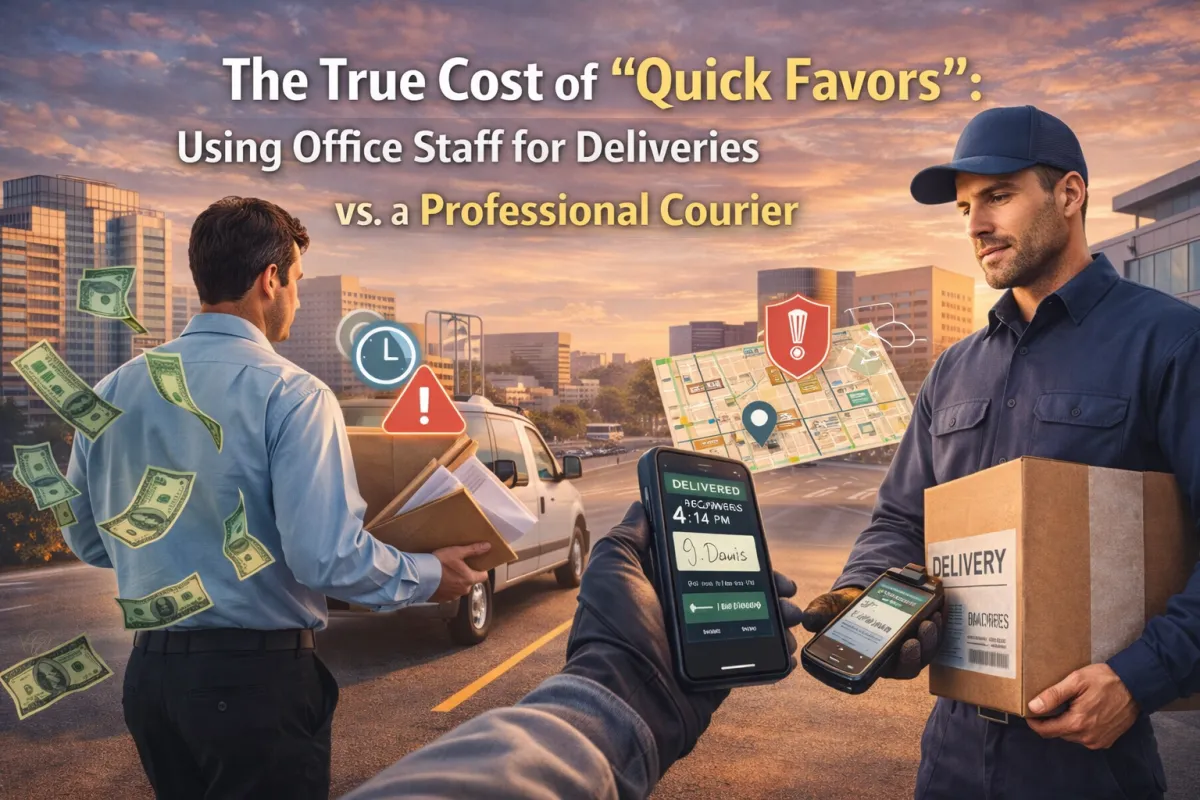
The True Cost of “Quick Favors”: Using Office Staff for Deliveries vs. a Professional Courier
Almost every operation has a version of this moment.
A client needs a signed contract by end of day. A check has to get to a bank before cutoff. A file needs to move from one office to another so a team can keep working. Someone says, “It’s quick, can you just run it over?”
It feels harmless because it looks like you are using “free” labor you already have. But quick favors are rarely free. They create real costs in wages, mileage reimbursement, scheduling disruption, risk exposure, and accountability gaps. Those costs are just hidden because they are spread across departments, absorbed by salaried staff, or never tracked properly.
A professional courier turns these “quick favors” into a controlled system with tracking, documented proof of delivery, and predictable service tiers. When you compare the true cost, the difference is often not as big as people assume, and in many cases the courier option is cheaper when you count everything that actually happens.
Why quick favors happen, and why they keep happening
Quick favors are usually a symptom of one thing: delivery needs exist, but the organization has not defined a delivery operating model.
When there is no formal process, staff fills the gap. It becomes cultural. “We always handle it ourselves.” A few favors become routine. Then one day a favor goes wrong, and the organization discovers it never had a delivery process at all.
At the same time, last-mile logistics is widely recognized as one of the most expensive parts of shipping. Research reviews often estimate last-mile delivery can account for a very large share of total shipping costs, sometimes around half.
That is not to say you should outsource everything. It is to say that delivery work is real work, and it carries real cost even when it is “just down the street.”
The hidden cost categories most teams forget to count
1) Wages are only the beginning
When an office staff member does a delivery, you pay for the time they are away from their actual role. That is obvious. What is less obvious is the opportunity cost: calls and emails not answered, invoices not processed, customer support delayed, intake or scheduling pushed back, and managers doing extra coordination to cover the gap.
Even if the employee is salaried, the time is not free. It is paid time redirected away from your revenue and operations.
This is why many organizations eventually create a rule: staff can do deliveries only when it is truly unavoidable, not because it is convenient.
2) Mileage and vehicle cost adds up fast
If staff is using a personal vehicle for deliveries, there is a direct cost that many businesses do not track properly: vehicle expense and mileage reimbursement.
A quick way many operators estimate true vehicle cost is the IRS standard mileage rate. For 2026, the IRS set the business standard mileage rate at 72.5 cents per mile.
Even if you do not reimburse at the IRS rate, it is a strong proxy for what that driving actually costs in fuel, wear, maintenance, depreciation, and other vehicle expenses.
3) Reimbursement obligations can be a legal requirement
In California, this becomes even more important. California Labor Code 2802 requires employers to indemnify employees for necessary expenditures or losses incurred in direct consequence of their duties. That includes reasonable costs employees incur to do their job, which is commonly applied to business driving expenses.
So if your “quick favor” model relies on employees driving their personal vehicles for business tasks, the reimbursement side is not optional in many situations. You need a policy and a tracking method.
4) Risk and liability exposure is real, even for short trips
Once employees drive for work, driving becomes a workplace safety issue, not a personal errand. OSHA provides guidance for employers on motor vehicle safety, including managing workloads and work schedules so employees can drive safely and comply with applicable rules.
This matters because accidents, injuries, and disputes do not care that the trip was “quick.” Even minor incidents can create delays, paperwork, insurance complexity, and operational disruption.
5) Lack of visibility and proof creates disputes and rework
The biggest practical cost of staff deliveries is often the one no one budgets for: accountability.
If a staff member drops off an envelope and the recipient later says they never received it, what happens next? Usually, your team spends time reconstructing events. People call each other. Someone checks with reception. The staff member tries to remember who signed. The client is frustrated. Trust drops.
Professional courier workflows are designed to prevent that. Real-time tracking and documented proof of delivery make the story simple later: pickup, in transit, delivered, who received it, and when.
A simple cost comparison that makes the hidden costs visible
Let’s keep this realistic.
Imagine a staff member does a “quick” round trip delivery that is 16 miles total, and the entire task takes 60 minutes once you include leaving the desk, parking, waiting at the receiving desk, and returning.
Vehicle cost proxy using the 2026 IRS rate:
16 miles x $0.725 = $11.60 in vehicle expense proxy
Now add labor. Even if you only estimate the hourly cost as the employee’s loaded wage, that hour is still a real cost. Then add the soft costs: interruptions, coordination, and the fact that the delivery likely had no professional proof of delivery.
When you compare that against a courier option, the courier cost is often close, and the courier cost usually includes visibility, proof, and an operational owner for exceptions.
This is why the decision is not only about the price of a run. It is about the full cost of the task plus the cost of risk and rework.
Where office staff deliveries create the most damage
When the item is time-sensitive
Court filings, cutoff-based drop-offs, bid packages, and end-of-day banking runs are not good candidates for casual delivery. When timing matters, you want a model that is built for deadlines, not availability.
When the item is high-value or cash-equivalent
Checks, card kits, deposits, lockbox materials, and sensitive financial documents should be moved with clear custody and proof.
When confidentiality matters
HR files, government documents, contracts, and regulated materials are often sensitive. Staff deliveries can accidentally increase exposure because the process is informal.
When the “favor” becomes recurring
The moment your team starts saying “we do this twice a day,” you no longer have a favor. You have a route. At that point, a dedicated route model usually reduces total cost and operational disruption compared to constant staff runs.
Internal link: Courier services, including routes and scheduled programs
When it is actually fine to use staff for a delivery
Not every delivery needs a courier. The mistake is not that quick favors exist. The mistake is not defining where they are allowed.
Staff deliveries can be reasonable when the trip is truly minimal, the item is low-risk, and the delivery is within a controlled environment. For example, walking something to a nearby building in the same complex, or moving non-sensitive supplies between departments when you can confirm receipt easily.
The best approach is to define a clear policy boundary so staff deliveries remain the exception, not the default.
What a professional courier adds beyond “someone drives it”
A good courier model replaces multiple hidden costs with one controlled service.
You get operational ownership. Someone is responsible for the move.
You get visibility. Tracking reduces status chasing.
You get documentation. Proof of delivery reduces disputes.
You get escalation. Exceptions are handled through dispatch and process, not improvisation.
You get consistency. The same expectations exist every time.
ECS states that electronic proof of delivery includes recipient signature and confirmation and is accessible through online tracking.
How to transition away from quick favors without slowing the business down
The cleanest transition is not banning staff deliveries overnight. It is creating a simple delivery decision rule.
Start by separating deliveries into two buckets.
The first bucket is predictable, recurring movement. Those should become scheduled courier routes or recurring pickups.
The second bucket is urgent exceptions. Those should become on-demand courier runs, with clear approval rules.
Then define what staff can still do. Keep it narrow. Keep it low-risk. Keep it documented.
If you want a ready-made guide for when organizations typically switch from internal drivers to a courier partner, including cost and risk considerations, this ECS article is a strong reference point.
Closing: quick favors feel cheap, until you count the real bill
Quick favors look like a shortcut because the costs are scattered. Wages hide inside payroll. Mileage hides inside personal vehicles. Risk hides until something goes wrong. Accountability gaps hide until a client disputes a delivery.
A professional courier compresses those hidden costs into a visible, controlled system with tracking, proof of delivery, and an operational owner for exceptions.
If you want to replace office-staff deliveries with a better model, start here.

Alpha Gabriel Marquina
Start Transforming Your
Logistics Landscape
Need a Delivery Partner You Can Rely On?
Get a custom courier solution for your business today.
Ready to Experience Reliable Courier Services?