Reliable Courier & Logistics Solutions
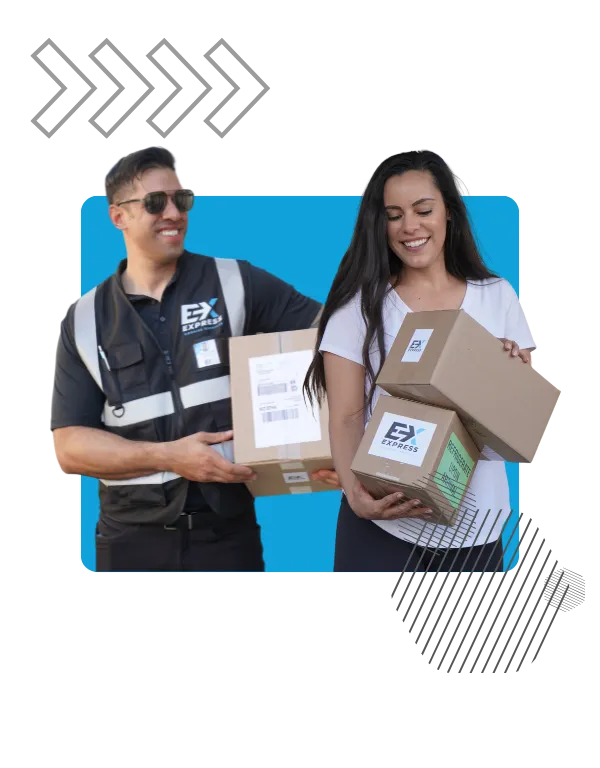
At Express Courier Services, we understand that your deliveries are more than just packages — they represent commitments, deadlines, and trust. That’s why we’ve built a courier system designed for speed, security, and accuracy. From urgent medical supplies to sensitive legal files, we deliver with the highest level of care. Our statewide coverage ensures that no matter where you are in California, dependable service is always within reach. We offer flexible solutions for businesses of every size, from one-time deliveries to long-term dedicated driver programs. Our experienced team and advanced logistics ensure smooth handling and real-time tracking at every stage. We take pride in being the courier service businesses rely on to keep operations running smoothly. With Express Courier Services, you gain a partner who delivers peace of mind with every shipment.
Start Transforming Your
Logistics Landscape
Reliable Courier & Logistics Solutions Across Industries
Your Premier Choice for Critical
Medical Supply Deliveries
Industry Highlights
Healthcare & Pharma
Secure, compliant delivery for clinics, labs, and pharmacies.
Healthcare & Pharma
Cold-chain options, chain-of-custody, and real-time tracking for temperature-sensitive shipments.
Click to Learn More
Legal Services
Time-sensitive filings and confidential document delivery.
Legal Services
Secure handling, proof of delivery, and rush courthouse runs you can trust.
Click to Learn More
Retail & E-commerce
Fast last-mile and same-day delivery for online and in-store.
Retail & E-commerce
Flexible windows, returns management, and live ETAs to delight customers.
Click to Learn More
Manufacturing & Industrial
Critical parts and MRO deliveries to keep lines running.
Manufacturing & Industrial
Expedited hot-shot runs, vendor pickups, and scheduled route coverage.
Click to Learn More
Government & Education
Dependable inter-office and campus courier services.
Government & Education
Audit-ready logs, secure handling of records, and scheduled routes across sites.
Click to Learn More
Food & Beverage Logistics
Fresh, safe, and timely deliveries for perishables.
Food & Beverage Logistics
Temperature-controlled options, HACCP-aware handling, and route optimization.
Click to Learn More
Why
Choose
Express Courier Services?

Speed
Same-day & STAT deliveries

Security
HIPAA, chain-of-custody, tamper-proof handling

Technology
Real-time GPS tracking & proof of delivery

Coverage
Serving all of California with local expertise
Tailored Solutions for Every Specialty Medication
From small parcels to sensitive medical supplies, our tailored courier solutions meet the needs of every industry we serve.

On-Demand & Same-Day Delivery
Scheduled Routes & Recurring Logistics

Temperature-Controlled Transport

Secure & Regulatory-Compliant Handling
Specialized
Logistics
for
Every Industry
We understand that each sector has unique requirements. That’s why our solutions are tailored — whether you’re a pharmacy, law firm, manufacturer, or retailer.
Track
Every
Delivery
in
Real
Time
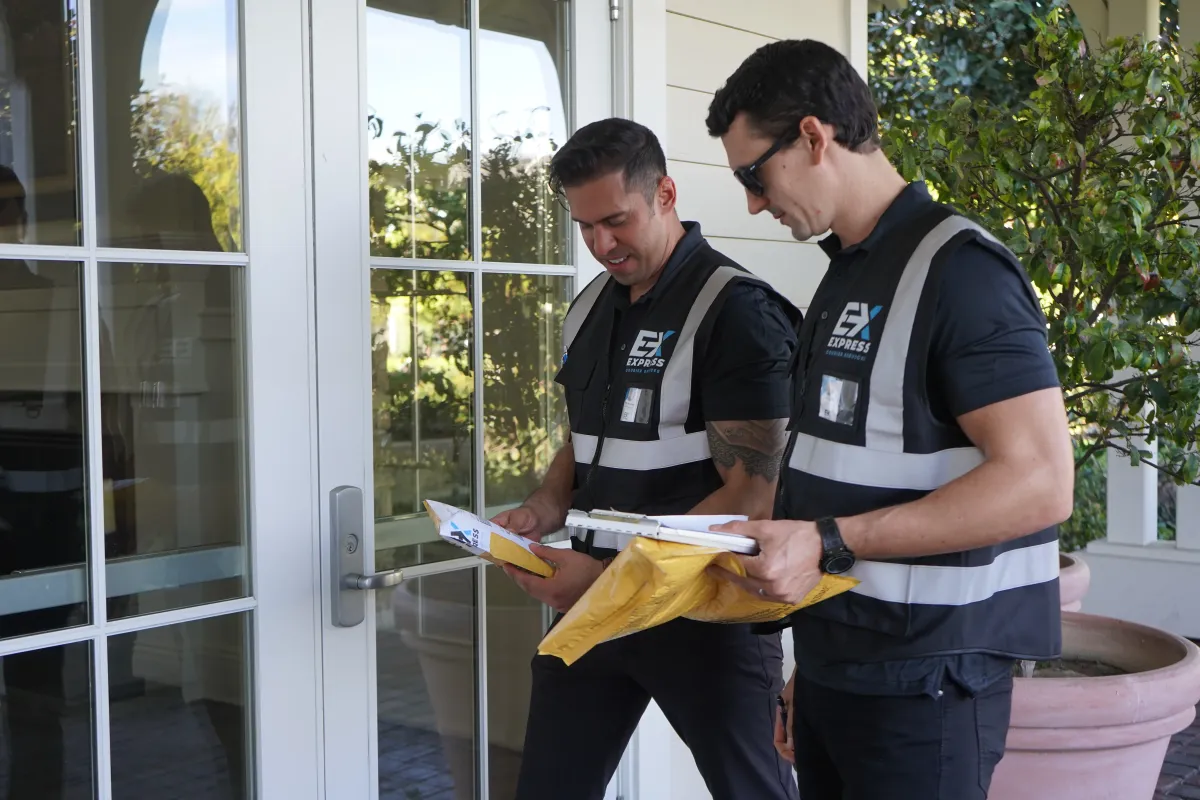
GPS & route optimization
Proof-of-delivery signatures/photos
Secure client portal
Trusted Across California
Michelle Rodriguez
Pharmacy Manager
"Express Courier Services has seriously transformed the game for us at Central Health Pharmacy. As a Pharmacy Manager, the constant juggling of medical supplies can be a headache. But with these guys, it's like they've taken the stress out of my job.
Now, I don't lose sleep over running out of essentials. Their deliveries are a lifesaver!"

Alex Nguyen
Pharmacist
"These guys at Express Courier Services are next level! Being a pharmacist is no joke, and precision is everything. Unlike other couriers that left us biting our nails, these guys handle our sensitive materials like pros. It's a breath of fresh air - finally, a courier service that gets it right every time! Highly recommended!"
Dr. Jonathan L. Kim
Medical Director
"Express Courier Services is the secret weapon in our urgent care playbook.
As a Medical Director, I can't afford delays. These folks have cracked the code to prompt deliveries. Now, we can focus on what really matters taking care of our patients without the hassle of late shipments. Working with them is always a pleasure."
Need to verify our reliability?
Our Sales team will provide you with letters of recommendations from our current clients.
Logistics Insights & Industry Trends
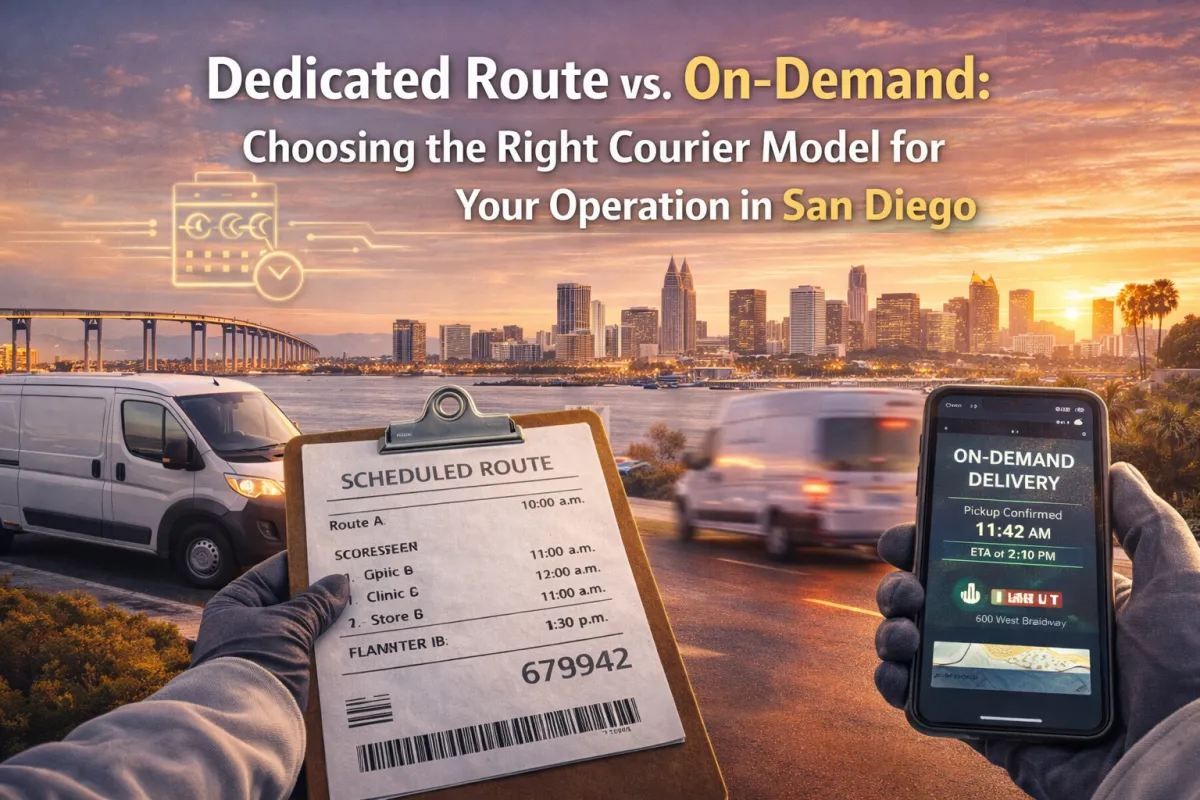
Dedicated Route vs. On-Demand: Choosing the Right Courier Model for Your Operation in San Diego
San Diego operations rarely run on one single delivery pattern. You might have predictable daily stops between offices, clinics, stores, or departments, and you might also have unpredictable “we need this there now” moments that show up without warning. That’s why the courier question in San Diego is not whether you need a courier. It’s which model matches how your work actually behaves: a dedicated route program, on-demand delivery, or a hybrid of both.
A dedicated route is built for repeatable movement. On-demand is built for urgency and variability. Picking the wrong one usually shows up as unnecessary spend, missed receiving windows, too much internal coordination, and constant status chasing.
If you want a local starting point for how Express Courier Services supports both structured route programs and urgent STAT needs in Greater San Diego, see the San Diego coverage page here.
What “dedicated route” really means
A dedicated route is a scheduled, recurring courier service designed around your predictable patterns. It runs at set times, often with consistent stops and defined handoff rules. In larger transportation language, the “dedicated” concept is similar to dedicated contract carriage, where vehicles and drivers are reserved for a specific customer under contract, which improves control and consistency.
In courier terms, a dedicated route does not have to mean one vehicle only serving you all day. It means your movement is planned, consistent, and treated as a program, not a series of emergencies.
A helpful way to visualize it is the “milk run” concept in logistics, where a vehicle makes multiple planned stops on one efficient route rather than doing random point-to-point trips.
Dedicated routes win when your work is predictable
Dedicated routes tend to fit best when you have repeatable stops and repeatable timing. This is common in San Diego for inter-office transfers, medical networks, retail store-to-store movement, records runs, and regular replenishment tasks.
If your organization is moving internal mail, records, kits, or supplies between facilities, route-based courier services are specifically designed for that kind of repeatability.
What “on-demand” really means
On-demand delivery is built for flexibility. The request happens when the need happens, and the courier is dispatched to respond within a short time window. Large logistics providers define on-demand delivery in terms of allowing the customer to control delivery timing and location preferences, and more broadly, on-demand models exist because customers and operations increasingly expect speed and flexibility.
In a business-to-business San Diego context, on-demand is usually the right fit when the cost of waiting is high. That might be a missed cutoff, a patient impact, production downtime, a service recovery need, or a revenue-threatening stockout.
Why this choice matters more in San Diego than people expect
San Diego’s delivery environment includes dense corridors, limited parking in many commercial areas, gated or controlled facilities, and day-part congestion that can turn short distances into long variance. Urban logistics reports repeatedly highlight how last-mile delivery in cities faces rising complexity and pressure, including congestion and curb constraints.
Research on urban logistics also points out that last-mile and urban delivery can represent a large share of overall delivery cost, which is one reason choosing the right courier model has a direct financial impact.
When your environment is variable, your courier model has to reduce risk rather than add it. Dedicated routes reduce operational noise and cost when movement is predictable. On-demand reduces failure risk when timing and urgency are unpredictable.
The practical differences that matter in real operations
Predictability vs flexibility
A dedicated route is predictable by design. Your teams know when pickups happen and where deliveries land. That predictability reduces internal coordination. On-demand is flexible by design. It handles the unexpected but should not become your default for everything.
Cost structure
Routes usually lower cost per stop over time because the work is consolidated and planned. On-demand is often priced at a premium because you are buying immediate capacity and responsiveness.
Service level behavior
Routes are built for throughput and consistency. On-demand is built for priority. If you run everything on-demand, you tend to pay premium rates for routine work and you also risk capacity conflicts during peak periods.
Visibility and defensibility
Both models should still have modern fundamentals like real-time tracking and proof of delivery, otherwise you are trading one kind of risk for another.
Internal link: Tracking and proof of delivery technology.
Internal link: Why real-time tracking and POD matter.
When a dedicated route is usually the right answer in San Diego
Dedicated routes make the most sense when your delivery pattern looks like a schedule already. Common examples include:
Inter-office mail and internal transfers between offices, departments, and facilities. This is exactly what route-based courier programs are designed to modernize and standardize.
Retail store-to-store transfers, returns consolidation, and inventory shuttles where predictability matters more than urgency most of the time.
Healthcare and pharmacy support runs that happen daily, like routine replenishment and planned transfers, with separate escalation for STAT needs.
Government and education workflows that require repeatable movement and easy record retrieval.
If you want a San Diego-specific statement of coverage that explicitly mentions both urgent needs and structured route programs, ECS includes that positioning on its San Diego location page.
When on-demand is usually the right answer in San Diego
On-demand is the right fit when your delivery needs are irregular, deadline-driven, or tied to real-world triggers that cannot wait for the next scheduled run. Think of it as the model for “this has to move now” moments.
On-demand is common for:
STAT and time-sensitive healthcare deliveries where the cost of delay is operational or clinical.
Legal and contract deliveries where cutoffs and handoff quality matter.
Critical parts runs and service recovery for operations where downtime is expensive.
Customer save-the-sale scenarios in retail where a same-day transfer prevents a cancellation.
The easiest mistake is treating on-demand as a convenience instead of a controlled tool. It should be used deliberately and protected with rules so it stays available for true urgency.
The hybrid model is the most common “right answer”
Most San Diego operations end up with a hybrid program:
A dedicated route layer handles baseline predictable volume.
An on-demand layer handles urgent exceptions and true variability.
This is the model that protects both budget and service levels. It also keeps your team from turning every request into a last-minute scramble.
A good internal rule is simple: if a delivery repeats, it belongs on a route. If it is urgent and irregular, it belongs on-demand.
A decision framework you can use this week
If you want a clean way to decide without overthinking, evaluate your delivery activity using four questions:
How repeatable are the stops?
If the same locations appear over and over, a route will almost always reduce cost and noise.
How stable is the timing?
If you have consistent windows, routes fit. If timing shifts constantly, on-demand stays important.
What is the cost of delay?
If delay creates patient risk, deadline failure, downtime, or revenue loss, use on-demand.
How much internal time is being consumed by coordination?
If your staff is constantly coordinating runs, chasing status, or doing self-delivery, you are paying hidden costs that routes can remove.
A related evaluation is whether you should even keep in-house drivers for part of the work. ECS has a practical discussion of when in-house delivery works early and when scaling creates hidden costs and risks.
What to demand from either model (non-negotiables)
Regardless of whether you choose routes, on-demand, or hybrid, these fundamentals should be present:
Real-time tracking that reduces “where is it” calls.
Proof of delivery that is easy to retrieve for audits, disputes, and reconciliation.
Exception handling with documentation, not improvisation, especially when receiving rules cannot be followed.Exception handling with documentation, not improvisation, especially when receiving rules cannot be followed.
Clear service tiers so routine work does not consume priority capacity.
A San Diego example that makes the decision obvious
Imagine you have three kinds of deliveries:
Daily inter-office pouch stops between two facilities and a storage site.
Twice-daily scheduled pickups from a clinic network.
Random urgent “deliver this in two hours” runs when something breaks.
If you run all three on-demand, you will overpay on the daily and twice-daily work and you will also create internal uncertainty because nothing is scheduled. If you run all three as routes, you will miss urgent needs or force teams to wait for the next run.
The hybrid approach solves it cleanly. Put the daily and twice-daily into dedicated routes. Reserve on-demand for the urgent exceptions. That is the structure that turns delivery into a system.
Closing: choose the model that matches your operation, not your habits
Dedicated routes are for repeatable movement. On-demand is for urgent, variable needs. In San Diego, most operations need both, but they need them with rules.
If you want help mapping your San Diego stops into a route schedule and defining what qualifies as on-demand, these pages are the best starting points:

Alpha Gabriel Marquina
Start Transforming Your
Logistics Landscape
Need a Delivery Partner You Can Rely On?
Get a custom courier solution for your business today.
Ready to Experience Reliable Courier Services?